Sony APM-20AV (1980s)
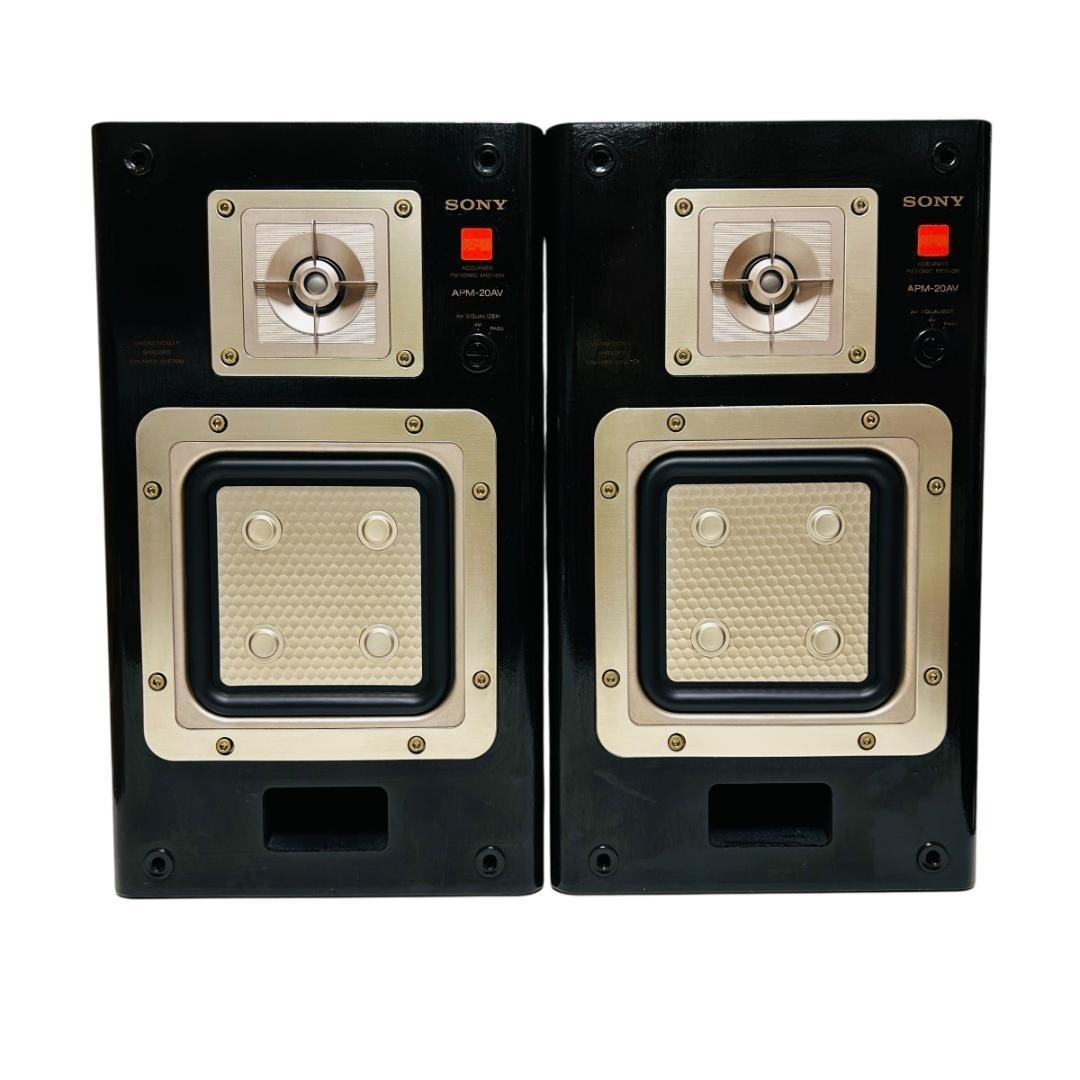
At 10kg and just under 43cm tall, these bookshelf speakers carry a presence that belies their era—magnetic shielding, a plane woofer, and a switchable AV mode built for the living room.
Overview
The Sony APM-20AV isn’t a relic of audiophile minimalism—it’s a product of its time, built when TVs still dominated the entertainment center and speaker designers had to worry about distorting the picture. Released in the 1980s, this 2-way, 2-speaker system was engineered as a magnetic shielding type, meaning both the woofer and tweeter were designed to prevent color shifts or unevenness on nearby television screens. That alone tells a story: these weren’t meant for dark listening rooms, but for real homes, where music and broadcast coexisted. Priced at ¥29,500 per unit around 1986, they occupied a mid-tier position—serious enough for enthusiasts, but not out of reach for the discerning consumer.
Housing a 210 cm² APM (Acoustic Plane Magnetic) type plane woofer and a 2.5 cm dome-type SUD (Sony Unified Diaphragm) tweeter, the APM-20AV leans on proprietary Sony driver tech that doesn’t quite fit standard classifications. The “APM” in the name may stand for Acoustic Plane Magnetic, but the Vintage Technology Archive also references APM as Advanced Polymer Matrix driver technology—sources don’t fully align, but the physical design is clear: a square woofer housed in a bass reflex enclosure. The cabinet itself uses an “acoustic rounded enclosure” design, a subtle but intentional shaping meant to reduce sound diffraction, particularly at the edges, where sharp corners can scatter waves and blur imaging.
Despite their compact bookshelf footprint—250 mm wide, 430 mm high, 295 mm deep—they pack a rated input of 50W and can handle instantaneous peaks up to 100W, suggesting a tolerance for dynamic swings without distress. With a frequency response spanning 40 Hz to 20,000 Hz and a sensitivity of 89dB/W/m, they’re neither ultra-efficient nor exceptionally deep-bass performers, but within context, they’re competent. The 8 Ω impedance makes them compatible with most solid-state receivers of the era, and the 2kHz crossover splits duties cleanly between the plane woofer and the dome tweeter.
What sets the APM-20AV apart is its dual-position AV equalizer. Flip it to AV, and the mid and high frequencies are slightly suppressed—likely a concession to the often harsh tonality of broadcast audio or early home video soundtracks. Switch it to PAS (pass), and the response opens up, aiming for a more natural tonal balance. It’s a small toggle, but it speaks volumes: this speaker was designed to do double duty, adapting to both music and multimedia long before “AV receiver” became a household term.
Specifications
| Manufacturer | Sony |
| Product type | 2-way, 2-speaker, bass reflex system, bookshelf type, anti-magnetic/magnetic shielding type speaker system |
| Production years | 1980s |
| Original price | ¥ 29,500 (for 1 unit, around/circa 1986) |
| Woofer | 210 cm² APM (Acoustic Plane Magnetic) type plane woofer |
| Tweeter | 2.5 cm dome type SUD (Sony Unified Diaphragm) unit |
| Frequency response | 40 Hz to 20000 Hz |
| Output sound pressure level | 89dB/W/m |
| Impedance | 8 Ω |
| Maximum instantaneous input level | 100W |
| Rated input level | 50W |
| Crossover frequency | 2kHz |
| External dimensions | Width 250 mm x Height 430 mm x Depth 295 mm |
| Weight | 10kg |
| Enclosure type | Bass reflex enclosure |
| Magnetic shielding | Magnetic shielding for TV use |
| System type | Two-way system |
| Driver technology | APM (Advanced Polymer Matrix) driver technology |
| Woofer design | Square woofer design |
| The enclosure | Acoustic rounded enclosure designed to prevent the diffraction phenomenon of sound |
| AV equalizer | 2-position: AV (mid/high slightly suppressed), PAS (natural sound quality) |
Key Features
210 cm² APM Plane Woofer with Square Design
The APM-20AV’s most distinctive feature is its square, planar magnetic woofer—210 cm² of active surface area, labeled as an APM (Acoustic Plane Magnetic) type. Unlike conventional cone drivers, this design uses a flat diaphragm with conductive traces suspended in a magnetic field, aiming for lower distortion and more uniform piston-like movement. The square shape is unusual for the era, where circular drivers dominated, and likely ties into the acoustic symmetry of the cabinet. While not a full ribbon or electrostatic design, it represents Sony’s mid-tier push into alternative driver topologies during the 1980s. Owners report a tight, controlled low end for a speaker of this size, though the 40 Hz lower limit suggests it doesn’t plumb the deepest octaves without assistance.
2.5 cm SUD Dome Tweeter
Paired with the plane woofer is a 2.5 cm dome-type SUD (Sony Unified Diaphragm) tweeter. The “Unified Diaphragm” terminology hints at a material or construction method aimed at broadening dispersion and reducing breakup modes. It’s not a ring radiator or AMT, but a conventional soft dome with proprietary tuning. Positioned just above the woofer, it benefits from the rounded baffle’s diffraction control. The 2kHz crossover point is conservative enough to avoid overloading the tweeter, and with the system’s 20 kHz upper limit, it delivers a smooth, if not hyper-detailed, high-frequency response. The PAS mode likely opens up the top end, while AV mode may slightly attenuate it to reduce listener fatigue during extended TV sessions.
Acoustic Rounded Enclosure
The cabinet’s edges aren’t sharp—they’re gently rounded, a design choice explicitly intended to minimize sound diffraction. When sound waves hit a sharp cabinet edge, they scatter, creating interference patterns that smear imaging and color tonality. By rounding the front baffle and likely the vertical edges, Sony reduced these edge effects, resulting in a cleaner off-axis response. It’s a subtle but thoughtful touch, especially for a speaker not marketed as a high-end monitor. The bass reflex port is integrated into this design, though its exact placement isn’t documented—typical locations would be front or rear, but given the TV-friendly intent, a front-firing port would make the most sense for flexible placement.
2-Position AV Equalizer Switch
Few bookshelf speakers from the 1980s came with a dedicated AV mode. The APM-20AV does. A small toggle on the rear panel lets users switch between AV and PAS (pass) modes. In AV mode, the mid and high frequencies are slightly suppressed—likely a gentle roll-off above 1–2 kHz—to tame the often bright or compressed sound of broadcast TV audio. Flip it to PAS, and the signal passes through unaltered, preserving the speaker’s natural tonal balance for music listening. This dual-purpose design reflects a transitional moment in home audio, when systems were beginning to serve both hi-fi and home theater roles, long before surround sound became standard.
Magnetic Shielding for TV Use
In the CRT era, unshielded speakers could distort the colors on a television screen, especially when placed close by. The APM-20AV was built to avoid this: both the woofer and tweeter are magnetic shielding types. This means internal shielding—likely mu-metal or similar—contains the driver’s magnetic field, preventing interference with nearby electronics. It’s a feature that dates the speaker, but also speaks to its intended role: a stereo pair flanking a TV, not isolated on distant stands. The trade-off? Shielding adds weight and can slightly reduce driver efficiency, but at 89dB/W/m, the APM-20AV doesn’t suffer excessively.
Collectibility & Value
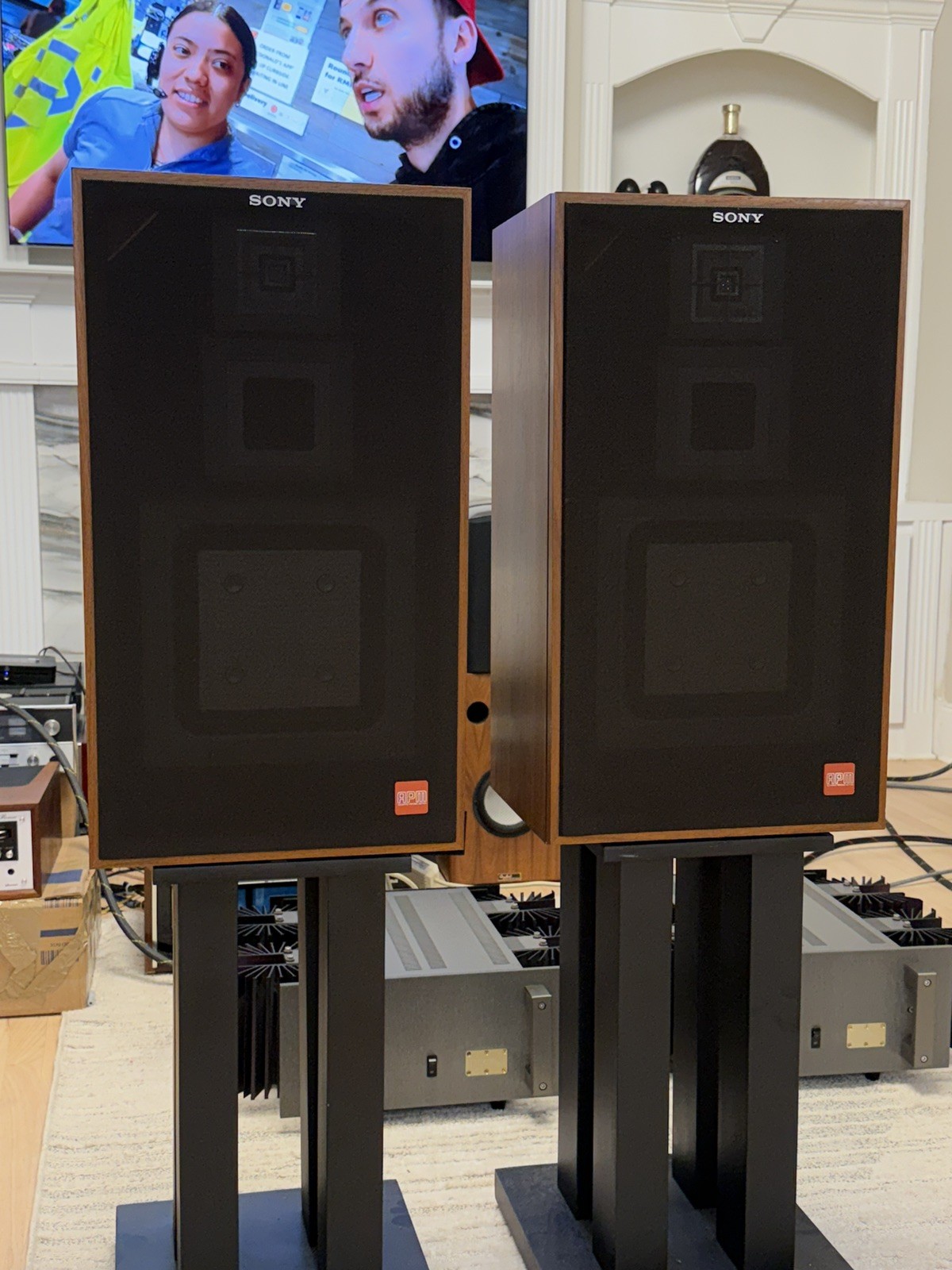
The APM-20AV is listed as a "Classic Model" in the Sony brand archive, a nod to its unique design and era-specific engineering. Current market examples reflect a niche but active interest: a tested, working unit was listed on eBay for $850, another for S$1,089.79 in Singapore, and a Russian retailer (Shopozz.ru) listed one at 24,190₽—all suggesting strong demand among collectors who value magnetic shielding, unusual driver tech, and 1980s Sony innovation. A dedicated stand, the WS-200 (sold as a two-piece set for ¥13,800), was available separately, though availability today is extremely limited. No documented common failures or maintenance issues are reported, but given the age, capacitor degradation in the crossover and potential foam surround breakdown—though not confirmed—are plausible concerns for long-term reliability.
eBay Listings


As an eBay Partner, we earn from qualifying purchases. This helps support our independent vintage technology research.
Related Models
- Sony ps-5550 (1978-1980)
- Sony ps-lx5r (1983-1985)
- Sony ss-7220a (1970s)
- Sony ss-97 (Late 1970s (approximately 1977-1979))
- Sony ss-999 (Late 1970s (approximately 1977-1979))
- Sony st-j88 (1986-1988)
- Kenwood kl-888s (Late 1970s (approximately 1978-1980))
- Sansui sax-200 (Late 1970s)
- Sansui sax-600 (Late 1970s)
- Sansui sr-222 (1973-1975)