Sansui D-99D (1982–1983)
Two tape decks in one chassis, built for the mixtape era—mechanically complex, logically brilliant, and now, a ticking time bomb if the belts haven’t been changed.
Overview
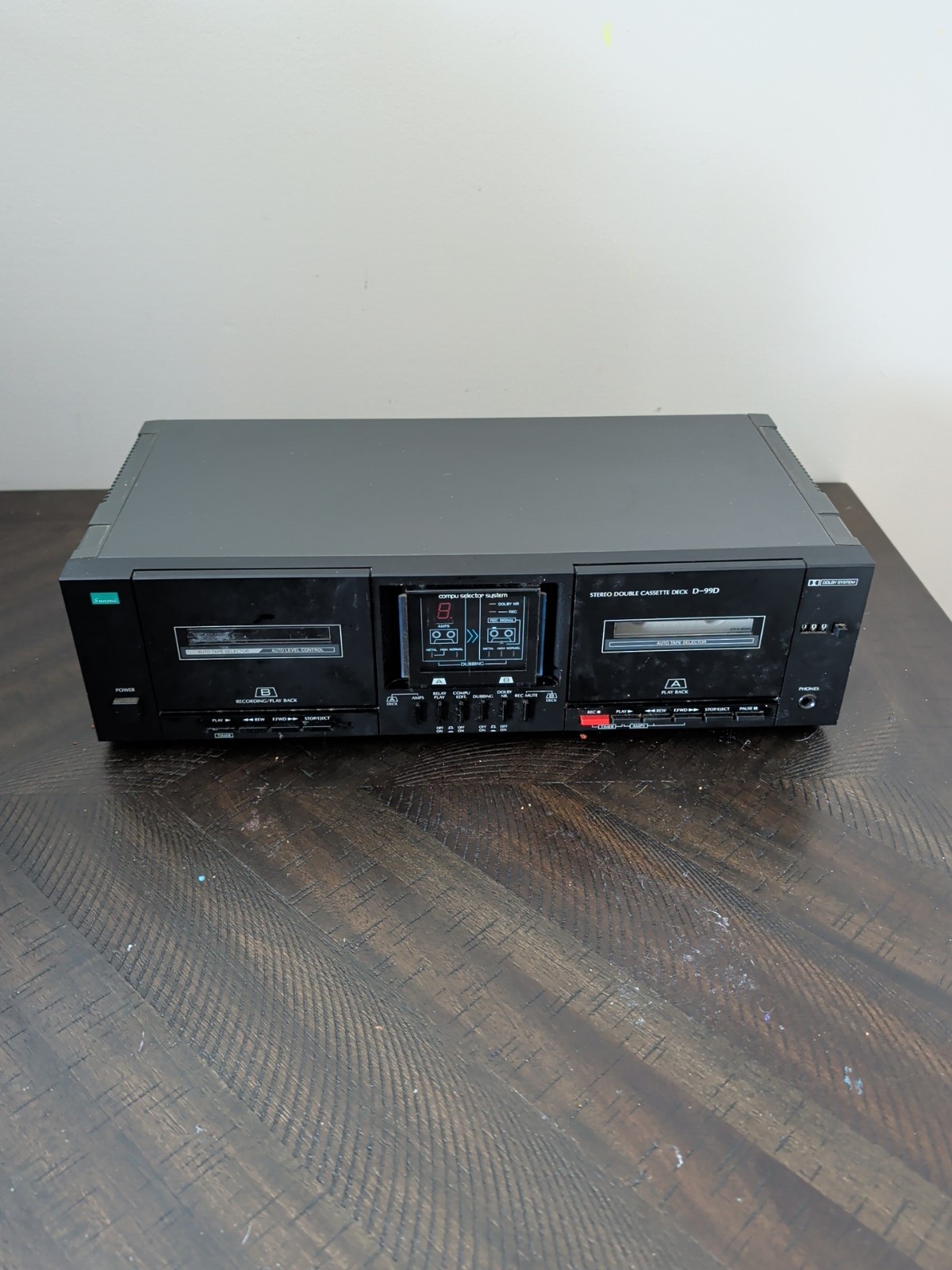
The Sansui D-99D isn’t subtle. It’s a double cassette deck from 1982 that stares at you like a twin-eyed console from a forgotten age of home audio engineering—when copying tapes wasn’t just convenient, it was a ritual. This thing was built to dub, edit, and organize analog music with a level of automation that felt like magic at the time. Two full tape transports sit side by side, not just slapped together but interconnected in a way that lets them talk to each other, syncing play, record, and even automated editing sequences. It’s the kind of machine that made mixtapes a serious art form, not just a romantic gesture.
Produced only in 1982 and 1983, the D-99D arrived when cassette decks were hitting their technical stride—better tapes, better noise reduction, better motors. Sansui, already known for high-end receivers and amplifiers, brought some of that pedigree here. It’s not labeled as a flagship, and one Reddit user bluntly called it “not Sansui’s best gear but good enough,” which might be the most honest summary out there. It doesn’t pretend to be a Nakamichi Dragon, but it wasn’t trying to be. It was built for functionality: dubbing from turntable to tape with Compu Edit (if you had the right Sansui turntable), skipping silence with AMPS, and managing tape levels automatically so you didn’t fry your CrO2s.
And yes, it’s heavy on features. Automatic Tape Selector, Dolby B, ALC—Automatic Level Control—it’s all here. The Compu Edit function, which lets you program track transfers from vinyl to tape, is a niche gem if you’re deep in the analog workflow. But this is also a machine that, 40 years later, is almost guaranteed to need servicing. One owner on HiFi Engine noted their unit “doesn’t operate properly” after sitting untouched since 1984, having seen only about 100 hours of use. That tells you something: even minimal use doesn’t spare these from aging. And the consensus? “That tape deck more than likely needs belts,” as one Reddit user put it. With six belts inside, that’s not a quick fix.
Specifications
| Manufacturer | Sansui |
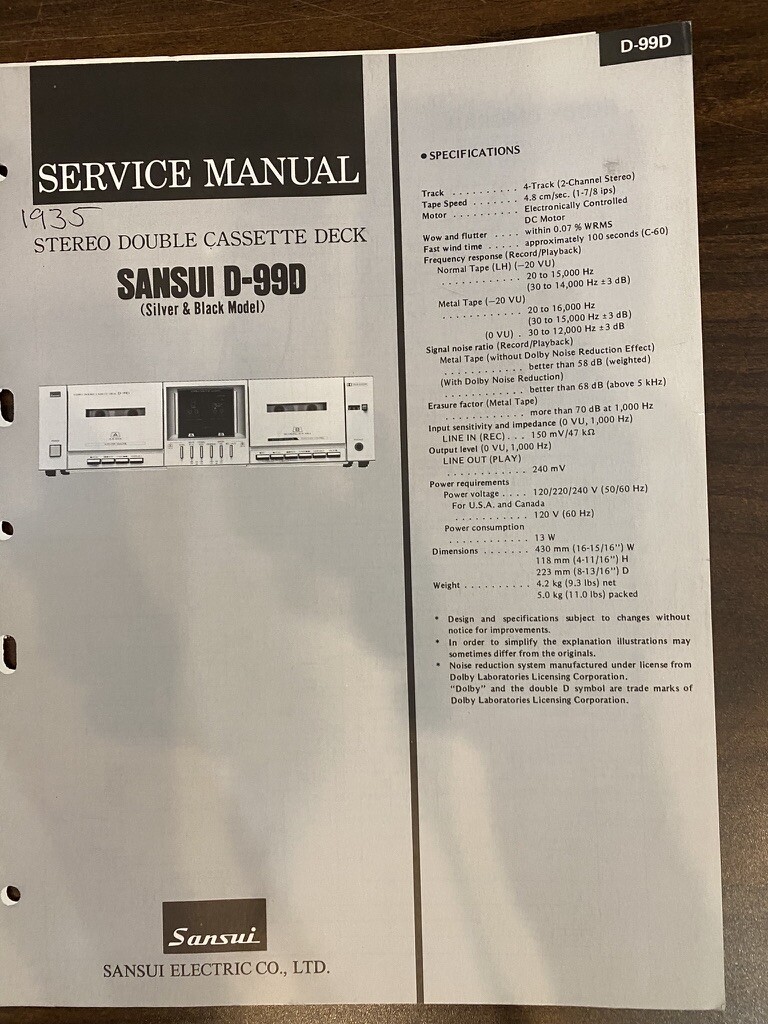
| Track System | 4-Track, 2-Channel Stereo |
| Tape Speed | 4.8 cm/sec (1-7/8 ips) |
| Heads | Rec/Playback : High-Bs Hard Permalloy; Erase : High-Bs Ferrite |
| Motor | Electronically Controlled DC Motors |
| Wow and Flutter | 0.07% (WRMS) |
| Frequency Response (Metal Tape) | 20 - 16,000 Hz |
| Frequency Response (High Bias Tape) | 20 - 16,000 Hz |
| Frequency Response (Normal Tape) | 20 - 15,000 Hz |
| Signal-to-Noise Ratio (Metal Tape) Dolby B NR "On" | 68 dB (above 5 kHz) |
| Signal-to-Noise Ratio (Metal Tape) Dolby B NR "Off" | 58 dB (weighted) |
| Tape Type | type I, CrO2, Metal |
| Noise Reduction | Dolby B |
| Dimensions (W x H x D) | 430 x 118 x 223 mm |
| Weight | 4.2 kg |
| Pitch | +/- 6 % |
| Recording type | cassette |
| Audio inputs | 2 Line |
| Audio outputs | Stereo L/R RCA |
| Features | Hi-Fi |
Key Features
Double Transport, One Purpose
The D-99D isn’t just two cassette slots—it’s two full tape transports, each with its own set of heads, motors, and capstans. They’re independent but synchronized, allowing for real-time dubbing from one deck to the other without external cables. This was a big deal in 1982. You could set up a master tape on one side and clone it flawlessly to a blank, all within the same chassis. The electronically controlled DC motors help keep speed stable, and with a wow and flutter rating of just 0.07% WRMS, it’s solid for a consumer deck. The heads are High-Bs Hard Permalloy for record and playback, which was a step above basic ferrite—better for metal tapes and high-frequency response.
Smart Tape Logic
Sansui packed in automation that felt futuristic. The AMPS (Automatic Music Program Sensor) could detect silence between tracks, letting you cue, skip, or repeat sections without manual intervention. That’s how you got clean edits on a mixtape—no awkward fade-ins from the middle of a song. Then there’s ALC, or Automatic Level Control, which monitored input levels during recording and adjusted them to prevent distortion. That’s especially useful when recording from dynamic sources like vinyl or FM radio. And the Auto Tape Selector automatically detected tape type (I, CrO2, or Metal), so you didn’t have to flip bias switches manually—just pop in the tape and go.
Dubbing with a Brain
The “Compu Edit” function is the D-99D’s secret weapon—if you had the right turntable. Compatible with the Sansui P-M77 or P-L50, it let you program track starts and stops on a vinyl record, then automatically dub only those sections to tape. Imagine building a mixtape from an LP without touching the record button manually. That level of integration was rare and shows Sansui was thinking about workflow, not just specs. The unit also supports “sophisticated synchronized tape editing and series play,” meaning you could chain recordings, edit across decks, and even set up repeat loops. For its time, this was as close as consumer audio got to a DAW.
Collectibility & Value
Today, the D-99D trades mostly as a project or parts machine. A unit listed on eBay in April 2025 was priced at EUR 89.00, marked “for parts or not working.” Another on PicClick Canada went for $73.87, also for parts. In Romania, one was listed at 200 RON (~$43) in May 2022. A bid on Yahoo Auctions Japan reached ¥1,480 (~$10) in July 2025, suggesting low demand but some interest in Asia. None of these prices reflect a working, fully serviced unit—because those are rare.
The biggest hurdle? Belts. All six need replacement after 40 years, and one Fixya post warns that belt replacement “may involve disassembly of mechanism parts and critical adjustments to follow.” In other words, it’s not a plug-and-play fix. A complete belt kit is available on Amazon for $35.50, made to OEM specs with a lifetime warranty—so at least the parts exist. But the labor and calibration? That’s on you. One listing noted “acest deck a fost servisat” (“this deck has been serviced”), which implies it needed it—and probably needed it badly. If you’re buying one, assume it’s non-functional out of the box. And if it claims to work? Be skeptical. As one owner found after 30 years of storage: “I notice it doesn’t operate properly.” That’s the reality of 1980s mechanics in 2025.
eBay Listings


As an eBay Partner, we earn from qualifying purchases. This helps support our independent vintage technology research.
Related Models
- Sansui sax-200 (Late 1970s)
- Sansui sax-600 (Late 1970s)
- Sansui sr-222 (1973-1975)
- Sansui sr-717 (1974-1976)
- Sansui sr-2050c (1975-1977)
- Sony ps-5550 (1978-1980)
- Sony ps-lx5r (1983-1985)
- Sony ss-7220a (1970s)
- Sony ss-97 (Late 1970s (approximately 1977-1979))
- Sony ss-999 (Late 1970s (approximately 1977-1979))