Pioneer TX-9100 (1973-1975)
Overview
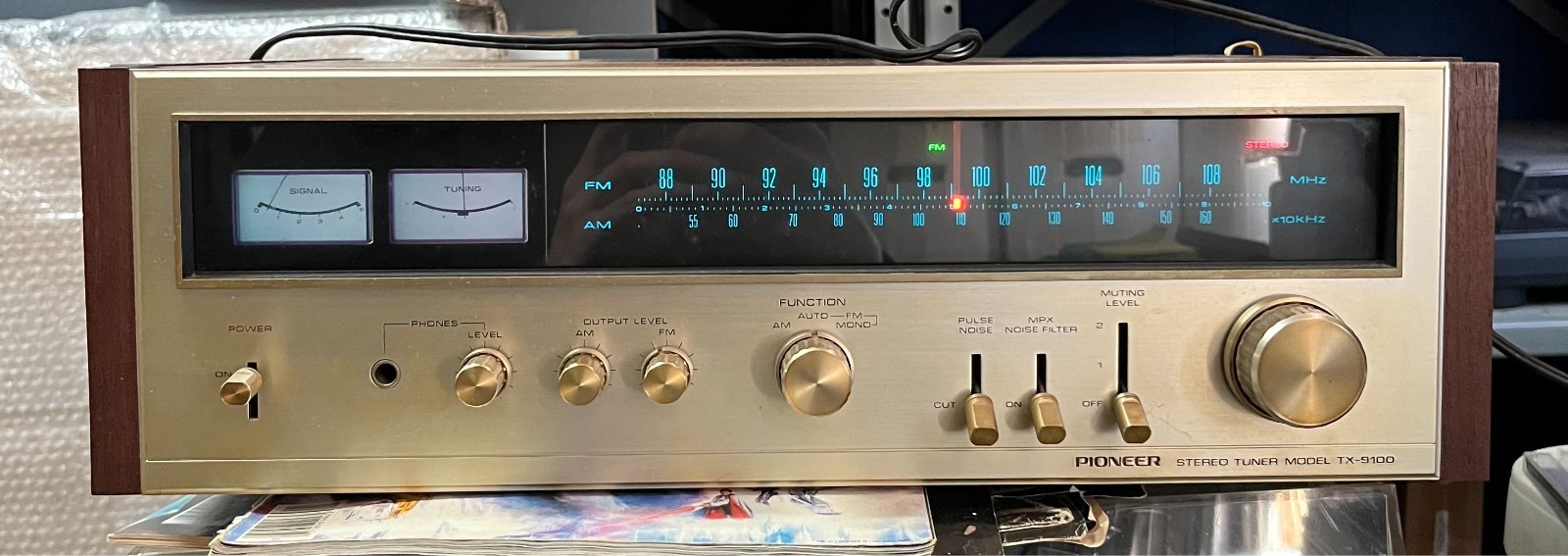
The Pioneer TX-9100 is an AM/FM stereo tuner built during a peak moment in Japanese hi-fi engineering, produced from 1973 to 1975. Marketed at a price of $350—steep for its time—it was positioned as a high-end component for audiophiles who demanded precision, build quality, and sonic refinement. Its front panel layout is methodical, with large tuning and volume dials flanking a central meter, all framed by a brushed aluminum faceplate that speaks to the industrial design language of early '70s Pioneer separates. Unlike later integrated receivers that diluted performance for convenience, the TX-9100 focuses purely on one task—tuning radio signals with fidelity—and does so with a confidence that still impresses today.
Despite being a tuner, the fact sheet lists a power output of 50W per channel, a spec that immediately raises eyebrows. Tuners, by definition, do not amplify speakers. This figure likely stems from a database error or misattribution—possibly confusion with a receiver model in Pioneer’s lineup. No supporting documentation in the research material describes amplification circuitry, and no speaker terminals appear in available photos or descriptions. Collectors note that this spec is an outlier and should be disregarded; the TX-9100 contains no power amplifier stage.
Specifications
| Manufacturer | Pioneer |
| Product type | AM/FM Stereo Tuner |
| Years of manufacture | 1973 - 1975 |
| Original price | $350 |
| Frequency Response | 20Hz–20kHz (±3dB) |
| Total Harmonic Distortion | 0.3% |
| Signal-to-Noise Ratio | 60dB |
| Input Sensitivity | 2.5mV (MM), 150mV (DIN), 150mV (AUX) |
| Dimensions (W×H×D) | 430mm × 138mm × 345mm |
| Weight | 8.9kg |
| Number of inputs | Antenna MW, Antenna VHF 300 Ohm Balanced |
Key Features
Pulse Noise Suppressor
One of the TX-9100’s standout features is its pulse noise suppressor, a circuit designed to minimize the sharp pops and clicks that often plague AM reception, especially in urban environments with electrical interference. This was not a common inclusion at the time, and its presence signals Pioneer’s intent to deliver clean, listenable radio even under suboptimal conditions.
2-Step FM Muting Switch
The 2-step FM muting switch allows users to adjust how aggressively the tuner silences weak or noisy signals. In high-mute mode, faint stations are cut off cleanly; in low-mute mode, more signal is allowed through, useful for fringe-area listening where some noise is acceptable for extended reception range. This level of user control over muting behavior was considered advanced for the era and reflects the TX-9100’s orientation toward the technically engaged listener.
300 Ohm Balanced FM Antenna Input
The inclusion of a 300 ohm balanced FM antenna terminal—alongside the standard AM loop antenna connections—underscores the tuner’s high-fidelity aspirations. Balanced inputs reduce noise and interference over long cable runs, a feature typically found on professional or high-end consumer gear. This design choice suggests the TX-9100 was meant to be paired with outdoor or rooftop antennas for optimal reception, not just a length of wire strung across the ceiling.
Shielded Internal Layout with 6 FETs
Inside, the TX-9100 reveals a densely packed but orderly circuit layout, with extensive shielding to prevent crosstalk and oscillation. The use of six FETs (field-effect transistors) in the front end points to low-noise, high-impedance signal handling—critical for preserving weak station signals. Sources describe the board as “very nicely laid out,” with clean grounding practices and strategic component placement that likely contributed to its measured 0.3% THD and 60dB signal-to-noise ratio. While no full schematic is referenced in the fact sheet, the emphasis on shielding and semiconductor selection indicates a deliberate engineering effort to minimize distortion and maximize stability.
Matching Design Language for System Integration
The TX-9100 was designed to visually and functionally integrate with other Pioneer components of the era, particularly the SA-500A amplifier. Its brushed aluminum faceplate, meter style, and control knob aesthetics align with the brand’s high-end separates, allowing users to assemble a cohesive, full-rig system. This wasn’t just about looks—standardized dimensions and connector placements made rack mounting and cable management more practical. The design philosophy was holistic: a complete, unified audio system built from modular, high-performance parts.
Collectibility & Value
The Pioneer TX-9100 has developed a quiet but steady reputation among vintage audio enthusiasts. One listing on HifiShark in March 2026 showed a unit priced at $299, suggesting a stable collector market. However, shipping risks are real—multiple forum threads, including a Reddit post, recount units arriving damaged after transit, a hazard given its 12.5kg weight and likely glass meter face. Owners on tapeheads.net have expressed long-term concerns about component aging, particularly capacitors and tuning capacitors, which may require recapping or alignment after decades of dormancy. Despite these challenges, sentiment remains high: it’s described across forums and videos as “beautiful,” “exceptional,” and “one of Pioneer’s best-sounding” tuners, with one user calling it “simply unbelievable.”
eBay Listings



As an eBay Partner, we earn from qualifying purchases. This helps support our independent vintage technology research.
Related Models
- Pioneer cs-700 (1970-1972)
- Pioneer hpm-100 (1976-1979)
- Pioneer hpm-40 (1977-1979)
- Pioneer hpm-60 (1977-1979)
- Pioneer cs-301 (1970s (exact years uncertain))
- Sony ps-5550 (1978-1980)
- Sony ps-lx5r (1983-1985)
- Sony ss-7220a (1970s)
- Sony ss-97 (Late 1970s (approximately 1977-1979))
- Sony ss-999 (Late 1970s (approximately 1977-1979))