Pioneer tx-910 (1977)
At 8.9kg, it lands on the rack like a declaration: this is serious tuning, built when specs meant something.
Overview
The Pioneer TX-910 isn’t subtle. From the moment it’s lifted—its 8.9kg heft immediately apparent—it announces itself as a product of an era when high-end audio meant dense engineering, not sleek minimalism. Released in 1977 as the flagship of Pioneer’s tuner lineup, it was positioned at the top of a coordinated UA Series that included the SA-910 and SA-810 amplifiers, the TX-810 and TX-710 tuners, and even the F-4000 quadraphonic system. Priced at ¥75,000 (a significant sum at the time, noted around 1973 values), the TX-910 wasn’t for casual listeners. It was aimed squarely at audiophiles and broadcast enthusiasts who demanded precision, low noise, and rock-solid stability from their FM and AM reception.
Cosmetically, it fits the mold of Pioneer’s late-1970s “silver series”—a high-end family of components distinguished by a silver faceplate with black accents, suggesting both technical authority and a touch of luxury. But the real story is inside. The TX-910 leans heavily on semiconductor integration at a time when many competitors still relied on discrete transistor designs. Its FM front-end uses a dual-gate MOS FET for both the two-stage RF amplifier and the mixer stage, a design choice that improves linearity and reduces distortion. The local oscillator includes a buffer circuit, which helps prevent frequency pulling—a common issue in tuners where oscillator signals leak into the antenna or IF stages and destabilize tuning.
What really sets the TX-910 apart is its use of integrated circuits to replace traditional transistor-based IF amplification. The IF section relies on monolithic ICs—specifically, three single-stage differential ICs and one 3-stage differential IC—offering better consistency, reduced drift, and improved reliability. Filter elements are handled by a set of four two-element ceramic filters, which provide sharp selectivity without the alignment hassles of LC circuits. This is not a tuner built for nostalgia; it was engineered to perform.
On the demodulation side, the TX-910 integrates a PLL (phase-locked loop) circuit into the MPX section, a relatively advanced feature for the time. The ICPA 1310 IC at the heart of this stage includes not only the PLL but also a double-balanced differential demodulation circuit, an indicator circuit, and automatic switching logic. This integration contributes to the tuner’s excellent stereo separation and low distortion. A dedicated low-pass filter suppresses the 19 kHz pilot tone and 38 kHz carrier leakage during demodulation, reducing audible artifacts and improving overall clarity.
For users, the TX-910 delivers a full suite of monitoring tools: a signal strength meter, a center tuning meter, and a multipath meter, all benefiting from an AGC circuit that improves the linearity of the display. The muting circuit—capable of two-step level switching—effectively silences inter-station noise, and a pulse noise suppressor helps clean up AM broadcasts. Pop noise during switching is minimized via a dual-action lead relay system, while the headphone output uses a Darlington OTL (output transformerless) amplifier, capable of driving 8 Ω loads to 150 mV.
Despite its technical sophistication, the TX-910 avoids digital tuning. Contrary to some misattributed claims, it does not use a quartz-locked digital synthesizer. Instead, it relies on a 5-series variable capacitor system in a differential 6-stage limiter configuration—a high-precision analog approach that prioritizes signal purity over digital convenience. The AM section uses a one-stage synchronous RF amplifier with a 3-row varicon and a frequency-number-line type varicon, contributing to its strong AM sensitivity and selectivity.
Owners report that the tuning controls have a deliberate, mechanical feel—no light-touch potentiometers here. The variable output level can be adjusted independently for FM and AM, a rare and practical feature for systems where different sources require different gain staging. A multi-pass terminal allows connection to external devices like the SD-100 stereo display or an oscilloscope, making it easier to optimize antenna positioning for maximum stereo separation and minimum multipath distortion.
Specifications
| Manufacturer | Pioneer |
| Product type | AM/FM stereo tuner |
| Production years | 1977 |
| Original price | ¥ 75,000 (around 1973) |
| FM Practical sensitivity (IHF) | 1.5 μ V |
| FM Capture Ratio (IHF) | 1.0dB |
| FM Effective selectivity (IHF) | 90dB |
| FM Signal-to-noise ratio | 75dB |
| FM Image Interference Ratio (82 MHz) | 110 dB or more |
| FM IF Interference Ratio (82 MHz) | 110 dB or more |
| FM Spurious interference ratio | 110 dB or more |
| FM AM suppression ratio | 65dB |
| FM Harmonic distortion factor | Mono : not more than 0.2% Stereo : 0.3% or less |
| FM Frequency response (stereo) | 20 Hz to 15 kHz + 0.2 -2.0 dB 50 Hz to 10 kHz + 0. 2-0. 5 dB |
| FM Stereo separation | 1 kHz : 40 dB or more 50 Hz to 10 kHz : 30 dB or more |
| FM Carrier leak suppression ratio | 65dB |
| FM Antenna | 300 Ω Balanced Type 75 Ω Unbalanced Type |
| FM Muting | Two step level switching |
| FM MPX Noise Filter | ON-OFF |
| AM Practical sensitivity (IHF, bar antenna) | 300 μ V/m |
| AM Practical sensitivity (IHF) | 15 μ V |
| AM Selectivity | 40dB |
| AM Signal-to-noise ratio | 50dB |
| AM Image interference ratio | 65 dB or more |
| AM IF interference ratio | 85 dB or more |
| AM Antenna | Ferrite bar antenna included |
| Output Level / Impedance | Fixed : 650mV/4.7k Ω Variable : 70 mv ~ 2V/300 Ω Headphone : 150 mv (8 Ω) |
| Semiconductor used | Transistor : 33 FET : 6 IC : 8 Diode, etc. : 21 |
| Power supply voltage | 100 VAC, 50Hz/60Hz |
| Power outlet | Power switch not linked : 1 system |
| Power consumption | 30W |
| External dimensions | Width 430x Height 138x Depth 345 mm |
| Weight | 8.9kg |
| Tuning Range | FM, MW |
Key Features
FM Front-End with Dual-Gate MOS FET
The use of a dual-gate MOS FET in both the two-stage RF amplifier and mixer stage is a hallmark of high-performance tuner design from this era. This configuration provides superior gain control, reduced intermodulation distortion, and better handling of strong signals without overload—critical for maintaining clarity in urban environments with dense RF traffic.
Monolithic IC-Based IF Section
Replacing traditional transistor-based IF amplifiers with monolithic ICs—three single-stage differential and one 3-stage differential—results in tighter tolerances, improved temperature stability, and reduced need for alignment. This design choice reflects Pioneer’s push toward higher integration for reliability and consistency across units.
Ceramic Filter IF Elements
The IF filter system uses four two-element ceramic filters, offering a sharp, consistent bandwidth without the drift and microphonics associated with LC filters. This contributes directly to the TX-910’s 90dB effective selectivity and excellent adjacent-channel rejection.
PLL Circuit in MPX Demodulation
The inclusion of a PLL circuit in the MPX section, centered on the ICPA 1310 IC, ensures highly accurate stereo decoding. The PLL locks precisely to the 19 kHz pilot tone, minimizing stereo crosstalk and improving stereo separation, especially under weak signal conditions.
Double-Balanced Differential MPX Demodulator
This circuit topology, integrated into the ICPA 1310, provides superior rejection of common-mode noise and distortion. It contributes to the low harmonic distortion figures—0.2% mono, 0.3% stereo—and ensures clean L-R signal extraction.
Low-Pass Filter for Pilot and Carrier Suppression
A dedicated low-pass filter removes residual 19 kHz pilot tones and 38 kHz carrier leakage after demodulation. This prevents high-frequency noise from reaching the audio output and improves the subjective clarity of the stereo image.
Two-Step Muting Circuit with Dedicated IC
The muting system uses a custom MOS IC and can be switched between two operation levels, allowing users to balance between aggressive noise suppression and smoother transitions between stations. This is particularly useful for weak-signal tuning where muting can otherwise feel jarring.
Pop Noise Suppression via Dual-Action Lead Relay
Mechanical relays are used in a dual-action configuration to minimize pop noise during input switching or muting events. This is a thoughtful touch that preserves the listening experience during operation.
Signal, Center Tuning, and Multipath Meters
The front panel includes three meters: signal strength, center tuning (for precise station alignment), and multipath detection. The AGC circuit improves the linearity of these displays, making them more reliable for optimizing reception.
Multi-Pass Terminal for External Monitoring
A dedicated terminal allows connection to external devices like the SD-100 stereo display or an oscilloscope. This enables precise adjustment of antenna position for maximum stereo separation and minimal multipath interference—a feature aimed at serious DXers and installers.
Darlington OTL Headphone Amplifier
The headphone output uses a Darlington-paired, output transformerless (OTL) amplifier capable of delivering 150 mV into 8 Ω loads. While not powerful by modern standards, it provides a clean, direct drive path suitable for vintage or high-impedance headphones.
AM Section with Synchronous RF Amplifier
The AM tuner uses a one-stage synchronous RF amplifier with a 3-row varicon, improving sensitivity and selectivity. The frequency-number-line type varicon allows for more precise tuning across the MW band, reducing drift and improving station stability.
Historical Context
The TX-910 was launched in 1977 as the flagship of Pioneer’s tuner range, part of a coordinated UA Series that included the SA-910 and SA-810 integrated amplifiers, the TX-810 and TX-710 tuners, and the F-4000 quadraphonic system. It belonged to Pioneer’s high-end “silver series,” a lineup defined by its silver front panels and black trim, signaling both technical ambition and premium positioning. Designed to compete with top-tier tuners from Sansui, Yamaha, and Kenwood, the TX-910 emphasized engineering rigor over flashy features, relying on semiconductor integration, precision filtering, and robust RF design to deliver reference-grade reception.
eBay Listings


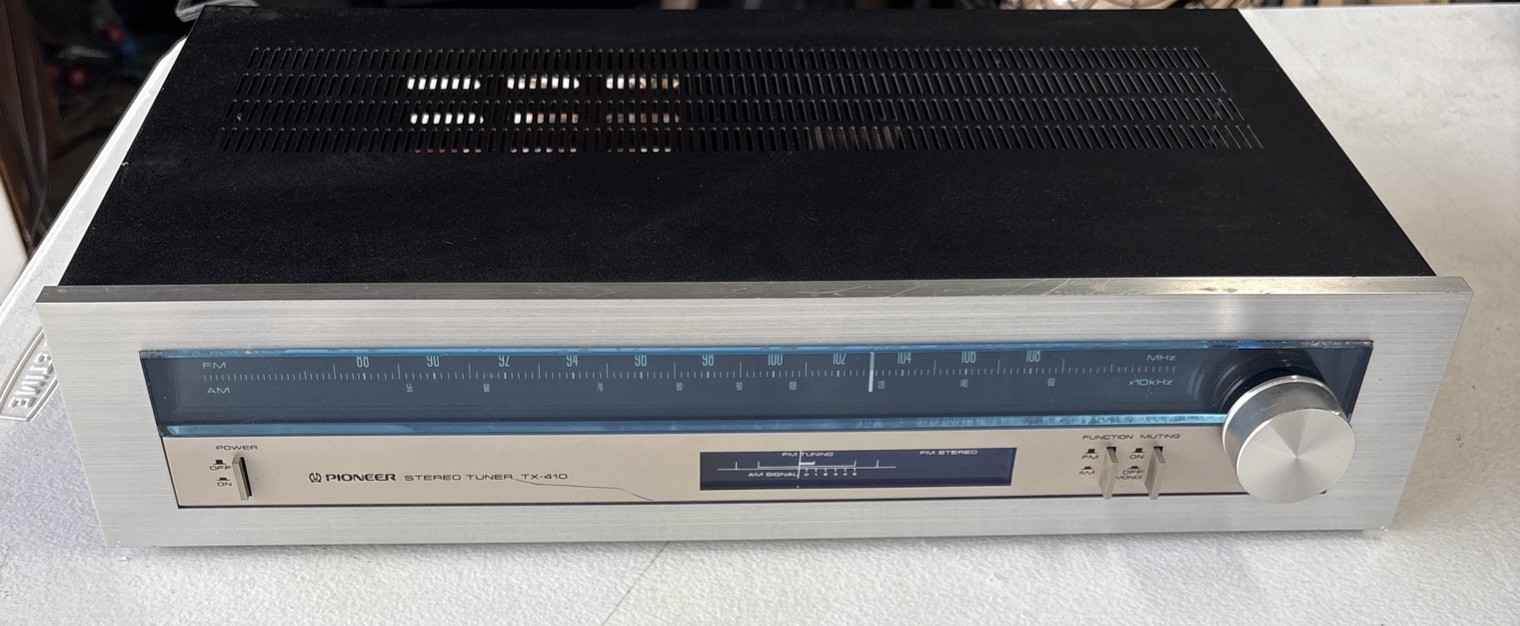

As an eBay Partner, we earn from qualifying purchases. This helps support our independent vintage technology research.
Related Models
- Pioneer cs-700 (1970-1972)
- Pioneer hpm-100 (1976-1979)
- Pioneer hpm-40 (1977-1979)
- Pioneer hpm-60 (1977-1979)
- Pioneer cs-301 (1970s (exact years uncertain))
- Sony ps-5550 (1978-1980)
- Sony ps-lx5r (1983-1985)
- Sony ss-7220a (1970s)
- Sony ss-97 (Late 1970s (approximately 1977-1979))
- Sony ss-999 (Late 1970s (approximately 1977-1979))