Pioneer PL-5 (also known as Pioneer PL-420) (Circa 1981-83)
At 4.5kg and just over 10cm tall, it glides into place like a lab instrument that also happens to play records
Overview
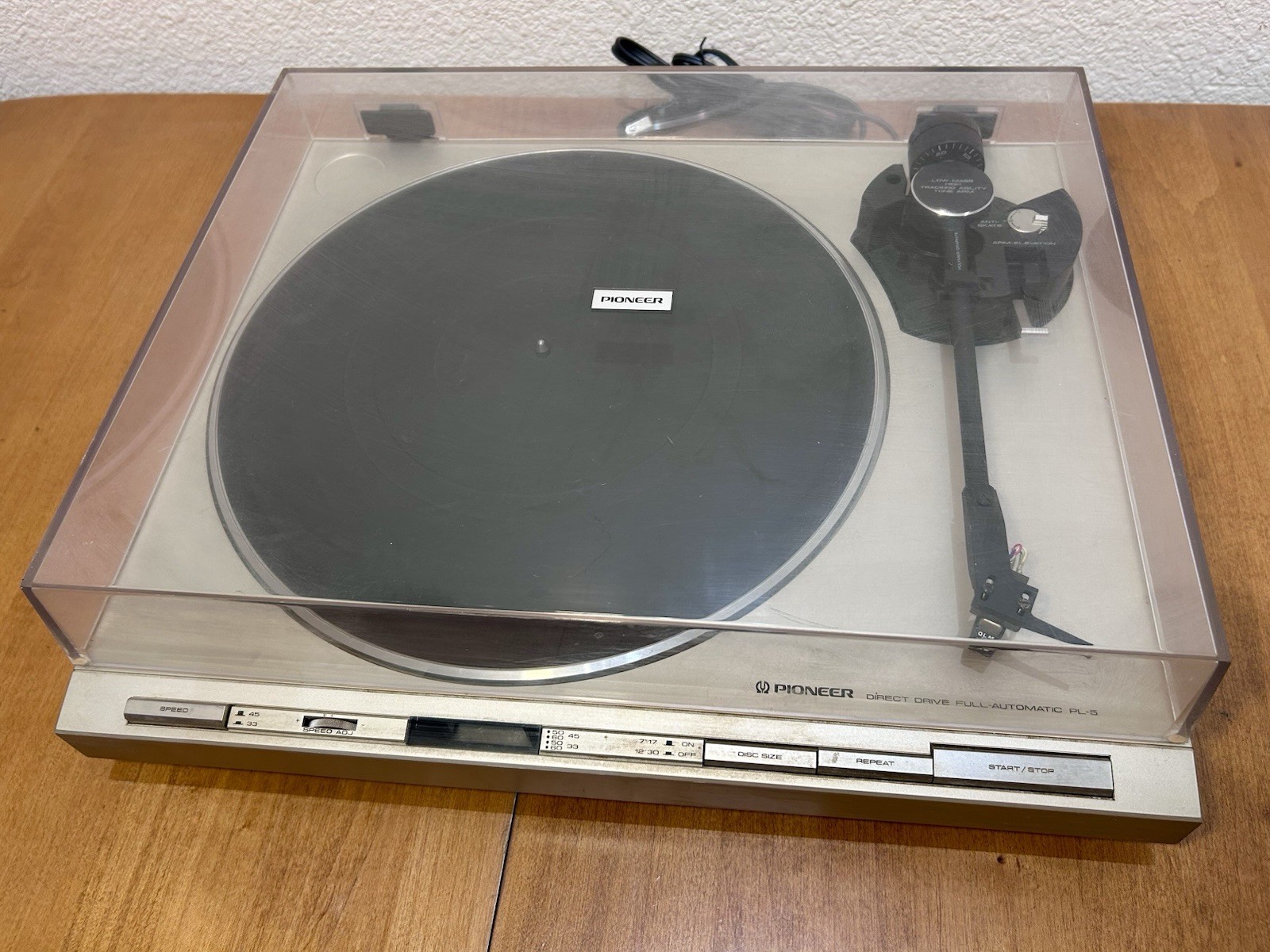
The Pioneer PL-5 isn’t flashy, but it’s serious—engineered for people who wanted everything to work at the push of a button without sacrificing build quality. Marketed as a fully-automatic turntable, it was the self-contained sibling to the semi-automatic PL-4, offering the same precision in a more hands-off package. Built in Japan around the early 1980s, it carries the no-nonsense elegance of that era’s mid-tier hi-fi: clean lines, a champagne-colored finish, and a low-slung profile that suggests stability over showmanship. Owners report it was designed to be quiet—both mechanically and sonically—with a vibration-proof cabinet and a direct-drive DC servo motor that keeps speed errors to a minimum. It’s not a showpiece, but a tool, one that delivers high-quality performance with minimal fuss once properly maintained.
Despite its automation, the PL-5 doesn’t feel cheap or gimmicky. The S-shaped static-balance tonearm, fitted with a gimbal bearing, provides smooth tracking and is compatible with a wide range of cartridges in the 4–6g range. The inclusion of a direct-reading stylus pressure gauge and a built-in stroboscope hints at Pioneer’s intent: this was for users who cared about setup accuracy, even within an automatic framework. Fully automatic operation means the arm lifts, returns, and shuts off the motor after the record finishes—conveniences that still impress when they work flawlessly, though they demand regular servicing to stay that way.
Specifications
| Manufacturer | Pioneer |
| Product type | Fully-Automatic Turntable |
| Drive type | Direct-Drive |
| Operation type | Fully-Automatic |
| Motor | DC servo motor |
| Speeds | 33 1/3 and 45 rpm |
| Wow and flutter | 0.025% WRMS |
| Signal-to-noise ratio | 78dB (DIN B) |
| Tone-arm type | Static balance S-shaped tonearm |
| Tonearm effective length | 221mm |
| Tonearm overhang | 15mm |
| Headshell | Standard 1/2" mount |
| Cartridge weight | 4 - 6g |
| Bearing | Gimbal bearing |
| Dimensions | 420 x 360 x 105mm (16.5" x 14.2" x 4.1") |
| Weight | 4.5kg (9.9 lbs) |
| Power Requirements | AC 120 V, 60 Hz |
| Finish | Champagne finish |
| Country of manufacture | Japan |
Key Features
Direct-Drive DC Servo Motor with 0.025% WRMS Wow and Flutter
The heart of the PL-5 is its direct-drive DC servo motor, a hallmark of high-end turntable engineering in the early '80s. This system eliminates belt wear and slippage, delivering rock-solid speed stability. The wow and flutter rating of 0.025% WRMS is exceptionally low, rivaling more expensive models of its time. Owners who have serviced their units report near-quartz levels of consistency—provided the speed switch is clean and the potentiometers are properly adjusted. It’s a system that rewards maintenance but delivers in spades when dialed in.
S-Shaped Static-Balance Tonearm with Gimbal Bearing
Mounted on a gimbal bearing, the S-shaped tonearm offers smooth vertical and horizontal movement with minimal friction. Its static-balance design means it relies on counterweight adjustment rather than springs, giving users precise control over tracking force. The 221mm effective length and 15mm overhang are standard for the era, ensuring compatibility with most alignment protractors. The 1/2" headshell mount opens up cartridge options, though the 4–6g weight limit narrows the field slightly—still, enough to accommodate many moving magnet types of the period.
Fully-Automatic Operation with Semi-Auto Mode
True to its class, the PL-5 handles every step: lowering the arm at the start of the record, lifting it at the end, and returning it to the rest. But it also includes a semi-automatic mode, allowing users to manually cue the record while retaining automatic lift-off. This flexibility was a smart touch, appealing to both casual listeners and those who preferred more control. However, the mechanism requires regular cleaning and relubrication—especially the cueing damper, which needs silicone fluid to operate smoothly. Neglect it, and the automation becomes erratic or fails entirely.
Direct-Reading Stylus Pressure Gauge and Stroboscope
Few automatic turntables offered such attention to setup detail. The direct-reading stylus pressure gauge lets users dial in tracking force without external tools, a rare convenience. The built-in stroboscope, paired with the edge markings on the platter, allows for quick visual speed verification under 60Hz lighting. These features underscore that the PL-5 wasn’t just about automation—it was about doing it right, with measurable precision.
Historical Context
The Pioneer PL-5 was positioned as the fully automatic counterpart to the semi-automatic PL-4, offering a step up in convenience without a radical redesign. It occupied a middle ground in Pioneer’s lineup—above basic belt-drive models but below the quartz-locked turntables that followed. The next tier up reportedly featured quartz speed control, a technology that offered even greater accuracy but at a higher cost. The PL-5, then, represents the peak of non-quartz automatic turntable engineering from Pioneer—refined, reliable when maintained, and built to last.
Collectibility & Value
Market prices for the PL-5 vary wildly depending on condition and provenance. One unit sold for $129.99 in November 2022, while another was picked up for just $10 on Facebook Marketplace—proof that condition and local demand heavily influence value. Because these units are now over 40 years old, most require some level of refurbishment. Common issues include speed instability due to a dirty speed switch, erratic auto-return behavior, and cueing mechanisms that stick or fail. Some owners have reported the turntable spinning in reverse, potentially linked to incorrect power supply voltage. Typical maintenance includes cleaning and relubricating the automatic mechanism, refilling the tonearm damper with silicone fluid, servicing the anti-skate system, and cleaning the gimbal bearing. Enthusiasts who enjoy tinkering often seek out the PL-5 specifically for its blend of automation and serviceability.
eBay Listings


As an eBay Partner, we earn from qualifying purchases. This helps support our independent vintage technology research.
Related Models
- Pioneer cs-700 (1970-1972)
- Pioneer hpm-100 (1976-1979)
- Pioneer hpm-40 (1977-1979)
- Pioneer hpm-60 (1977-1979)
- Pioneer cs-301 (1970s (exact years uncertain))
- Sony ps-5550 (1978-1980)
- Sony ps-lx5r (1983-1985)
- Sony ss-7220a (1970s)
- Sony ss-97 (Late 1970s (approximately 1977-1979))
- Sony ss-999 (Late 1970s (approximately 1977-1979))