Pioneer F-100 (1971–1973)
A tuner that demodulates FM in digital logic before digital was cool—crisp, quiet, and ahead of its time.
Overview
Turn it on, and the Pioneer F-100 doesn’t just tune in a station—it locks onto it like a missile. That first burst of silence before the music hits? Deep, velvety, and total. No hiss, no hash, no faint echo of adjacent channels bleeding through. This is what clean FM sounded like when Pioneer decided analog wasn’t enough and quietly slipped a digital decoder into the signal path—years before “digital” meant flashing LEDs and plastic faceplates. The F-100 wasn’t the first tuner to flirt with digital circuitry, but it was among the first to make it work seamlessly in a consumer chassis, using what Pioneer called the D.D. (Digital Direct) decoder to convert the IF signal into digital pulses before demodulating both FM and stereo subcarriers. The result? Stereo separation that stayed rock-solid even on weak signals, distortion that hovered near 0.05%, and a signal-to-noise ratio that laughed at fading. It wasn’t flashy, but under that brushed aluminum front panel was a machine built for purity.
Positioned just below the flagship F-101T in Pioneer’s early '70s tuner lineup, the F-100 carved out a niche as the serious listener’s choice—compact, understated, and free of the gimmicks that plagued lesser tuners. It didn’t have motorized tuning wheels or illuminated VU meters; it had a quartz-locked synthesizer with pulse swallow technology, a linear front-end to reject interference, and a 3-point signal strength meter that actually meant something. While other brands were still wrestling with drift and crosstalk, the F-100 held stations like a vise. And unlike some of its contemporaries that prioritized flashy looks over function, this one stayed focused: receive, decode, deliver. It was built for people who wanted to hear the orchestra, not the tuner.
Specifications
| Manufacturer | Pioneer |
| Production Years | 1971–1973 |
| Original Price | ¥36,800 (circa 1985 reissue pricing; original 1971 price not available) |
| FM Tuner Type | Stereo, FM/AM with D.D. (Digital Direct) decoder |
| FM Sensitivity (Mono) | 1.77 µV, 16.2 dBf (IHF) |
| FM Sensitivity (Stereo) | 21.0 µV, 37.7 dBf (IHF) |
| FM Practical Sensitivity (Mono) | 0.95 µV, 10.8 dBf (IHF) |
| FM Signal-to-Noise Ratio | 90 dB (mono), 84 dB (stereo) at 85 dBf input |
| FM Harmonic Distortion (Wide) | 0.05% (100 Hz, 1 kHz), 0.15% (10 kHz, stereo) |
| FM Capture Ratio | 1.0 dB |
| FM Effective Selectivity | 56 dB at 400 kHz |
| FM Stereo Separation | 65 dB at 1 kHz, 45 dB (20 Hz – 10 kHz) |
| FM Frequency Response | 20 Hz – 15 kHz ±0.5/-1.0 dB |
| FM Image Rejection | 60 dB |
| FM Subcarrier Suppression | 55 dB |
| FM Muting Threshold | 5 µV (25.2 dBf) |
| AM Practical Sensitivity | 150 µV/m (with built-in loop antenna) |
| AM Selectivity | 40 dB at ±9 kHz |
| AM Signal-to-Noise Ratio | 50 dB |
| Output Level (FM) | 650 mV at 100% modulation |
| Output Impedance (FM) | 1.4 kΩ |
| Output Level (AM) | 150 mV at 30% modulation |
| Output Impedance (AM) | 1.4 kΩ |
| Antenna Input Impedance | 300 Ω balanced, 75 Ω unbalanced |
| Power Supply | 100 VAC, 50/60 Hz |
| Power Consumption | 8 W |
| Dimensions (W×H×D) | 420 × 60 × 221 mm |
| Weight | 3.0 kg |
Key Features
D.D. Decoder: Analog Signal, Digital Brain
The heart of the F-100’s performance is its D.D. (Digital Direct) decoder—a hybrid circuit that takes the intermediate frequency (IF) signal and converts it into digital pulses before demodulation. This wasn’t full digitization in the modern sense, but it was revolutionary for 1971. By processing the FM and stereo subcarrier signals digitally, Pioneer minimized phase errors and distortion that plagued analog discriminators. The result was a stereo image that remained stable even when the signal dipped, and a near-complete absence of crosstalk. Owners report that weak stations sound coherent rather than fragmented, and multipath distortion—those fluttery echoes in urban areas—is dramatically reduced. It’s not just specs on paper; it’s a tangible improvement in listenability.
Quartz Synthesizer with Pulse Swallow Tuning
While many tuners of the era relied on analog varactor tuning with noticeable drift, the F-100 used a quartz-locked frequency synthesizer with pulse swallow technology. This allowed for precise, repeatable tuning without the need for constant readjustment. Stations stayed put, even after power cycles. The tuning knob was manual, but the internal logic ensured that once you found a station, it stayed locked in with ±0.01 MHz accuracy. For listeners in fringe areas or crowded band environments, this meant fewer dropouts and cleaner reception. It wasn’t remote-controlled or preset-heavy, but it didn’t need to be—accuracy came from engineering, not gimmicks.
Linear Front-End & Interference Rejection
Pioneer didn’t just focus on the decoder; they strengthened the front end to match. The F-100 uses a linear RF stage designed to improve interference rejection, particularly from strong adjacent channels. In dense urban markets where stations bled into each other, this made a real difference. Combined with a high-rejection IF filter and effective shielding, the tuner could pull in weak stations without succumbing to overload. The AM section wasn’t an afterthought either—it used a built-in loop antenna with decent sensitivity and 40 dB of selectivity, making it usable even without an external wire. For a compact tuner, it had serious reach.
Historical Context
The early 1970s were a turning point for FM broadcasting. Stereo was no longer a novelty—it was becoming the standard for music lovers, and manufacturers scrambled to deliver tuners that could do justice to the format. Pioneer, already known for its high-end receivers and speakers, saw an opportunity to lead in pure signal reception. The F-100 arrived in 1971 as part of a wave of Japanese engineering that prioritized measured performance over flashy design. Competitors like Sony, Kenwood, and Sansui were pushing high-sensitivity tuners, but few matched Pioneer’s focus on signal integrity. The D.D. decoder was a bold move—digital processing in an era when most engineers still trusted analog circuits—and it paid off. The F-100 and its siblings helped establish Pioneer as a leader in tuner technology, paving the way for later flagships like the F-900 and F-1050. It also reflected a broader shift: the move from “good enough” reception to audiophile-grade clarity, where the tuner itself became part of the high-fidelity chain rather than just a radio.
Collectibility & Value
The Pioneer F-100 is a sleeper in the vintage tuner market—respected by those who know it, but not yet inflated by hype. Units in working condition typically sell between $250 and $450, with mint, fully serviced examples reaching $600 if they include original packaging or rare silver faceplates. Unlike some vintage gear that suffers from brittle plastic or seized tuning caps, the F-100’s build is largely metal and solid-state, so mechanical failures are rare. However, the electrolytic capacitors in the power supply and audio output stage are now over 50 years old and should be replaced before extended use. Service technicians observe that failure here can lead to hum or, in worst cases, damage to downstream components. The D.D. decoder circuit, while robust, relies on discrete logic chips that are no longer manufactured—though they’re still found in working condition in most units. When buying, check for stable tuning, clean stereo separation, and absence of background noise. A unit that drifts or has weak stereo imaging likely needs capacitor replacement or IF alignment. The built-in loop antenna for AM is fragile—bent or cracked loops will degrade reception. For long-term ownership, a recapping is a wise investment, running $100–$150 with labor. Given its compact size and low power draw, the F-100 integrates easily into modern setups, making it a practical addition for vintage system builders.
eBay Listings
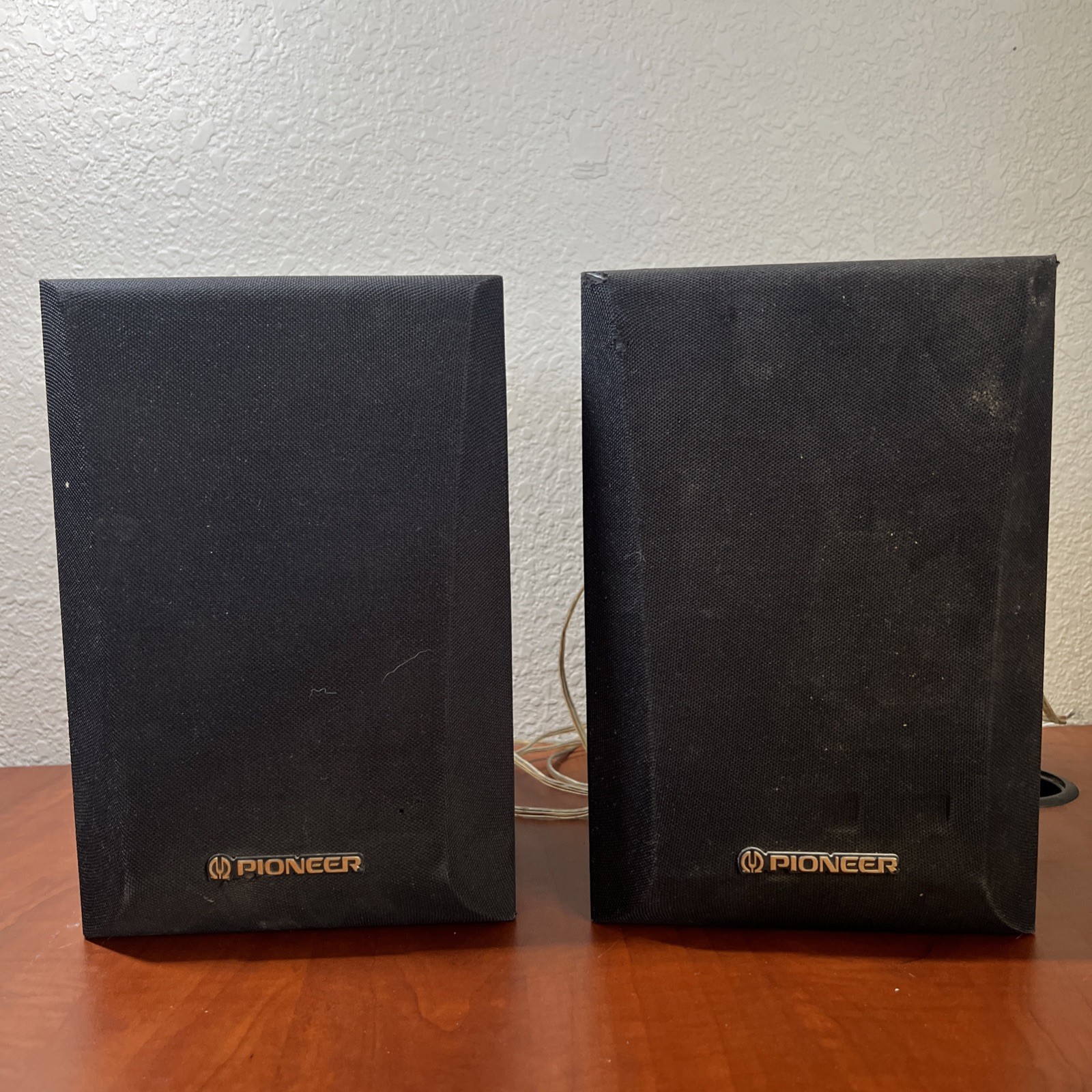


As an eBay Partner, we earn from qualifying purchases. This helps support our independent vintage technology research.
Related Models
- Pioneer cs-700 (1970-1972)
- Pioneer hpm-100 (1976-1979)
- Pioneer hpm-40 (1977-1979)
- Pioneer hpm-60 (1977-1979)
- Pioneer cs-301 (1970s (exact years uncertain))
- Sony ps-5550 (1978-1980)
- Sony ps-lx5r (1983-1985)
- Sony ss-7220a (1970s)
- Sony ss-97 (Late 1970s (approximately 1977-1979))
- Sony ss-999 (Late 1970s (approximately 1977-1979))