NAD 4020: The Affordable High-Fidelity Tuner Companion
Introduction
The NAD 4020 FM/AM tuner, introduced in 1979 and produced through 1983, stands as a quintessential example of NAD’s (NAD Electronics) philosophy during its golden era: delivering high performance at accessible prices. Launched at the height of the company’s reputation for value-driven audio excellence, the 4020 was designed as a natural companion to the legendary NAD 3020 integrated amplifier. While the 3020 became one of the best-selling amplifiers of all time, the 4020 tuner quietly earned respect among audiophiles and casual listeners alike for its solid reception, clean design, and seamless integration into NAD-based systems. Positioned as a mid-tier tuner, the 4020 offered strong FM and AM performance without the premium price tag of high-end separates, making it a favorite in home stereo setups throughout the early 1980s.
Technical Specifications
| Specification | Value |
| Model | 4020 |
| Category | Tuners |
| Years Produced | 1979-1983 |
| Power Output | Not specified |
| Impedance | 75 ohms |
| Frequency Response | 87.5MHz - 108MHz (FM), 530kHz - 1710kHz (AM) |
| Total Harmonic Distortion | < 1% |
| Signal-to-Noise Ratio | 70dB (FM, 50dB µV), 50dB (AM) |
| Dimensions | 430x125x310 mm |
| Weight | 7.5 kg |
Design & Engineering
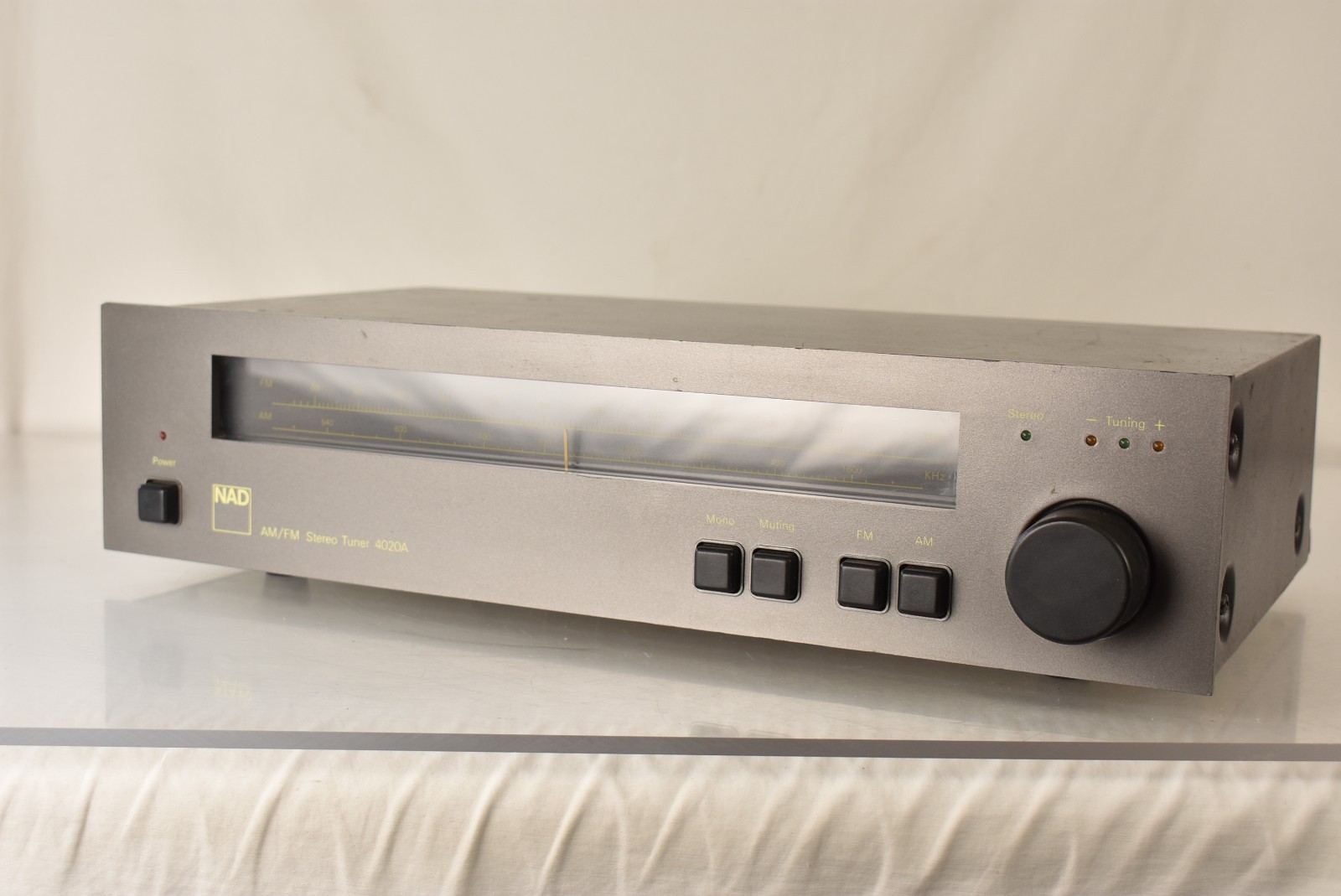
The NAD 4020 reflects the minimalist, functional design language that defined NAD’s product line in the late 1970s and early 1980s. Housed in a sturdy steel chassis with a black front panel and brushed aluminum accents, the tuner exudes a no-nonsense, utilitarian elegance. Its most prominent feature is the large silver tuning knob positioned on the left side of the front panel, offering smooth, precise control over station selection. Adjacent to the knob is a vertically mounted analog meter that displays signal strength, blending functionality with visual appeal—its green backlighting adds a subtle glow that enhances the unit’s presence on a shelf.
Internally, the 4020 employs a dual-gang variable capacitor for tuning, a design choice that ensures accurate station alignment and minimizes crosstalk. This was a notable feature at its price point, as many budget tuners of the era used varactor tuning, which could be less precise. The RF front end is engineered for high sensitivity and selectivity, allowing the 4020 to pull in weak FM signals while rejecting adjacent channel interference. The inclusion of both FM and AM bands—AM being often neglected in higher-end tuners—made the 4020 a practical choice for listeners who enjoyed talk radio or local broadcasts.
The rear panel is straightforward, featuring standard 75-ohm FM and 300-ohm AM antenna inputs, stereo RCA audio outputs, and a DC trigger input for system integration with other NAD components. The build quality is consistent with NAD’s reputation for durability: thick metal construction, high-quality potentiometers, and a well-regulated power supply contribute to long-term reliability.
Sound Characteristics
While a tuner does not "amplify" sound in the traditional sense, its role in preserving signal integrity is crucial. The NAD 4020 excels in delivering a clean, transparent signal path with minimal distortion. Its FM section offers a wide, stable stereo image with good channel separation and a natural tonal balance. The tuner handles multipath distortion well, maintaining clarity even in less-than-ideal reception environments. The audio output is line-level and designed to pair seamlessly with the input stage of the 3020 amplifier, preserving the warmth and musicality that NAD systems are known for.
On the AM band, the 4020 performs admirably for its era. While AM radio is inherently limited by bandwidth and noise, the 4020’s IF filtering and RF amplification help reduce static and improve intelligibility. It’s particularly effective with strong local stations, delivering a surprisingly full-bodied sound that belies its modest cost.
Listeners who pair the 4020 with a good external antenna often report reception quality that rivals more expensive tuners. Its ability to resolve low-level details and maintain stereo stability makes it well-suited for classical, jazz, and live broadcast recordings, where spatial cues and dynamic range are important.
Market & Collectibility
Today, the NAD 4020 is a sought-after component among vintage audio enthusiasts, particularly those restoring or building NAD-centric systems. While not as iconic as the 3020 amplifier, the 4020 has gained a loyal following due to its reliability, attractive design, and excellent value in the used market. Units in good working condition typically sell between $150 and $300, depending on cosmetic condition and functionality.
When purchasing a 4020, buyers should check for a few key issues: the tuning knob should turn smoothly without crackling, the signal meter should respond correctly to input, and the audio output should be free of hum or distortion. Over time, capacitors in the power supply may degrade, so a recapped unit is often preferred. Some owners upgrade the internal wiring or add modern RF shielding, though purists appreciate the tuner in original condition.
Because the 4020 was designed to match the 3020, complete NAD 3020 + 4020 + 2020 (preamp) systems are especially collectible and command a premium. These setups represent a complete snapshot of early 1980s British hi-fi design—modest in appearance, rich in performance.
The NAD 4020 remains a testament to the company’s commitment to accessible high fidelity. It may not have the flash of high-end separates, but in its quiet reliability and honest performance, it embodies the essence of what made NAD a household name in audiophile circles. For those seeking vintage charm with real-world usability, the 4020 is a tuner that still tunes in beautifully.
eBay Listings


As an eBay Partner, we earn from qualifying purchases. This helps support our independent vintage technology research.
Related Models
- Aiwa CS-250 (1978)
- Denon TU-1500RD (1995)
- Denon TU-280 (1976)
- Denon TU-501 (1977)
- Denon TU-550 (1978)
- Denon TU-750S (1975)
- Luxman R-1030 (1979)
- Luxman R-1050 (1975)
- Luxman R-117 (1975)
- Denon TU-400 (1976)