Luxman R-117 (1987–1992)
One of the last great high-powered stereo receivers before the A/V revolution changed everything
Overview
The Luxman R-117 isn’t just another receiver from the late '80s—it’s a statement. Built during a brief window when two-channel purity still reigned but digital sources were demanding more from amplifiers, the R-117 emerged as Luxman’s flagship stereo receiver and the pinnacle of the R-11x series. Introduced between 1987 and 1992, this beast was engineered to handle the wide dynamic swings of early CDs and the increasingly difficult impedance loads of modern speakers, all while maintaining a level of sonic refinement that earned Luxman the nickname “the McIntosh of Japan.” It’s widely regarded as one of the best receivers Luxman ever made, and many audiophiles argue it's among the finest stereo receivers of its era, period.
This was a time when surround sound was creeping in, and manufacturers began shifting focus toward multi-channel processing and home theater. The R-117, in contrast, doubled down on stereo performance. It delivered 160 watts per channel into 8 ohms with astonishingly low distortion (0.005%) and a damping factor of 200, giving it iron-fisted control over speakers. It wasn’t trying to be everything to everyone—it was built for music lovers who wanted maximum power, precision, and transparency without compromise.
Specifications
| Manufacturer | Luxman |
| Model | R-117 |
| Production Years | 1987–1992 |
| Product Type | Stereo Receiver |
| Power Output (8Ω) | 160 watts per channel |
| Power Output (4Ω) | 200 watts per channel |
| Dynamic Power Output | 700 dynamic watts per channel into 2 ohms |
| Frequency Response | 20Hz to 20kHz |
| Total Harmonic Distortion | 0.005% |
| Damping Factor | 200 |
| Input Sensitivity | 2.5mV (MM), 0.25mV (MC), 150mV (line) |
| Signal to Noise Ratio | 110dB (line) |
| Speaker Load Impedance | 8–16 ohms |
| Tuning Range | FM, AM (MW) |
| Tuner Presets | 40 station presets |
| Video Connections | Composite video switching |
| Dimensions (W×H×D) | 440 × 150 × 400 mm |
| Weight | 18.5 kg |
| Accessories | RR-117 remote control |
Key Features
Dual-Mono Class G Amplifier with ODNF
At the heart of the R-117 is a dual-mono design, meaning each channel has its own independent power supply—fed by a massive, triple-shielded toroidal transformer. This isn’t just overkill; it’s essential for maintaining channel separation and preventing crosstalk under heavy loads. The amplifier operates in Class G, which uses multiple power rails to increase efficiency and reduce heat. When the signal demands more power—specifically when output reaches 175 watts per channel—signal-controlled Darlington switches kick in, boosting the output-stage voltage by two-thirds for 30-millisecond bursts. This dynamic headroom allows the R-117 to deliver up to 700 watts dynamically into 2 ohms, making it one of the most current-capable receivers of its time.
Luxman’s proprietary ODNF (Only Distortion Negative Feedback) circuit is another key element. Unlike conventional feedback systems that correct error across the entire signal path, ODNF applies feedback only at the final output stage, minimizing phase shift and preserving transient detail. The result is a sound that’s both powerful and articulate—clean, warm, and remarkably tube-like despite being solid-state.
Phono and Source Flexibility
The R-117 doesn’t just cater to digital; it respects analog. Its phono stage handles both moving magnet (MM) and low-output moving coil (MC) cartridges, with input sensitivity down to 0.25mV. This was no afterthought—it’s a fully discrete, high-gain stage built to extract every nuance from vinyl. For CD lovers, the “CD Straight” circuitry bypasses all tone controls, loudness compensation, and signal switching, routing the signal directly from input to amp section for maximum purity.
Advanced Tuner and Video Capabilities
The tuner section uses quartz-PLL synthesized tuning with a 5-gang varactor and dual-gate MOSFET front end, delivering exceptional sensitivity and selectivity. Automatic hi-blend circuitry reduces high-frequency noise on weak stations, and the 40 preset memory makes station recall effortless. While primarily a stereo receiver, it includes composite video switching for up to three sources, with professional-grade wide-band video buffer amplifiers to maintain signal integrity—rare in a component of this class.
Build and User Experience
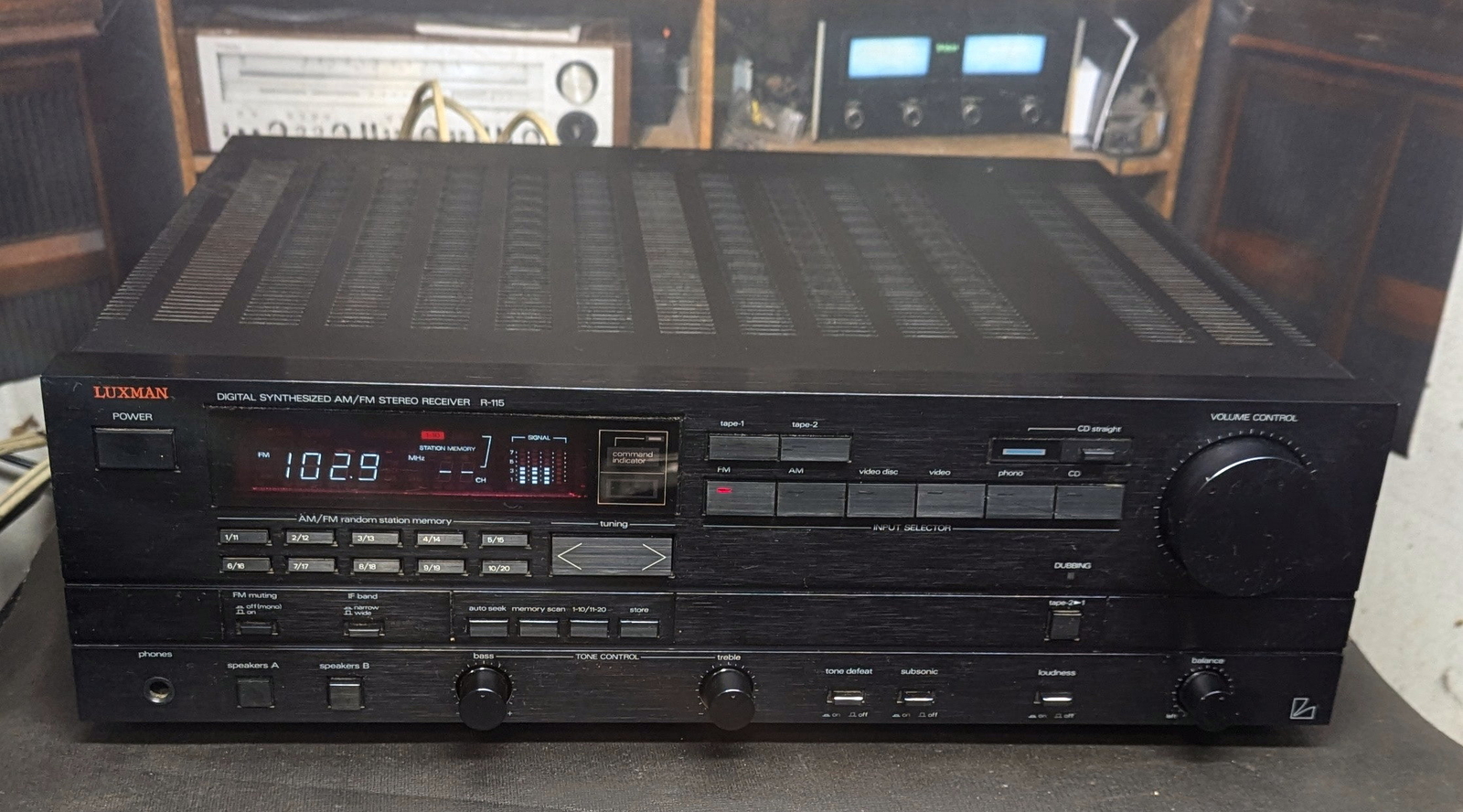
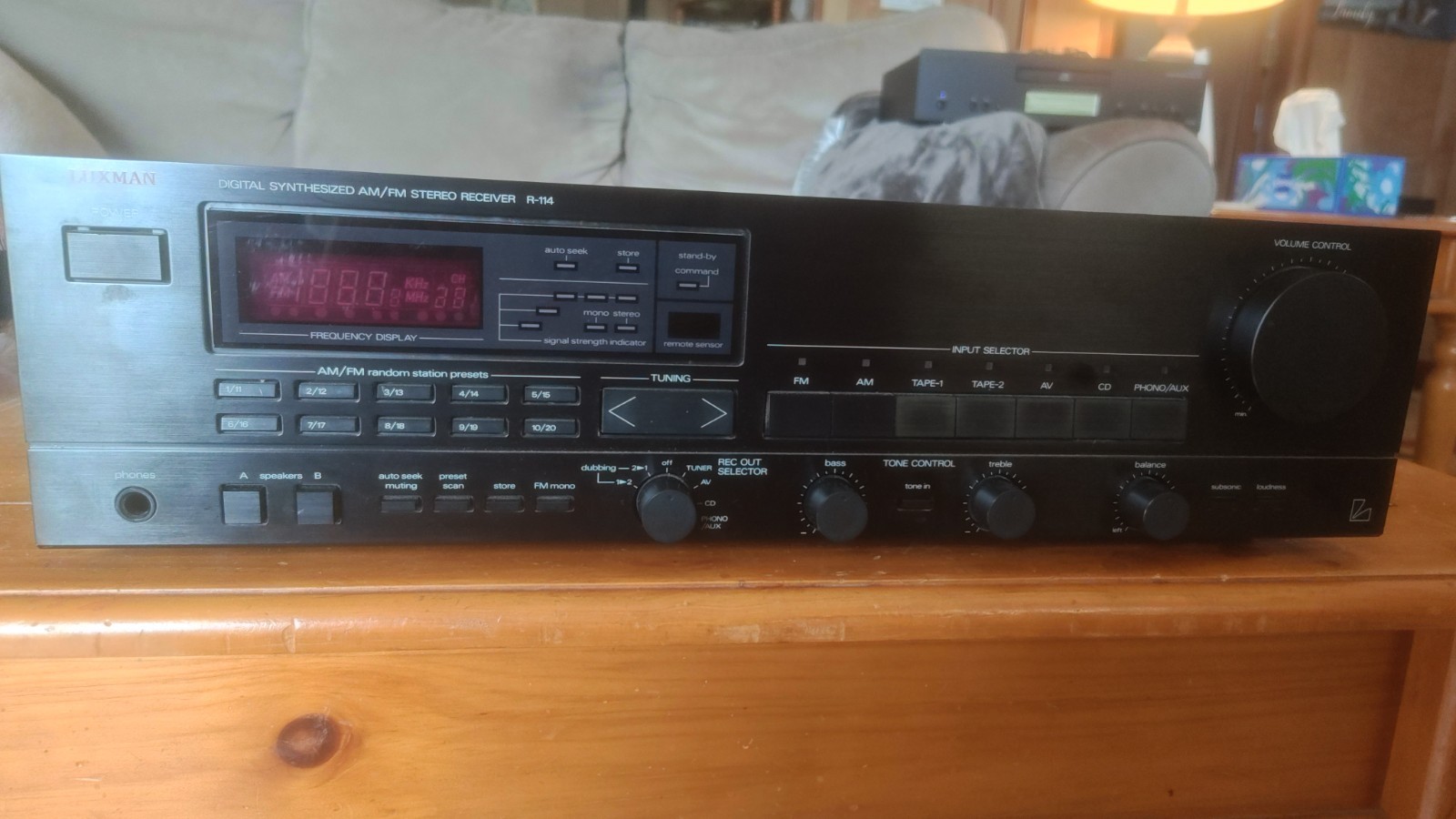
Everything about the R-117 screams quality. The front panel is black (not silver), with a motorized volume control and a fully digital display. Massive heat sinks ensure thermal stability, and the chassis is packed with 38 audio and video I/O jacks. The supplied RR-117 remote control operates all major functions and is compatible with other Luxman components, even supporting multi-room setups via an external remote eye. A switch inside the unit allows tuning in either 25- or 50-kHz increments, accommodating regional broadcast standards.
Historical Context
The Luxman R-117 arrived at a turning point. The compact disc was becoming the dominant format, offering wider dynamic range than vinyl and demanding amplifiers with greater headroom. At the same time, speaker designs were evolving, with some dropping to 4 ohms or lower, challenging amplifier stability. The R-117 was built to meet both challenges head-on. It was also one of the last high-powered, high-fidelity stereo receivers from a major Japanese manufacturer before the A/V revolution redirected engineering efforts toward surround sound and decoding formats like Dolby Pro Logic. In that sense, the R-117 represents the end of an era—a final, glorious expression of what two-channel receivers could achieve.
Luxman, then a division of Alpine Electronics, positioned the R-117 as its flagship, and advertising literature billed it as the “Ultimate Power Receiver.” It competed in a high-end space occupied by models like the Sony STR-GX10es and Onkyo TX-890, but its dual-mono architecture, ODNF topology, and sheer current delivery set it apart.
Collectibility & Value
The R-117 remains in high demand among vintage audio enthusiasts, particularly those who value high-current amplification and clean, dynamic sound. As of 2023, working units typically sell for $600 to $1,000, depending on condition. The original RR-117 remote is highly sought after, though aftermarket replacements exist.
Common issues include blown output transistors—specifically the 2SC3281 and 2SA1302 pairs—and the so-called “clicking relay” problem, where the speaker protection relay fails to engage properly. This is often due to degraded contacts or relay coil failure, and many technicians recommend cleaning or replacing the relay (common substitutes include the R22-1D16-24 NTE relays). Maintenance should be handled by a technician familiar with high-power solid-state gear, as failures can cascade if not addressed promptly.
Despite its age, the R-117 is often described as “bulletproof” when properly maintained. Its build quality is exceptional, and service manuals with schematics and alignment procedures are available, making repairs feasible. Repair shops like Stereo Rehab (Chicago), Approved Audio (CT), and Geardrum (NY) have experience with these units, according to owner reports.
eBay Listings


As an eBay Partner, we earn from qualifying purchases. This helps support our independent vintage technology research.
Related Models
- Luxman R-1030 (1979)
- Luxman R-1050 (1975)
- Luxman R-104 (1975)
- Luxman R-105 (1975)
- Luxman R-107 (1975)
- Aiwa CS-250 (1978)
- Denon TU-1500RD (1995)
- Denon TU-280 (1976)
- Denon TU-501 (1977)
- Denon TU-550 (1978)