Marantz MODEL 250 (1973–1975)
A power amplifier that asks for 1.5 volts and hands you 125 watts - and the service manual still tells you how to rewire it for Tokyo.
Overview
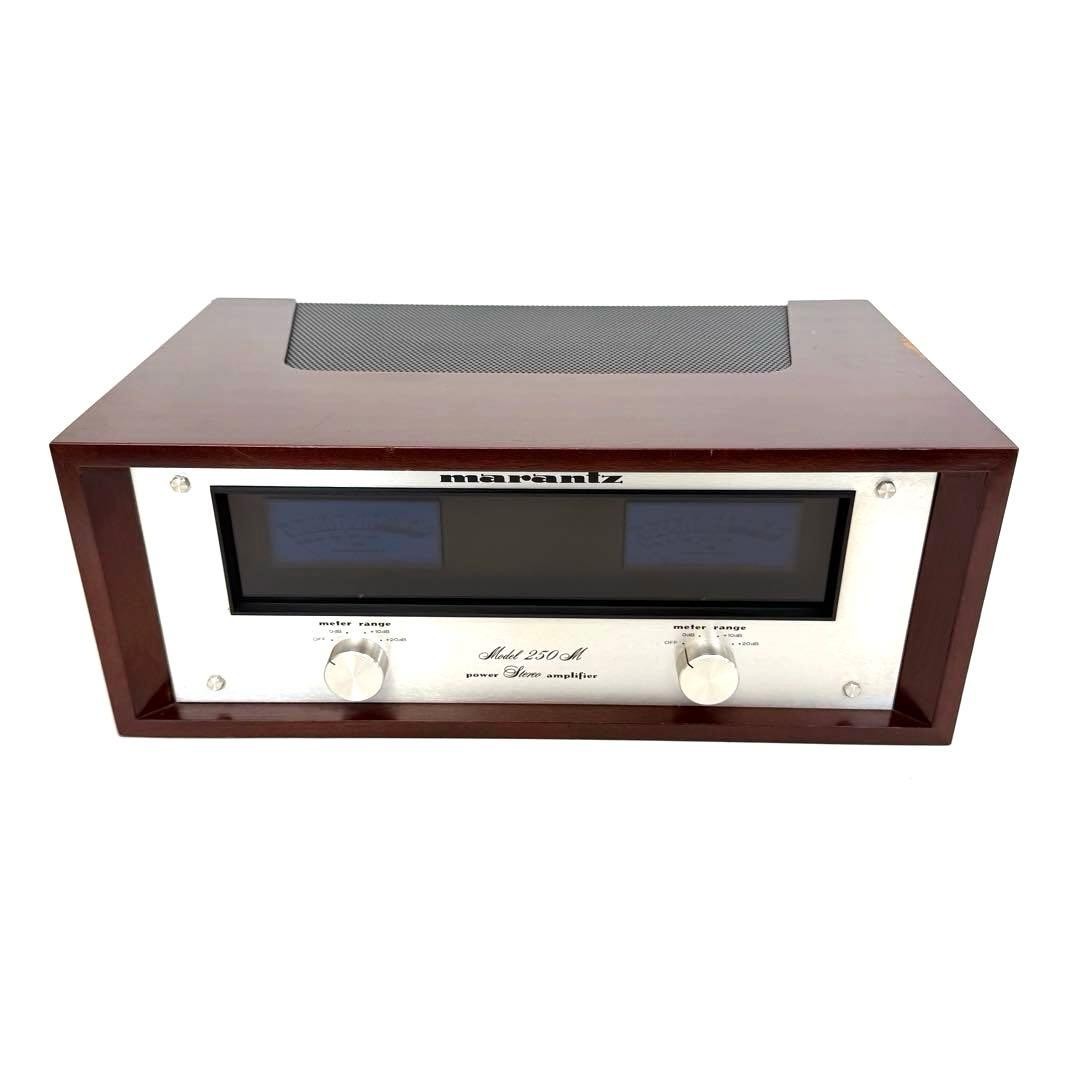
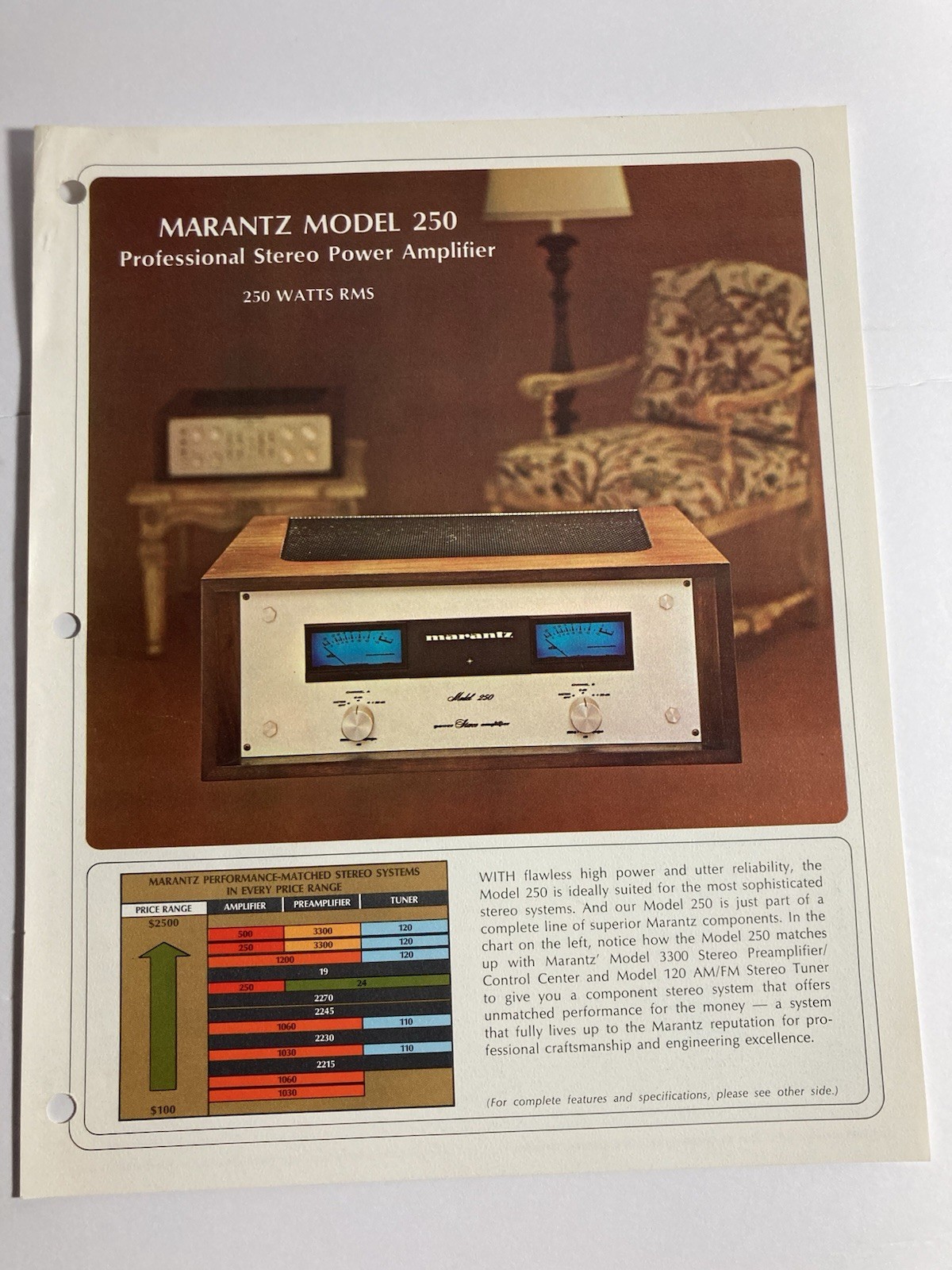
The Model 250 is a stereo power amplifier. It is not a receiver and not an integrated. There is no tuner, no phono stage, no tone controls. It takes a line-level signal and makes it loud, and Marantz's own literature framed it as the flagship of the company's golden era. The faceplate carries two large VU meters. The chassis is 15-3/8" wide, 6-1/8" tall and 9-1/2" deep, and it weighs 28 pounds. Two channels, one job.
The rated output is 125 watts per channel into 8 ohms, both channels driven, 20 Hz to 20 kHz, at no more than 0.1% total harmonic distortion. Marantz's service documentation lists the full load line: 150 watts per channel into 4 ohms, 125 into 8, and 64 into 16. The 4-ohm figure is the one to look at, since it says the 250 has real current behind it and not just a voltage swing. High Fidelity (July 1971, p.38) reported the Model 250 was designed to replace the Model 16, adding extra power and features at no additional cost, and confirmed the 125-watt continuous per channel rating and the $495 price. The same issue noted the output level meters were switchable for two sensitivity ranges.
Input sensitivity is 1.5 volts for rated power into a 100k-ohm input impedance. That is a high-impedance, line-level-only front end that expects a preamp ahead of it. Total noise is specified as better than 106 dB below rated power into 8 ohms. Damping factor is greater than 100 at 8 ohms. Frequency response runs 2 Hz to 100 kHz at +0/-1.5 dB, with ±0.1 dB across the 20 Hz-20 kHz band. Intermodulation distortion is under 0.1% by the SMPTE method, any two frequencies from 20 Hz to 20 kHz. The IEC-style power bandwidth figure is 5 Hz to 45 kHz.
One service note before you buy. Marantz built the 250 with split primary windings on the transformer, and the manual walks a technician through converting the unit from 120-volt to 220-volt operation. Jumper the grey and violet transformer wires at TB1, move the black and white power lead-ins to the brown and white wires, and swap the 6-amp, 250V mains fuse for a 4-amp, 250V part. A separate 100-volt conversion kit exists for the Japanese market.
Key Features
Dual-Mono Construction with Separate Power Transformers
The 250 uses dual-mono topology. Each channel gets its own power supply, rather than one shared supply split two ways. That keeps channel separation up under load, because one channel's current draw doesn't sag the other's rail. It also makes the amplifier heavier and more expensive to build than a shared-supply design of the same rated power, which is part of why this was never a budget piece.
Direct-Coupled Output Stage
The output is direct-coupled, with no coupling capacitor between the amplifier and the speaker terminals. That means bass extension and phase behavior that capacitor-coupled designs can't match, with no rolloff at the bottom and no electrolytic in the signal path. The cost is that a DC fault at the output goes straight to your woofers, which is why the protection circuitry matters so much on these units.
Class AB Bias and the Notching-Distortion Problem
Marantz's engineering notes describe a deliberate choice. Many high-power solid-state amplifiers of the period ran close to Class B at low levels, which produces the notching distortion transistors are prone to. The Model 250 supplies enough idling current to run Class AB. The claim is that this keeps low output levels clean, the quiet passages and not just the peaks. The marketing language may oversell it, but the design intent is documented, and the bias adjustment procedure is spelled out in the service manual, so it can be set correctly on a bench.
Differential Input and Matched Output Transistors
The circuit is described as a differential-amplified, fully complementary, all-stage direct-coupled OCL design. Both the differential input stage and the push-pull output stage use selected matched pairs of transistors, and the basic circuit is DC-balanced. A DC leakage detection circuit is fitted as well.
Independent Circuit Boards per Stage
Each block of the amplifier sits on its own printed circuit board. Marantz's documentation says this was done to keep the first and last stages from interfering with each other. It also makes servicing and troubleshooting far easier than a single dense board would.
Dual Power Meters with Switchable Sensitivity
Two large VU meters sit on the front panel, and High Fidelity (July 1971, p.38) noted they're switchable between two sensitivity ranges. The second range lets you watch a quiet signal on the meter without pinning the needle on transients. The meter lamps are a known wear item, and aftermarket LED replacement kits for the Model 250 meters are readily available.
Preamp/Main Amp Separation
The 250 can be separated from its preamp section. It can serve as a standalone power amplifier behind any preamp, or as the power stage of a Marantz system.
Historical Context
The Model 250 was built from 1973 to 1975 and described in Marantz's own framing as the flagship of the company's golden era. It was assembled in the USA. Audio-database lists an original price of ¥245,000, flagged there as "around 1972?" Treat that as approximate, since the yen figure and the production window don't line up cleanly. High Fidelity (July 1971, p.38) put the US price at $495 and described the 250 as the successor to the Model 16, with more power and features at the same cost. HiFi-Stereo (July 1971, p.21) ran it in its new-products column, noting the successor-to-Model-16 positioning and the two large front-panel VU meters. The Model 250 also appears in Audio's June 1972 issue listings alongside the Model 930 and Model 810, though no source states an explicit hierarchy among those three.
Collectibility & Value
The 250 sits at 8 out of 10 on collectibility. Recent eBay completed sales run $1,514 to $1,630, with a median of $1,531 across three sales in the past twelve months. That is thin volume, roughly one unit a month. The broader undated range quoted for the model is $800 to $1,500 depending on condition and restoration status, so the two data points don't fully agree. Treat the completed-sales figure as the more current read. Active listings have been observed at $1,295, $1,548, $1,700, and $1,899, with the top of that range attached to a one-owner example with paperwork.
Buying advice: these amplifiers are past fifty years old, and the electrolytic capacitors are the first thing to go. A full recap and bias calibration is the standard restoration path, and owners report it brings a neglected unit back to spec, with some claiming better than factory. Check DC offset at the output transistors and refresh the thermal paste before running one hard. The relays stick, particularly on units that sat unused for years. Output transistor failures are documented. At least one owner's unit arrived with the finals on both channels blown along with the mains fuse, so a "powers on" listing means very little. Aftermarket LED meter-lamp kits exist if the originals are dark.
A naming caution for anyone shopping: listings appear under both "Model 250" and "Model 250M," and no available source explains the relationship between the two designations. Some 250M listings describe Japanese-market 100V units imported by an authorized Marantz dealer, and junk/for-parts 250M examples turn up regularly. The two names are not interchangeable in the marketplace, so confirm exactly which unit you're looking at before committing.
Market Value
┌──────────────────────────────────────────────────────────────────────────┐
│ MARANTZ MODEL 250                                               Nov 2026 │
├──────────────────────────────────────────────────────────────────────────┤
│ High      $1,630                                  Latest          $1,630 │
│ Median    $1,531                                  Trend                — │
│ Low       $1,514                                  Volume           ~1/mo │
├──────────────────────────────────────────────────────────────────────────┤
│ $2,000 ┤                                                                 │
│        │                                                                 │
│        │                                                                 │
│ $1,571 ┤                                                                .│
│        │.                                                     .          │
│        │                                                                 │
│        │                                                                 │
│ $1,000 ┤                                                                 │
│        ├─────────────────────────────────────────────────────────────────│
│    vol │█                                                     █         █│
│        └─────────────────────────────────────────────────────────────────│
│         2026-03                      2026-05                      2026-06│
└──────────────────────────────────────────────────────────────────────────┘
eBay completed sales. Excludes accessories, parts, and non-working units. Hover points for details.
eBay Listings
Recently sold on eBay: $1,514–$1,630 (median $1,531, based on 3 completed sales, past 12 months)


As an eBay Partner, we earn from qualifying purchases. This helps support our independent vintage technology research.
Related Models
- Marantz 1530L
- Marantz 3600 (1976-1977)
- Marantz 3800 (1976-1978)
- Marantz 4100 (1976-1978)
- Marantz 4430 (1972)
- Braun AUDIO-1 (1965)
- Braun AUDIO-250 (1965)
- Magnavox Component Systems (1972)
- Acoustic Research AR (1967-1976)
- Acoustic Research 11