Acoustic Research AR-11 (1975–[VERIFY])
Its performance, drivers, and crossover are identical to the AR-10π - except it strips away the one feature that made the 10π famous.
Overview
The AR-11 weighs 53 pounds. It came out in 1975 alongside the flagship AR-10π, and it shares every driver, crossover component, and cabinet design with its more expensive sibling. It differs in exactly one functional detail. Acoustic Research's own promotional copy, reprinted in High Fidelity (October 1975, p.29), called it "the most accurate speaker system ever made by Acoustic Research" - the same language used for the 10π. The claim rests on real engineering. The AR-11 uses a substantially improved version of the 12-inch acoustic suspension woofer that AR pioneered decades earlier. It is paired with the dome midrange driver developed for the legendary AR-3a and a newly designed tweeter that extended the top end with what period listeners described as exceptional smoothness.
What the AR-11 does not have is the Woofer Environmental Control (WEC) switch. That is a multi-position attenuator on the 10π's front baffle, and it let users tailor bass response to room placement. Advertisements published in HiFi-Stereo (July 1975, p.79) confirm the omission, and it is the only functional difference between the two models. The drivers are the same. The crossover network is the same. The sealed enclosure dimensions, the internal bracing, the damping materials are all identical. Collectors and owners report that in most domestic listening rooms, positioned with reasonable care away from walls and corners, the AR-11 performs indistinguishably from the 10π at a lower original purchase price.
The crossover hands off from the 12-inch woofer to the dome midrange at frequencies AR's engineers picked to keep phase disruption minimal through the critical vocal range. It then hands off again to the dome tweeter above approximately 5 kHz. The circuit uses film capacitors and air-core inductors on a glass-epoxy board. Even forty-plus years later, these parts rarely drift out of specification unless physically damaged. Owners report that crossover capacitor replacement, a routine maintenance item on the earlier AR-3a, is far less urgent on the AR-11 series. The binding posts accept bare wire, spade lugs, or banana plugs. The spacing is tight, though, and modern audiophile cables with oversized connectors can be a frustrating fit.
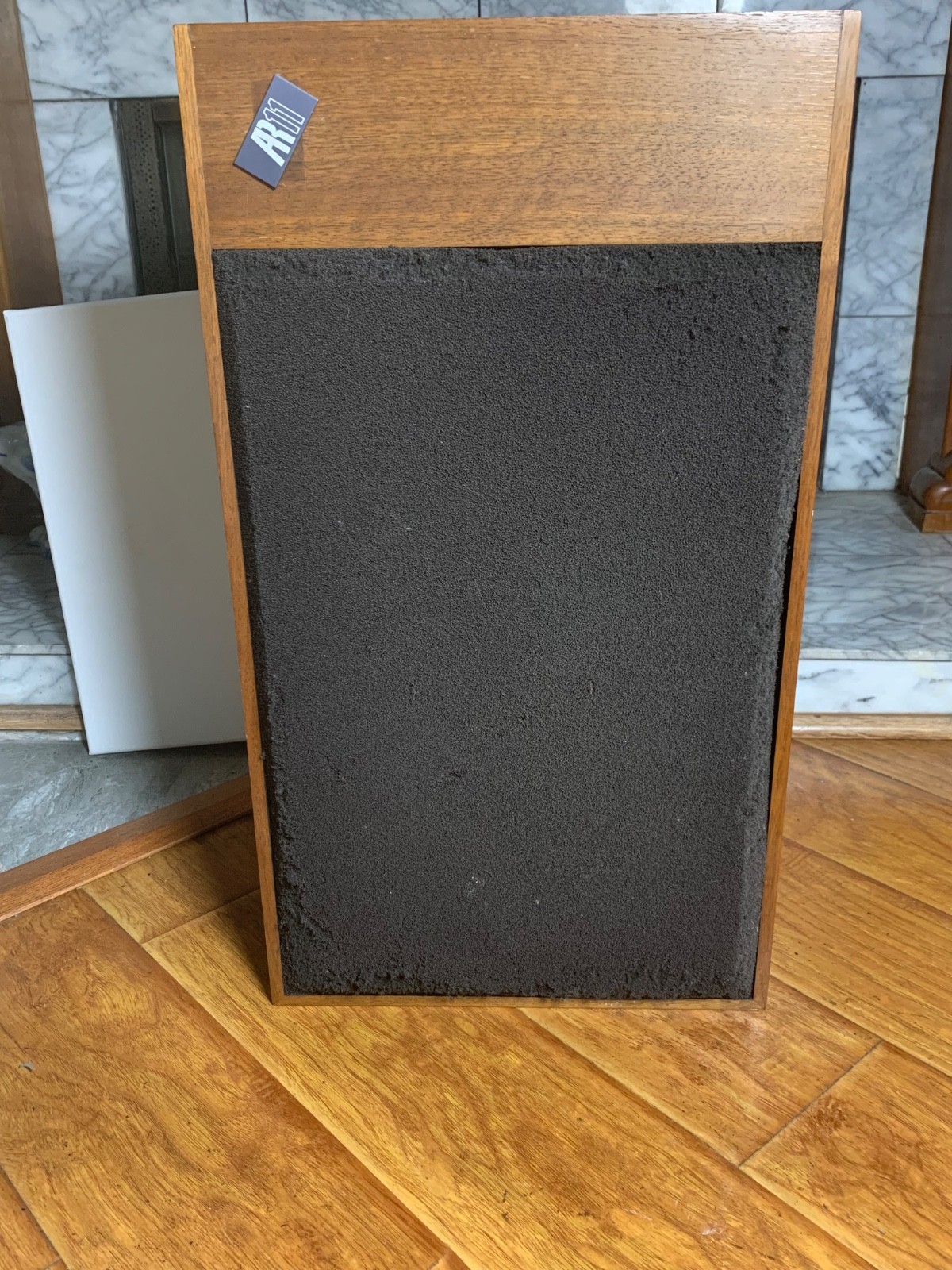
The cabinet is real walnut veneer over a dense particleboard substrate, with mitered joints and a removable grille frame covered in acoustically transparent linen cloth. At roughly 14 by 25 by 11 inches, the AR-11 is a floor-standing speaker that doesn't overwhelm a modest room. It wants at least eighteen inches of clearance from the rear wall, to avoid bass reinforcement that the sealed alignment does not need. The acoustic suspension design relies on the air trapped inside the cabinet as a restoring spring for the woofer cone. Placing the speaker flush against a wall or into a bookshelf defeats the tuning and produces thick, congested low frequencies. On open floor stands, fed by an amplifier that can deliver clean power into its nominal impedance, the AR-11's bass extends deep enough to make pipe organ pedal notes physical without sounding overblown.
The engineering philosophy behind the AR-11, and behind Acoustic Research's whole mid-1970s lineup, favored flat energy response measured in real rooms over anechoic perfection. HiFi-Stereo (1976, p.119) noted that the AR-11, alongside the 10π and the AR-MST/1 miniature studio transducer, represented "a new family of loudspeakers" unified by this approach. The AR-11 originally shipped with a five-year warranty covering both workmanship and performance. Most competitors offered two years at most. Every driver was tested against a reference standard before leaving the factory in Cambridge, Massachusetts.
Power handling is generous by the standards of the mid-1970s. Owners have successfully driven AR-11s with everything from 35-watt tube amplifiers to 200-watt solid-state monoblocks. The speakers are not especially sensitive, and they reward amplifiers with substantial current delivery rather than inflated wattage ratings. A high-quality 60-watt amplifier will make the AR-11s play louder and cleaner than a mediocre 150-watt receiver. The impedance curve stays reasonably flat across most of the audible spectrum, dipping no lower than [VERIFY: exact minimum impedance not documented]. This makes them an easier load for tube amplifiers than many competing acoustic suspension designs of the period.
The dome midrange driver is the AR-11's greatest strength and also its most vulnerable component. The voice coil is exposed to open air behind the dome, so dust, pet hair, and curious children's fingers can cause irreparable damage. Original replacement midranges are scarce. Rebuild services exist but add significant cost to any restoration. The woofer's foam surround, unlike the cloth surrounds on earlier AR models, deteriorates predictably after fifteen to twenty years. Re-foaming is a straightforward job for a competent technician, and aftermarket kits are widely available. Buyers should still assume any AR-11 with original surrounds will need immediate attention. The crossover capacitors are more durable than the electrolytics in earlier AR designs, but they can still drift over decades. Many owners report their AR-11s measure close to specification even after forty years of service.
eBay Listings


As an eBay Partner, we earn from qualifying purchases. This helps support our independent vintage technology research.