Marantz Model 140 Stereo Power Amplifier
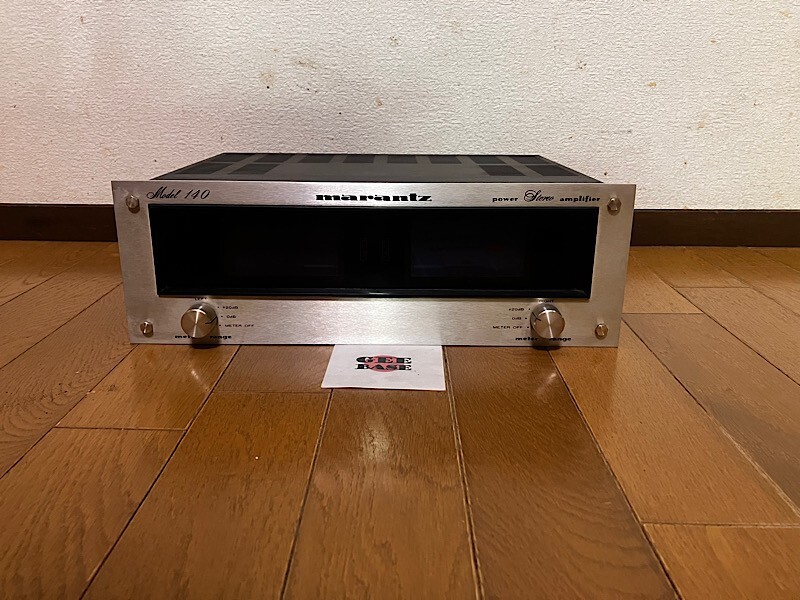
A silver-faced 75-watt-per-channel brute from the Superscope era, with VU meters that glow and a protection circuit that flashes red when you push it too hard.
Overview
The Marantz Model 140 is the power amp that sat at the heart of a serious mid-'70s system — no tuner, no preamp, no tone controls, just a slab of silver-faced chassis with two big meters and a job to do. Marantz Company, then operating as a subsidiary of Superscope Incorporated out of Sun Valley, California, built it in Japan and sold it as a standalone stereo power amplifier for high-fidelity audio systems. The company's own literature described it with typical Superscope restraint: a stereo power amplifier with improved cost performance while applying traditional Marantz technology. Translation: they kept the good parts and cut the fat.
The Model 140 is rated at 100W + 100W into 4 Ω and 80W + 80W into 8 Ω, both channels driven across 20 Hz to 20 kHz. That looks conservative next to the receiver wars, but it's a real spec - full bandwidth, both channels, not a 1 kHz number. Total harmonic distortion is held to 0.1% or less across the same band, and cross modulation distortion stays under 0.15%. The frequency characteristic is quoted as 20 Hz to 20 kHz ± 0.1 dB, which is very flat. Input sensitivity and impedance are listed at 1.5V and 30k Ω, and the damping factor is 45 or more into 8 Ω.
At 11 kg, it's heavy enough that you notice when you lift it, and the chassis measures 360 mm wide by 120 mm tall by 273 mm deep, with the width and height figures referring to the front panel itself. Power consumption is rated at 250W, and the Japanese-market version ran on 100 VAC at 50 or 60 Hz. The faceplate is silver, which matters more than it should — the Model 140 is one of those pieces that looks like what people picture when they say "vintage Marantz."
Original list price was ¥ 89,000, dated to around 1976. That put it well above entry-level separates, aimed at buyers who already owned a decent preamp and wanted a power amp. Marantz listed it in its Classic Models Reference series.
Key Features
Fairchild D200W Output Transistors
The output stage runs Fairchild P D200W transistors. That's a specific, named part, not a generic "discrete output stage" line in the brochure. Anyone servicing these amps cares about the transistor type, both for matching replacements and for understanding the thermal behavior. The D200W was a workhorse part of the era.
Dual VU Meters with Independent Peak Indicators
Two VU meters sit on the front panel, and each channel gets its own peak indicator on top of that. A VU meter averages, while a peak indicator catches the transient the needle misses. With both on each channel, you can see a drum hit pushing the amp toward clipping before the VU needle even twitches. With no tone controls on the amp, the metering is the interface.
Current-Limiting Warning Light
When the current limiting circuit engages, during instantaneous clipping or when the amp sees an abnormally low impedance load, a red warning light comes on. Most amplifiers of the period either clipped silently or shut down with no explanation. The Model 140 at least tells you something is going on.
Optional Walnut Cabinet and Rack Adapter
Marantz sold two accessories separately for the Model 140: a walnut wood cabinet, the WC-20, at ¥ 5,900, and a rack mount adapter, the RA-10, at ¥ 4,900. Neither was included. A Model 140 in a factory walnut case is a different object than a bare chassis, and the used market prices it that way. The rack adapter is the rarer of the two and the one studio and broadcast buyers would have specified.
Historical Context
The Model 140 was built by Marantz Company, a subsidiary of Superscope Incorporated, at a time when the brand was manufacturing in Japan and selling globally. The ¥ 89,000 price, dated to around 1976, puts it in the mid-to-upper tier, not a flagship but not a budget piece either. Marantz's own framing was cost performance: traditional Marantz technology, applied more efficiently.
What's documented about how owners actually used them is thin but consistent. The Model 140 shows up paired with the Marantz Model 3600 preamp and the Marantz Model 3200 preamp in period system documentation — both natural partners, since the 140 has no preamp stage of its own. Beyond that pairing, the record doesn't say much about what Marantz intended it to sit above or below in the lineup. Production end year isn't documented either; the only firm date anchor is the ¥ 89,000 price around 1976. Contemporary coverage of the era's amplification practice is similarly oblique — Recording Engineer (October 1982, p.94) described MSI/Northwest Sound System's touring rig, in which every amplifier rack carried its own electronic crossover and third-octave graphic equalizer to simplify wiring at the house mix position, a reminder that by the early '80s the power amp had become one module in a modular rack rather than the centerpiece of a home system.
Collectibility & Value
Completed eBay sales for the Model 140 show a median of $1,157 and a latest sale of $589, with a low of $64 and a high of $13,323 across the tracked period. The $13,323 result is an outlier. The data points cluster far lower, with recent sales in the $570 to $660 range and a March 2026 sale at $1,157. The $12,586, $13,099, and $13,323 figures from June 2026 look like either a mis-categorized listing, a bundle, or a data artifact. The note on the source data says completed sales exclude accessories, parts, and non-working units, so that doesn't explain the outliers. The median is the more useful number.
Volume is roughly two units per month, which is thin enough that condition and completeness will move the price more than any trend line. Active listings at the time of writing sit in the $689 to $842 range for working units described as tested and maintained. A $6 LED light replacement kit is also listed, so the meter lamps are evidently a consumable.
The optional WC-20 walnut cabinet and RA-10 rack adapter, both sold separately when new, are worth asking about on any used example. A Model 140 with its original wood case will command more than a bare chassis, and the rack adapter is scarce enough that it's often missing.
eBay Listings



As an eBay Partner, we earn from qualifying purchases. This helps support our independent vintage technology research.
Related Models
- Marantz 1530L
- Marantz 3600 (1976-1977)
- Marantz 3800 (1976-1978)
- Marantz 4100 (1976-1978)
- Marantz 4430 (1972)
- Braun AUDIO-1 (1965)
- Braun AUDIO-250 (1965)
- Magnavox Component Systems (1972)
- Acoustic Research AR (1967-1976)
- Acoustic Research 11