Marantz HD-660 (1978–1980)
Warm, weighty, and built like a tank—these floorstanders deliver vintage Marantz soul with a bass punch most of their era couldn’t touch.
Overview
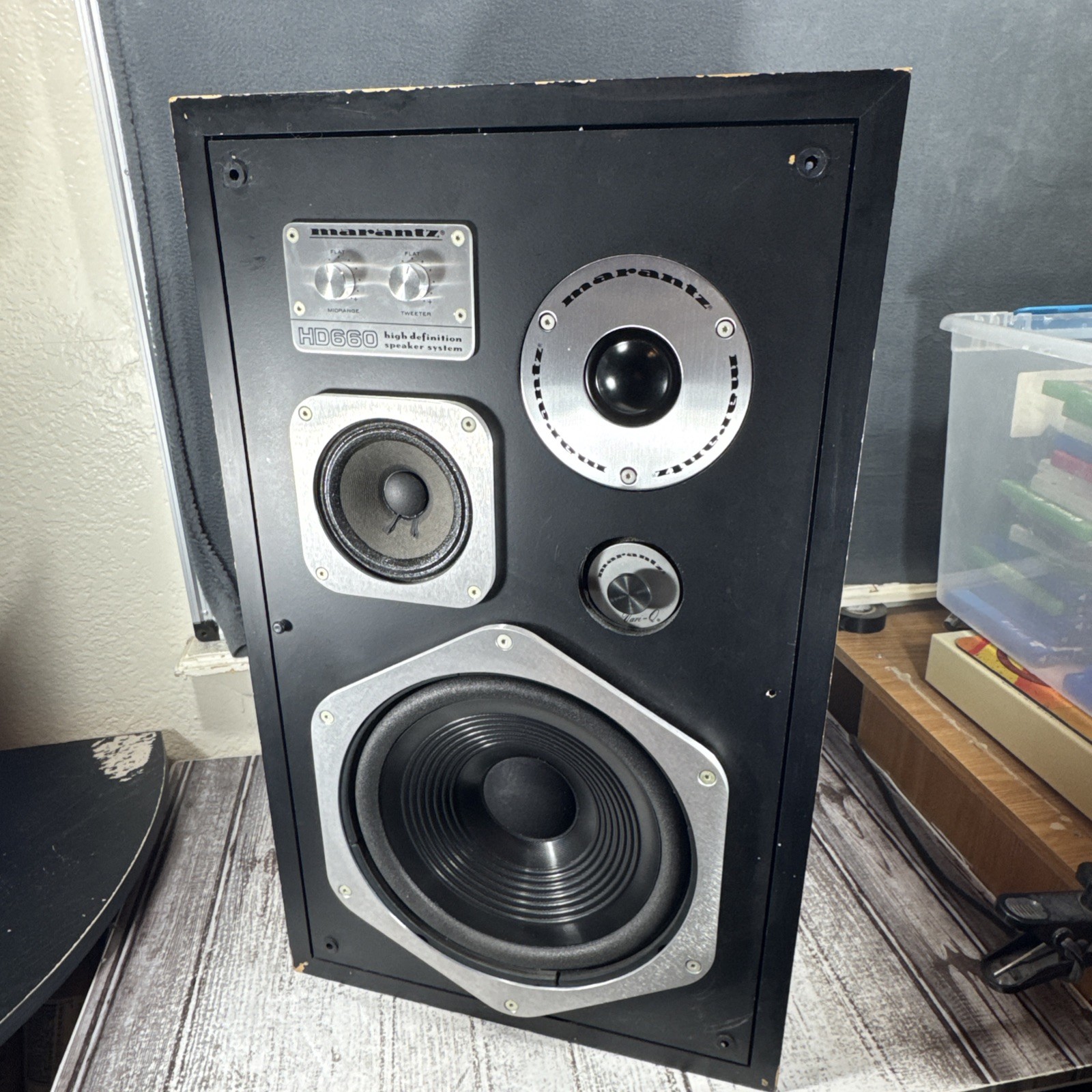
Pull one of these walnut-veneered beasts out of its box and you immediately understand why people still hunt for them: they feel solid, almost dense, like they were engineered to outlive their owners. The Marantz HD-660 isn’t flashy, but it’s got presence—tall, narrow cabinets with a clean, uncluttered baffle that lets the drivers do the talking. These were part of Marantz’s High Definition speaker series, a line that aimed to blend American cabinet craftsmanship with Japanese engineering precision during a transitional period for the brand. Designed under the guidance of Ed May, a respected acoustical engineer who worked closely with Saul Marantz in the company’s golden years, the HD-660 reflects a philosophy that prioritized musical coherence over sterile neutrality.
It’s a three-way floorstander with a 10-inch (255mm) woofer, a 5.25-inch (130mm) midrange, and a 1.5-inch (40mm) soft-dome tweeter—all mounted in a sealed cabinet with a clever twist: a port system called VariQ damping. Unlike a standard bass reflex, VariQ uses a removable acoustic plug that lets you tune the low-end response depending on room placement and taste. Slide it in, and the bass tightens up; pull it out, and you get a deeper, more resonant low end. It’s a rare feature for the time, and one that shows Marantz was thinking about real-world listening environments, not just anechoic chamber specs.
Sonically, the HD-660 leans warm and full-bodied, with a rich midrange that gives voices and acoustic instruments a lifelike weight. The bass is surprisingly deep and articulate for a late-’70s design, extending down to 35Hz with authority—no small feat when you consider most contemporaries were still chasing efficiency over extension. But it’s not a bass-forward speaker in the modern sense; the low end integrates smoothly rather than overwhelming. The tweeter rolls off gently above 15kHz, which some might call a limitation, but in practice it avoids the harshness that plagued many bright-sounding Japanese designs of the era. The trade-off? A slightly veiled top end that lacks the air and sparkle of later models like the HD770 or HD880, which added a super-tweeter for extended highs.
What really sets the HD-660 apart is its dynamic weight. At 88dB sensitivity, it’s not an easy load—it demands a solid amplifier with current to spare, especially in larger rooms. Pair it with a timid tube amp or a low-damping solid-state receiver, and the bass can turn woolly. But feed it with a robust Japanese integrated or a capable power amp from the early ’80s, and it opens up with a sense of control and scale that feels decades ahead of its time. Owners report that these speakers thrive with gear like the Marantz 2270 receiver or the Sansui AU-9900, both of which provide the grip and drive the woofers need.
Specifications
| Manufacturer | Marantz (Sound United LLC) |
| Production Years | 1978–1980 |
| Original Price | Not listed in research |
| Type | 3-way, sealed cabinet with VariQ damping port |
| Impedance | 8 ohms |
| Power Handling | 125 watts |
| Frequency Response | 35 Hz – 20,000 Hz |
| Sensitivity | 88 dB |
| Crossover Frequencies | 750 Hz, 2500 Hz |
| Woofer | 1 x 255mm (10") |
| Midrange | 1 x 130mm (5.25") |
| Tweeter | 1 x 40mm (1.5") soft dome |
| Dimensions (HWD) | 616 x 371 x 292 mm (24.25 x 14.6 x 11.5 inches) |
| Weight | Not listed in research |
| Enclosure Material | Walnut veneer over MDF/wood composite |
| Features | VariQ damping port, rotary level controls for midrange and tweeter |
| Country of Manufacture | United States |
| Grille | Removable fabric with wooden frame |
Key Features
VariQ Damping: Tunable Bass Without the Port Thump
Most late-’70s speakers with ports either boomed or didn’t, with little in between. The HD-660’s VariQ system was Marantz’s answer—a small, cylindrical foam plug that fits into the rear-firing port. When inserted, it effectively seals the cabinet, tightening the bass and reducing resonance. Remove it, and the cabinet becomes a passive radiator of sorts, extending low-frequency output. It’s a simple but effective way to adapt the speaker to different rooms or listening preferences. Service technicians observe that the port design also helps reduce air turbulence noise, a common issue in bass-reflex systems of the era. The result is a speaker that can be both deep and controlled, depending on setup.
Adjustable Midrange and Tweeter Levels
Few speakers from this period gave users real-time control over tonal balance, but the HD-660 includes two rotary dials on the rear panel—one for the midrange, one for the tweeter—allowing ±3dB adjustment. This isn’t just a gimmick; it’s a practical tool for room compensation. In a bright space with lots of glass or tile, rolling back the tweeter smooths things out. In a carpeted, heavily furnished room, a slight boost can add clarity. These are passive L-pads, not active crossovers, so they don’t alter impedance dramatically, but collectors note that using them too aggressively can affect driver damping. Still, the ability to fine-tune the sound without external EQ is a major advantage, especially for a speaker this forgiving of amplifier mismatches when properly adjusted.
Driver Quality and Cabinet Build
The original woofers used a butyl rubber surround, now long degraded, but the cone and motor structure were well-engineered for the time. Documentation shows the midrange driver used a doped paper cone with a phase plug, contributing to its smooth, natural vocal reproduction. The tweeter, while not ultra-extended, avoids the edginess that plagues some early soft domes. Cabinet construction is notable for its time—thick panels, internal bracing, and a sealed design that resists resonance. Unlike many mass-market floorstanders of the late ’70s, the HD-660 doesn’t rattle when pushed. The walnut veneer is applied evenly, and the overall fit and finish suggest a product aimed at the upper mid-tier, just below the exotic HD880.
Historical Context
The HD-660 arrived in 1978, the same year Marantz celebrated its 25th anniversary. The company was navigating a complex shift: still rooted in American design philosophy, but increasingly influenced by its Japanese ownership under Superscope. This era produced some of Marantz’s most distinctive speakers—models that balanced warmth with technical ambition. The HD-660 sat in the middle of the High Definition line: above the HD550 and HD600, below the HD770 and flagship HD880. It was positioned as a serious audiophile speaker, but not a no-compromise flagship. Competitors included the AR-3b, KLH Model Eleven, and Advent Large, all of which leaned on ported designs and higher efficiency. Marantz went a different route—lower sensitivity, sealed bass, and more complex crossovers—betting that serious listeners would pair them with capable amplifiers.
What made the HD-660 stand out was its holistic design. While companies like Sony and Pioneer were chasing specs and flash, Marantz focused on tonal balance and realism. The use of real wood veneer, the lack of plastic trim, and the thoughtful rear-panel controls all signaled a product built for connoisseurs. It also reflected Ed May’s influence—his background in studio monitoring brought a focus on accuracy without sterility. In a market flooded with bright, forward-sounding Japanese speakers, the HD-660 offered a more relaxed, natural alternative.
Collectibility & Value
Today, the HD-660 trades in the $250–$450 range for a pair in good, fully restored condition—higher if original drivers are intact and properly re-foamed. Unrestored pairs with degraded surrounds can be found for $100–$200, but buyers should factor in $100–$150 in refoaming costs per speaker if done professionally. DIY kits are widely available (search for F10-5 or A10-Bulk-086) and cost around $30–$40 per pair, but the angled surround attachment makes the job trickier than average. Service technicians observe that improper refoaming—especially if the adhesive isn’t applied evenly—can lead to cone misalignment and early failure.
The most common failure point is, predictably, the woofer surround. Nearly all original units have disintegrated foam, leading to flapping, distortion, or complete driver failure. The midrange and tweeter are more durable, but older capacitors in the crossover can dry out, causing imbalance or loss of high frequencies. When buying, check for rattles, test both speakers at moderate volume, and inspect the rear-panel controls for crackling—signs of oxidized potentiometers, which can often be cleaned with contact cleaner.
Despite their age, these speakers hold up well sonically when maintained. Their sealed cabinets resist port noise, and the robust build means cabinets rarely delaminate. However, grilles are often missing or damaged—the fabric tears easily, and the wooden frames can warp. Replacement grilles are not mass-produced, so finding a complete set adds value.
For the vintage audio enthusiast, the HD-660 is a sweet spot: it delivers 90% of the performance of the more coveted HD770 and HD880 at half the price, without the fragility of super-tweeters or the complexity of active crossovers. It’s not the last word in detail or imaging by modern standards, but in the right system—paired with a muscular amp and placed on sturdy stands—it still holds its own. If you’re after the warm, full-bodied sound of late-’70s high fidelity, the HD-660 isn’t just nostalgic—it’s a legitimate performer.
eBay Listings


As an eBay Partner, we earn from qualifying purchases. This helps support our independent vintage technology research.
Related Models
- Sony ps-5550 (1978-1980)
- Sony ps-lx5r (1983-1985)
- Sony ss-7220a (1970s)
- Sony ss-97 (Late 1970s (approximately 1977-1979))
- Sony ss-999 (Late 1970s (approximately 1977-1979))
- Sony st-j88 (1986-1988)
- Kenwood kl-888s (Late 1970s (approximately 1978-1980))
- Sansui sax-200 (Late 1970s)
- Sansui sax-600 (Late 1970s)
- Sansui sr-222 (1973-1975)