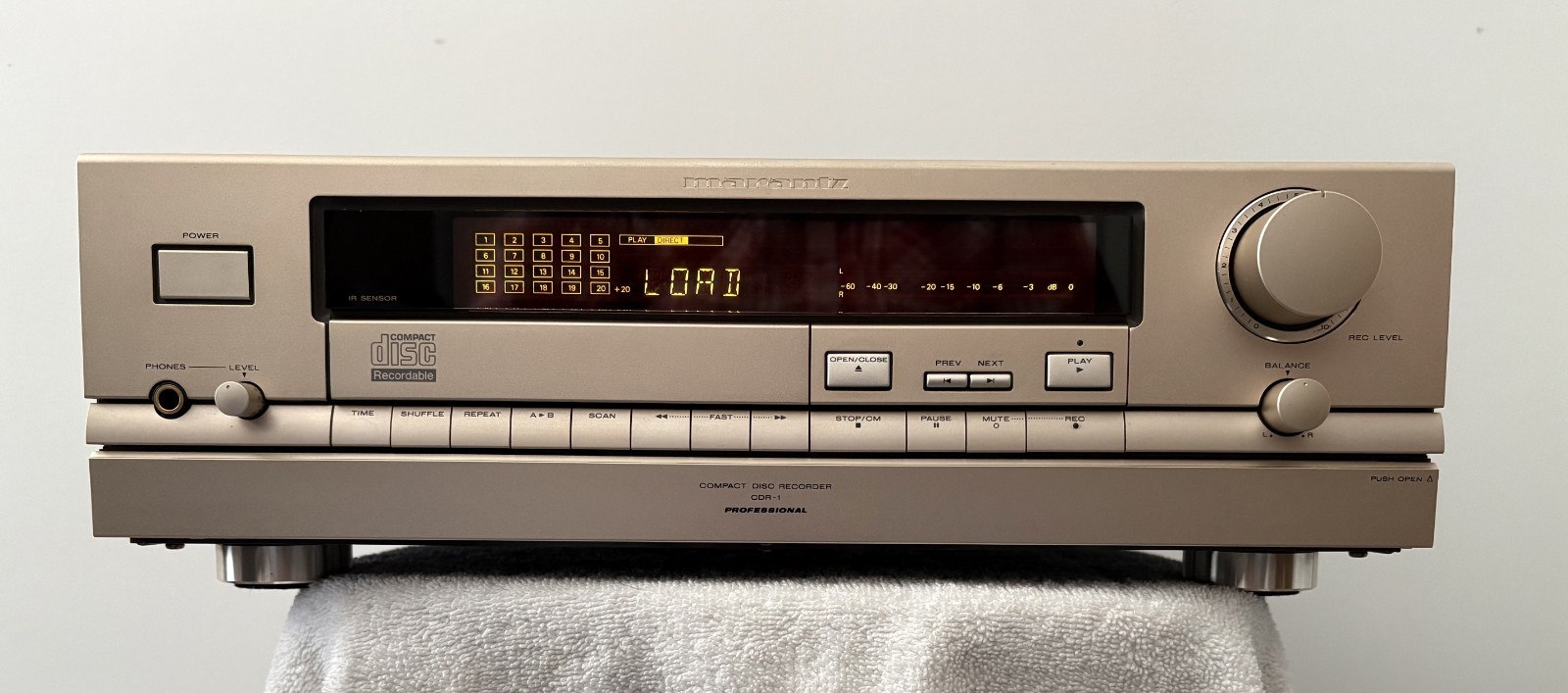
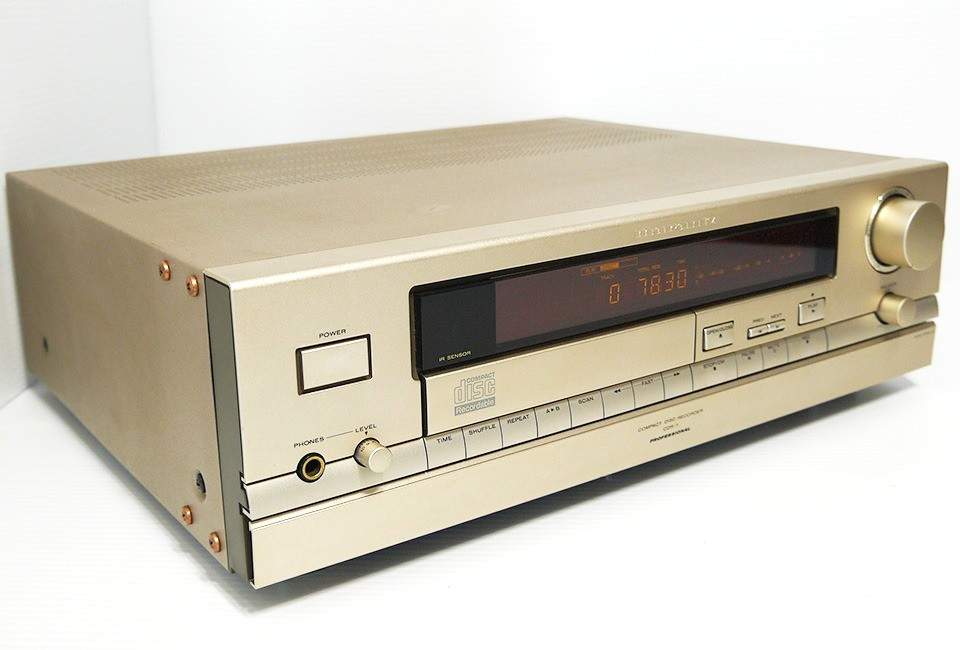
Marantz CDR-1
The Marantz CDR-1 was among the first generation of professional CD recorders. It could write a one-off disc that played on any standard CD player, and at the time that was still new and expensive. Audio (March 1992, p.46) noted that recordings made on the CDR-1 could be used on conventional CD players but could not be erased and rerecorded. That write-once limit came with the format in this era.
Marantz sold the unit as a professional product, with the price to match. Audio (March 1992, p.50) observed that the price was high for a professional unit, but that it offered balanced inputs and did not impose SCMS copy protection. That mattered to professional users, since consumer CD-R decks of the period were often forced to add a serial copy-management flag to their recordings. In the UK, the CDR-1 was distributed exclusively by HHB Communications, as Studio Sound (February 1992, p.10) recorded.
The CDR-1 was built around a 1-bit delta-sigma recording system with higher-order noise shaping. It used a 24-bit "Finalizer" digital processing stage that actively suppressed the noise of the recorder and analog output stages, which preserved low-level musical detail. The D/A converter ran in a 1-bit silent mode, and the unit used a high-precision crystal-based reference clock. The A/D converter was an ADC 80320 running double-speed sampling. Recordings could be made at the standard 44.1 kHz sampling rate with no digital compression applied.
Known specifications:
- Frequency response: 5 Hz - 20 kHz, ±0.5 dB
- Signal-to-noise ratio: greater than 95 dB
- Dynamic range: greater than 90 dB
- THD: less than 0.005%
- Input impedance: 50 kilohms
- Output level: 2 V, 600 ohms
No production years, original price, or detailed market history have surfaced in the record. Asking prices for used units run from roughly $450 to $900, though those are listing prices, not confirmed sales. Service documentation is scarce.
eBay Listings
As an eBay Partner, we earn from qualifying purchases. This helps support our independent vintage technology research.