Marantz HD 77 (1975–1977)
A floor-standing speaker from the 1970s with a 12-inch woofer, a foam port plug, and a super-tweeter that reaches beyond human hearing.
Overview
Pull one out of a basement crate after 40 years and the size hits you first. These are furniture. The Marantz HD 77 stands nearly two-and-a-half feet tall, with a broad footprint and walnut veneer wrapped around a hefty 21-kilogram cabinet. The details show it was Marantz's answer to the high-end speaker wars of the mid-1970s: a four-way system with a dedicated super-tweeter, user-adjustable crossover voicing, and a foam plug that lets you switch between bass-reflex and acoustic suspension tuning.
When properly maintained, the HD 77 sounds balanced and articulate for its era. The 12-inch woofer goes down to 30 Hz, and the 4.5-inch midrange keeps vocals clear and centered. A 2-inch dome tweeter handles the upper mids and lower treble, then hands off to a 1-inch super-tweeter that extends response to 23 kHz. That is beyond the range of human hearing, but listeners often describe the airy, open quality as "lifelike." Whether the extra extension is audible is debatable.
Then there's the foam plug. It goes into the rear-firing bass port. This dense cylinder of closed-cell foam is inserted and sealed with a screw-retained cap, which turns the cabinet into a sealed (acoustic suspension) design. Marantz marketed this as a way to tighten bass response and reduce port noise, so users could audition the same speaker in two tuning modes. It works. Insert the plug and the bass loses some of its boom, gaining definition at the expense of ultimate output. It reflects the era's fascination with user-adjustable acoustics. It also hints at a compromise: the ported alignment leans toward warmth, even bloat, in typical rooms, while the sealed mode can feel overly damped. The right setup depends as much on room placement and personal taste as on technical merit.
The HD 77 was designed by Edmond May, a former JBL engineer, and it carries the DNA of professional monitor design: overbuilt and over-specified. It competed with the AR-3, KLH Model Eleven, and Advent Large. Those speakers leaned into specific sonic signatures - AR's deep bass, KLH's efficiency, Advent's openness. The HD 77 aimed for neutrality, and Marantz displayed a frequency response graph in its brochures as flat as an anechoic chamber could measure. That neutrality came with controls: each high-frequency driver had a front-mounted potentiometer labeled "Room EQ" and "Flat," letting users dial in brightness based on room acoustics. It was a rare level of user control for the time, and it worked when the pots were set correctly. Decades later, those same pots are often seized, noisy, or misadjusted, which throws off the whole tonal balance.
Specifications
| Manufacturer | Marantz |
| Production Years | 1975–1977 |
| Original Price | Not available in research |
| Type | 4-way, 4-driver floor-standing loudspeaker |
| Frequency Response | 30 Hz – 23 kHz |
| Power Handling | 250 watts RMS, 330 watts peak |
| Nominal Impedance | 8 ohms |
| Sensitivity | Not available in research |
| Woofer | 1 x 12 inches (30 cm), cone |
| Midrange | 1 x 4.5 inches (11.4 cm), cone |
| Tweeter | 1 x 2 inches (5.1 cm), LPF film dome |
| Super Tweeter | 1 x 1 inch (2.5 cm), LPF film dome |
| Crossover | Passive, with selectable “Flat” and “Room EQ” voicing |
| Enclosure Type | Bass reflex with optional acoustic suspension via foam plug |
| Dimensions (H×W×D) | 28.5 × 15 × 12 inches (72.4 × 38.1 × 30.5 cm) |
| Volume per Cabinet | 2.8 cubic feet (79 liters) |
| Weight | 49 lb (22.2 kg) per speaker |
| Grille | Foam, removable |
Key Features
The Four-Way Crossover with Voicing Switches
Most speakers of the 1970s stopped at two or three drivers. The HD 77 split the high end between a tweeter and a super-tweeter, each with its own crossover network and front-panel potentiometer. "Flat" was for anechoic neutrality, and "Room EQ" compensated for typical room absorption. In theory, this let the speaker adapt to any environment. In practice, no two pairs sound exactly alike, especially now that the potentiometers have oxidized or been misadjusted. A well-serviced set with clean pots can deliver a startlingly accurate soundstage. A neglected pair often sounds harsh or dull, depending on which driver is out of alignment. The crossover is complex, with multiple inductors and capacitors, and it's not serviceable without expertise.
The 12-Inch Woofer and Convertible Bass Tuning
At the bottom of the baffle sits the 12-inch woofer. It's a long-throw design, and paired with the bass-reflex port it delivers a deep, resonant low end that can rattle drywall in a small room. Marantz knew not every room or listener wanted that much bass, so they included the foam plug: a solid cylinder of closed-cell foam that, inserted into the port and sealed with a screw cap, turns the cabinet into a sealed design. This reduces bass output but increases control, tightening transients and reducing one-note boom. The trade-off is that sealed mode requires more amplifier power to reach the same perceived bass level, and the overall efficiency drops. For critical listening or smaller rooms, it's a useful option.
User-Adjustable Driver Response
Each high-frequency driver - midrange, tweeter, and super-tweeter - has its own level control on the front baffle. These aren't tone controls in the traditional sense. They're attenuation pots that let you dial back brightness if the room is too reflective. It's a pro-audio touch in a consumer product, and it works. But decades of oxidation and dust mean many units now suffer from channel imbalance, crackling, or complete failure. Contact cleaner can help, but full restoration often requires disassembly and potentiometer replacement. When they work, these controls make the HD 77 one of the most flexible vintage speakers available, capable of everything from dead-flat monitoring to warm home listening.
Historical Context
By the mid-1970s, transistor amplifiers had matured, quadraphonic sound was fading, and consumers were beginning to treat speakers as the weak link in the chain. Marantz, still riding the reputation of its tube-era glory, responded with the HD series - High Definition, as the name promised. The HD 77 sat near the top, above the HD-66 and below the HD-88. It wasn't the most efficient speaker, nor the easiest to drive, but it was among the most technically ambitious. While many manufacturers were simplifying crossovers and cutting costs, Marantz went the other way, offering adjustability, extended bandwidth, and a heavy build.
It competed in a crowded market. AR, KLH, Advent, JBL, and Acoustic Research were all pushing large, multi-driver systems. Few offered the HD 77's combination of size, power handling, and user control. Where AR relied on acoustic suspension for tight bass, Marantz offered both sealed and ported modes. Where Advent used dome tweeters for smoothness, Marantz added a super-tweeter for air. JBL's professional monitors influenced many, and the HD 77 was one of the few consumer speakers designed by a former JBL engineer, Edmond May.
The timing was tricky. By 1977, the market was shifting toward smaller, more efficient designs. The rise of solid-state amplifiers with lower damping factors made large, complex speakers harder to control, and the oil crisis had made big, heavy cabinets less appealing. The HD 77, with its 49-pound weight and appetite for power, was already looking like a relic of the early 1970s even as it was being discontinued. It didn't vanish quietly, since reviews praised its clarity and depth, but it never reached the cult status of the AR-3 or the Advent Large.
Collectibility & Value
Today the Marantz HD 77 sits in a curious niche. It's not rare, since plenty survived, but it's not common either. Finding a pair in good condition takes patience, and restoring them takes effort. The foam surrounds on the woofers degrade over time, often crumbling into dust. Replacement kits exist but require careful installation. The foam grilles are even more fragile, and original ones are scarce. The super-tweeters and midrange drivers are less prone to failure but can suffer from diaphragm fatigue or voice coil misalignment after decades of use.
The real challenge is the crossover and controls. Those front-panel pots are notorious for going bad, and the internal crossover components, especially capacitors, can drift or fail. A full restoration might cost $200 - $400 per speaker, depending on driver replacement and labor.
Unrestored pairs sell for $150 - $300, often described as "for parts or repair." Functional but cosmetically worn sets go for $400 - $600. Fully restored pairs with replaced foam, cleaned controls, and verified crossovers can reach $800 - $1,200, especially if sold with original grilles and documentation. That's not "insane collector" money, but it's a serious investment for a speaker that competes with modern alternatives.
Buyers should inspect carefully: check for cabinet warping, verify that the foam plug and cap are present, test all potentiometers for smooth operation, and listen for distortion in the high frequencies. If the super-tweeter is damaged, replacement drivers are hard to find. The 12-inch woofer is more common, but original units have a specific tonal character that generic replacements won't match.
eBay Listings
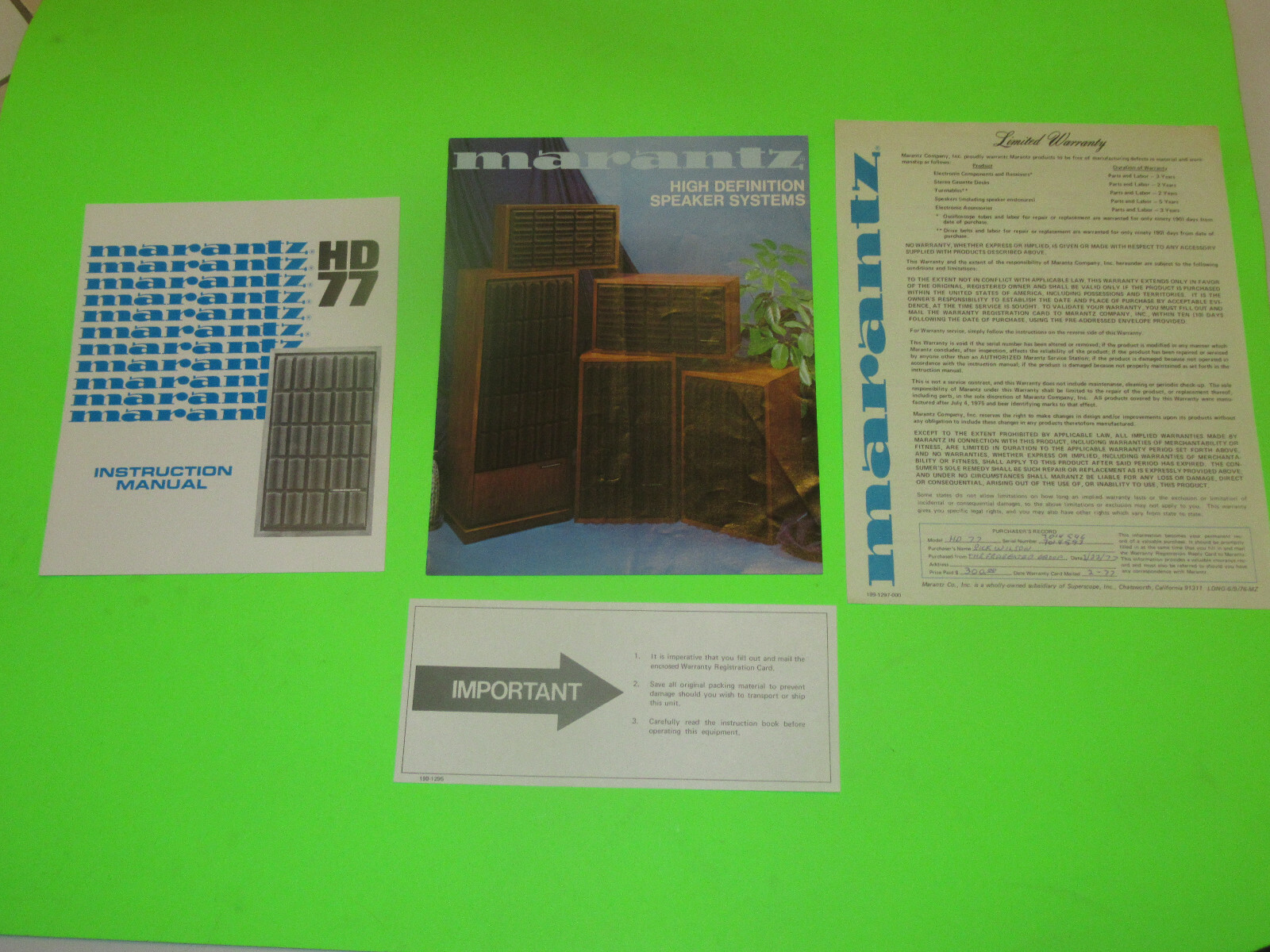
As an eBay Partner, we earn from qualifying purchases. This helps support our independent vintage technology research.
Related Models
- Marantz 1530L
- Marantz 3600 (1976-1977)
- Marantz 3800 (1976-1978)
- Marantz 4100 (1976-1978)
- Marantz 4430 (1972)
- Braun AUDIO-1 (1965)
- Braun AUDIO-250 (1965)
- Magnavox Component Systems (1972)
- Acoustic Research AR (1967-1976)
- Acoustic Research 11