Marantz 2440 (1975–1978)
A quiet powerhouse from the quadraphonic era that never quite got its due—this isn’t a full receiver, but a clever, compact amplifier built to bring surround sound to your living room without replacing your entire stack.
Overview
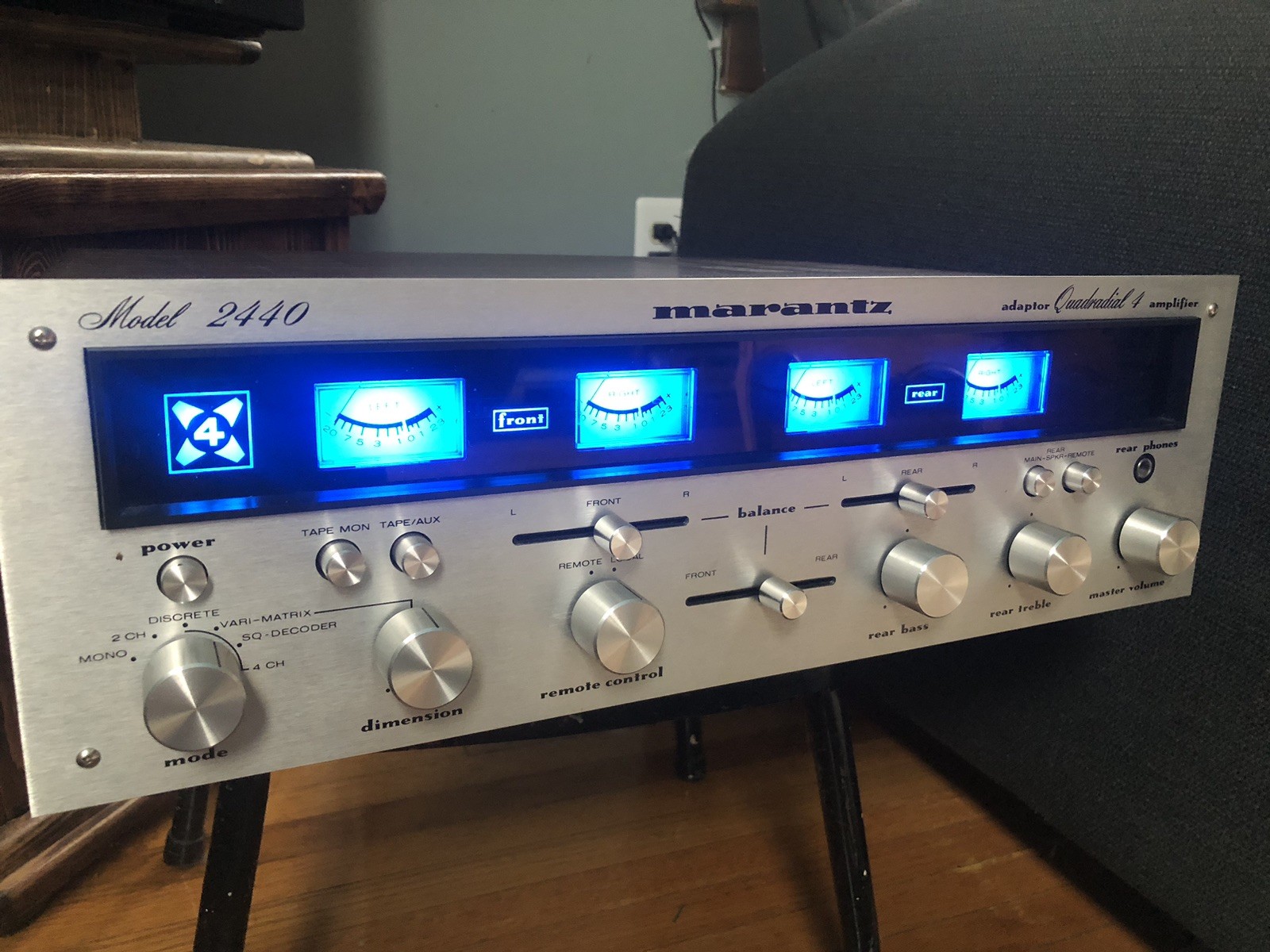
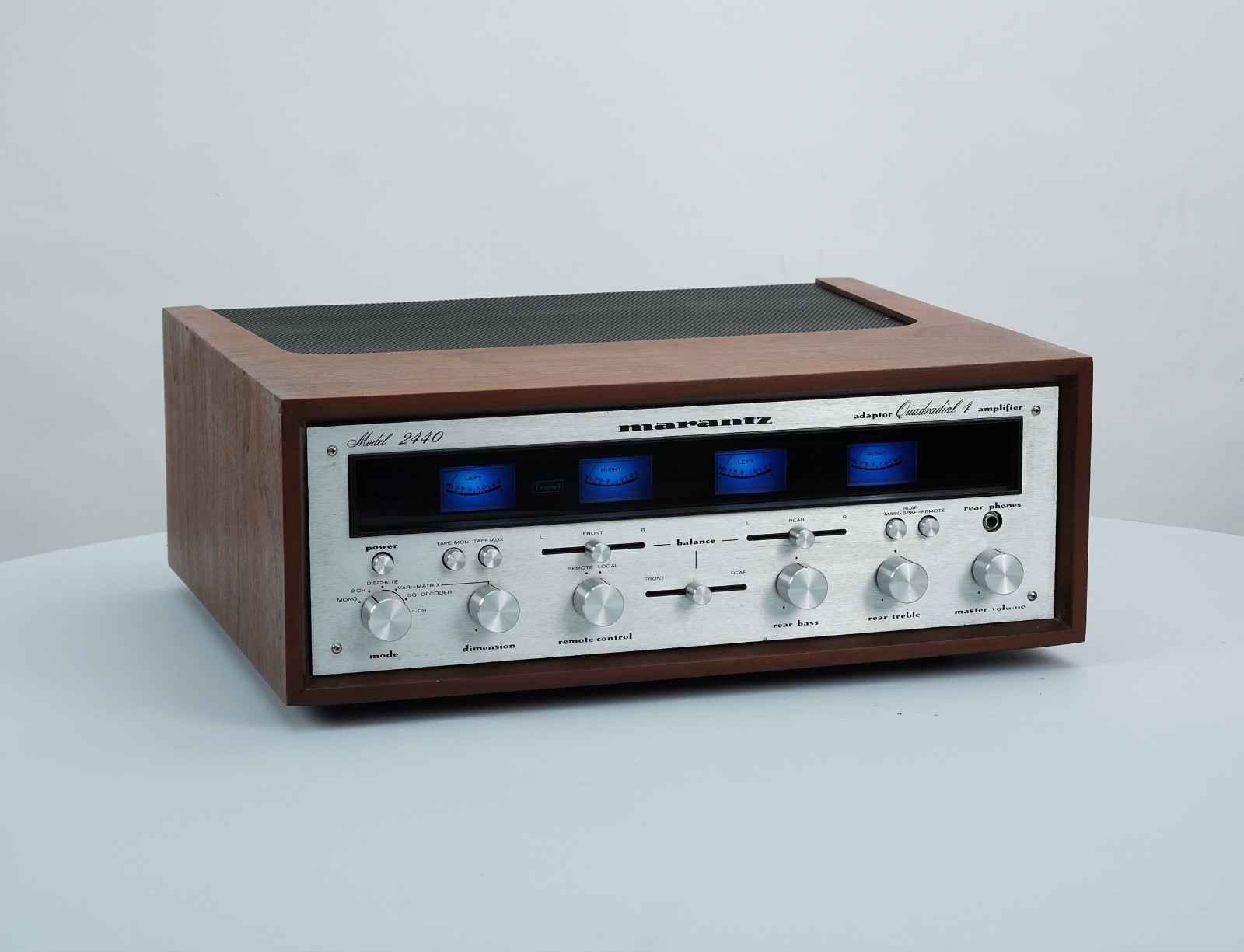
It doesn’t roar like a 2270 or command the rack like a 4400, but the Marantz 2440 has a quiet intelligence to it—a specialized tool from an experimental time when audiophiles were willing to wire up extra amplifiers just to hear drums come from behind the couch. This isn’t a stereo receiver in the traditional sense. It’s a rear-channel amplifier with a stereo power amp built in, designed to sit alongside your existing preamp or receiver and handle the back half of a quadraphonic setup. At first glance, it looks like a standard integrated unit, with Marantz’s clean 1970s faceplate, dual VU meters, and that warm, understated styling. But dig in, and you realize it’s more of a hybrid—a bridge between two-channel purity and four-channel ambition.
Originally priced around 1,450 DM in Germany when new, the 2440 was never a budget product. It carried Marantz’s reputation for build quality and sonic refinement, even if it didn’t have the raw power or feature set of their flagship models. Its 20 watts per channel into 8 ohms won’t drive inefficient speakers to concert levels, but it delivers that classic Marantz warmth—smooth highs, a slightly forward midrange, and bass that’s tight enough for the era. More than just an amp, it’s a decoder adaptor at heart, housing Marantz’s proprietary Vari-Matrix circuit that could extract four channels from matrix-encoded sources like SQ (Stereo Quadraphonic) or QS. If you picked up the optional SQA1 decoder module—slid neatly into a compartment beneath the front panel—it could decode Sansui’s QS system too. That flexibility made it a favorite among early adopters who wanted to future-proof their systems during the chaotic quad wars of the mid-70s.
But here’s the catch: the 2440 isn’t a standalone solution. It needs a stereo preamp or receiver to feed it signals. You can’t plug a turntable directly into it—there’s no phono stage. You can’t tune FM with it—no tuner section. It’s an amplifier with a very specific mission. And while that might sound limiting today, back then, it was a smart compromise. Instead of forcing people to buy an entirely new quad receiver (which often meant downgrading in sound quality), Marantz let you keep your beloved stereo amp and just add rear channels. That modular approach was ahead of its time, even if the quad format itself never stuck.
Specifications
| Manufacturer | Marantz |
| Production Years | 1975–1978 |
| Original Price | Approx. 1,450 DM (Germany, 1975) |
| Power Output | 20 watts per channel into 8Ω (stereo) |
| Frequency Response | 5 Hz – 45 kHz |
| Total Harmonic Distortion | 0.3% |
| Damping Factor | 45 |
| Inputs | 2 x Line Level (Front L/R), 2 x Line Level (Surround L/R) |
| Outputs | 4 x Speaker Terminals (Front L/R, Rear L/R) |
| Decoder Support | Vari-Matrix circuit (SQ matrix), Optional SQA1 module for QS decoding |
| Weight | 11 kg (24.25 lbs) |
| Dimensions | 482 x 127 x 356 mm (W x H x D) |
| Power Requirements | 120V AC (North America); requires step-down transformer for 230V regions |
| Features | Dual VU meters, Tape Monitor, Mute, Vari-Matrix circuit, Decoder compartment |
| Amplifier Type | Integrated rear-channel amplifier with stereo power amp |
| Impedance Matching | Compatible with 4–8Ω speakers |
| Signal-to-Noise Ratio | Not specified in available documentation |
| Channel Configuration | 4-channel (2 front, 2 rear) |
Key Features
The Vari-Matrix Brain
At the heart of the 2440 is Marantz’s Vari-Matrix circuit—a proprietary decoding system designed to extract four channels from matrix-encoded stereo recordings. Unlike discrete quad systems (which required four separate audio tracks), matrix systems like CBS’s SQ encoded rear-channel information into the stereo signal using phase shifts. The Vari-Matrix wasn’t the most accurate decoder on the market—dedicated units from Sansui or Dynaco could outperform it—but it was good enough for most listeners and far more convenient. It let the 2440 play everything: standard stereo records, mono tapes, and quad-encoded LPs, all without switching components. For someone who wanted a “set it and forget it” quad experience, that versatility was a big selling point.
Modular Decoder Slot
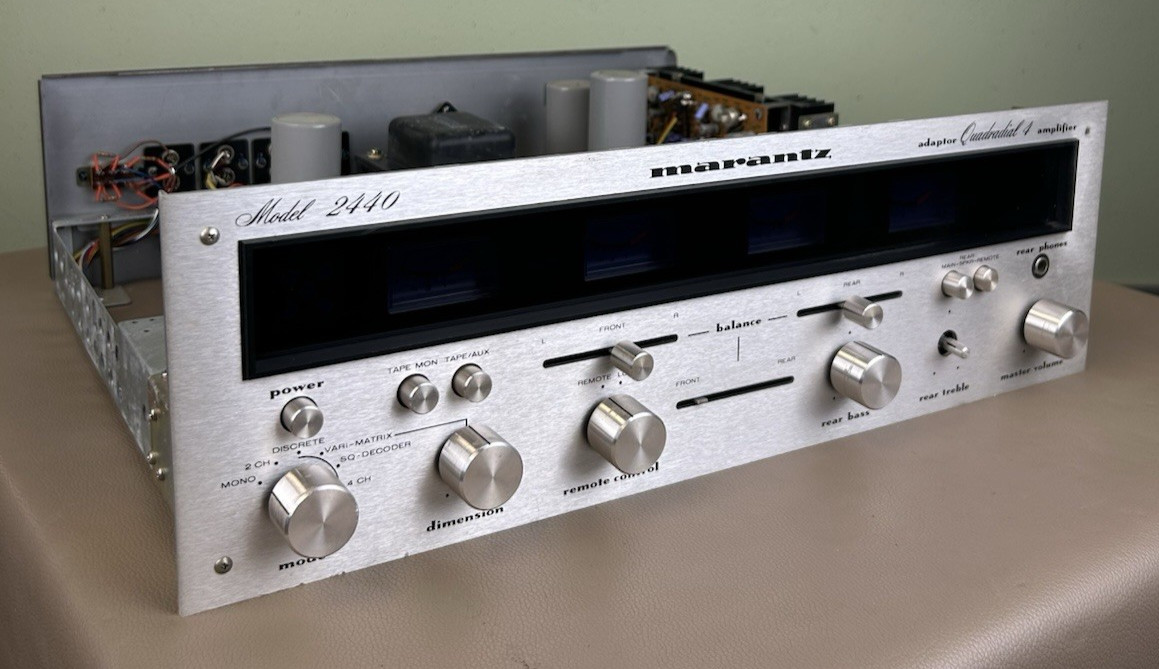
Beneath the front panel, hidden behind a small removable cover, is a slot for an optional decoder module. The most common was the SQA1, which added support for Sansui’s QS (Quadraphonic Sound) system. This modular design was clever—Marantz didn’t have to build two different models. Instead, buyers could upgrade later if they wanted broader compatibility. It also kept the base unit simpler and cheaper. But in practice, finding an SQA1 today is tough, and replacements are rare. Most 2440s in circulation only handle SQ decoding, which limits their usefulness unless you’re deep into vintage quad content.
Compact Powerhouse Design
Despite its specialized role, the 2440 doesn’t skimp on build. It uses a toroidal power transformer, solid-state circuitry, and Marantz’s signature attention to grounding and shielding. The dual VU meters aren’t just for show—they respond to front-channel output and give a satisfying visual pulse with the music. The chassis is heavy for its size, and the fit-and-finish matches other Marantz gear of the era. It lacks the phono inputs or tuner of a full receiver, but what it does have—clean amplification, flexible decoding, and solid construction—it does very well.
Historical Context
The mid-1970s were a wild time for home audio. Stereo was established, but the industry was chasing the next big thing: surround sound. Record labels were releasing quadraphonic LPs using competing matrix systems—CBS’s SQ, Sansui’s QS, and even discrete formats like CD-4. Receiver manufacturers scrambled to keep up, cramming decoders and extra amplifier channels into single boxes. But many of those all-in-one quad receivers sacrificed sound quality for convenience. Marantz took a different path. Instead of building a compromised receiver, they created the 2440 as a companion piece—a way to add quad capability without forcing audiophiles to abandon their high-fidelity stereo gear.
It was a smart strategy, but timing wasn’t on its side. By 1978, the quadraphonic fad was fading. Consumers were confused by the competing formats, record labels were pulling back, and the arrival of home video and multichannel film sound would eventually shift focus to 5.1. The 2440, along with other quad adaptors like the Yamaha QX-1 or Sansui QRX-1000, became relics of a short-lived experiment. Yet today, it’s gaining quiet appreciation among collectors who value its engineering and its role in audio history. It’s not just a curiosity—it’s a snapshot of a moment when the future of sound felt wide open.
Collectibility & Value
The Marantz 2440 isn’t a mainstream collector’s item like the 2270 or 4400, but it has a niche following. On the used market, prices range from $150 to $300, depending on condition and whether it includes the SQA1 decoder. Fully working units with both modules and original casing can fetch up to $780 in Europe, especially if sold by specialty vintage dealers. But most units on eBay go for under $250—reasonable for a Marantz with this level of build quality, though you’re paying partly for rarity.
Common failures include dried-up electrolytic capacitors, which can cause hum, channel imbalance, or complete amp failure. The power supply is particularly vulnerable, and recapping is often necessary for long-term reliability. The VU meter circuits can also degrade, leading to sluggish or non-responsive needles. Since the 2440 was designed for continuous operation in a quad setup, many surviving units have seen heavy use, so alignment and bias adjustments may be needed. Replacing the SQA1 module is nearly impossible today—few spares exist, and they’re prone to internal IC failure.
Before buying, test all four channels, check for DC offset at the speaker terminals, and verify that the VU meters respond evenly. Look for corrosion on the binding posts and ensure the tape monitor and mute functions work. If it powers on quietly with no hum, that’s a good sign—but don’t assume it’s stable without a proper service. A full restoration, including recapping and calibration, can cost $200–$300, so factor that into your purchase.
For modern use, the 2440 can still shine. Used as a stereo amplifier, it delivers that classic Marantz sound with modest power—fine for efficient speakers or background listening. As a dedicated rear-channel amp in a vintage quad setup, it’s one of the most authentic ways to experience 1970s surround. But if you’re not invested in quadraphonic media, its appeal is more historical than practical.
eBay Listings

As an eBay Partner, we earn from qualifying purchases. This helps support our independent vintage technology research.
Service Manuals & Schematics
- Service Manual — archive.org
Related Models
- Marantz 3600 (1976-1977)
- Marantz MODEL 112 (1971-1973)
- Marantz MODEL 115 (1975-1977)
- Marantz MODEL 260 (1976-1978)
- Marantz MODEL 28 (1971-1973)
- Akai AM-2850 (1975)
- Akai AP-206 (1975)
- Nakamichi BX-1 (1985)
- Acoustic Research research-ar-17 (1978)
- Acoustic Research AR-19 (1994)