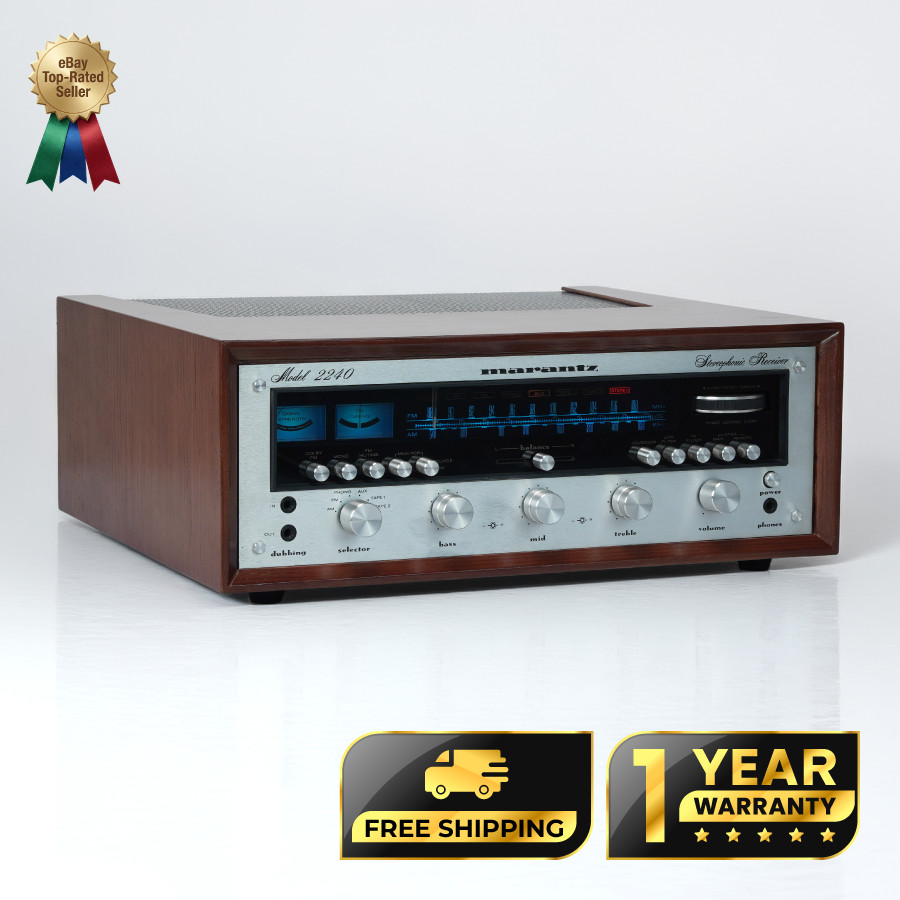
Marantz 2240 Stereo Receiver
The Marantz 2240 is an integrated stereo receiver built from 1974 to 1977. It belongs to the 22xx series. One chassis holds the amplifier, the phono preamp and an AM/FM tuner. The amplifier is discrete, the receiver has a dual power supply, and the cabinet is a walnut veneer. Collectors still go looking for it.
Key Features
- Discrete Amplifier Design: Utilizes discrete transistors instead of integrated circuits, contributing to its smooth and dynamic sound.
- Dual Power Supply: Separates power for analog and tuner sections to reduce noise and crosstalk.
- Phono Preamp: Built-in MM phono stage ideal for vinyl playback without external preamps.
- Tone and Loudness Controls: Independent bass, mid, and treble controls with a loudness contour switch for enhanced low-end at lower volumes.
- Preamp Out / Main In: Allows integration with external power amplifiers or signal processors for system expansion.
- Classic Aesthetic: Elegant walnut side panels and Marantz’s signature VU meters and analog tuning display.
Sound Signature
The 2240 has a warm, smooth sound. The midrange is detailed, which suits vocals and acoustic recordings. It is non-fatiguing, so long listening sessions stay easy. Many people call the discrete amplifier section "musical" and "analog," and it is a favorite with vinyl listeners.
Historical Context
The 2240 was part of Marantz’s 22xx series of integrated receivers, which were developed during the peak of the analog audio era. These models were engineered for superior build quality, sonic performance, and reliability. The 2240 stood out for combining high-end features like a dual power supply and discrete amplification in a consumer-friendly package. As one of the last generations of fully analog receivers before the digital revolution, the 2240 symbolizes the craftsmanship and audio purity that defined 1970s hi-fi design.
Maintenance and Tips
Like all vintage electronics, the Marantz 2240 benefits from regular maintenance to keep performing at its best:
- Cleaning Controls: Over time, potentiometers and switches can become noisy. Use contact cleaner (non-residue type) to clean volume, tone, and input controls.
- Capacitor Replacement: Aging electrolytic capacitors can degrade, affecting power supply stability and sound quality. Recapping the unit is often recommended, especially if it hasn’t been serviced in decades.
- Lamp Replacement: The tuning and power indicator lamps may fail. Replace with appropriate low-voltage bulbs (typically 12V).
- Relay Issues: Some units may develop intermittent relay problems. Inspect or replace relays if audio cuts out or channels drop.
- Bias Adjustment: After recapping or extended use, amplifier bias should be checked and adjusted by a qualified technician to ensure balanced output.
Collectibility and Market Value
The Marantz 2240 earns an 8/10 on the collectibility scale. Sound quality, build integrity and design keep demand steady. Units in original, unmodified condition with clean cosmetics and fully working operation command the highest prices.
- Market Value: $300–$600 USD, depending on condition, originality, and recent servicing.
- Restoration Potential: Well-restored units can approach the upper end of the price range, especially if upgraded with modern maintenance while retaining original components.
Conclusion
The Marantz 2240 is a benchmark of 1970s integrated receiver design. It has a lush sound and a comprehensive feature set. It suits a classic hi-fi setup, or it can be restored as a collector's item.
eBay Listings



As an eBay Partner, we earn from qualifying purchases. This helps support our independent vintage technology research.
Service Manuals & Schematics
- Service Manual — archive.org
Related Models
- Marantz 2226 (1974-1976)
- Marantz 2226B (1979-1980)
- Marantz 2235 (1974-1977)
- Marantz 2238B (1978-1980)
- Marantz 2250B (1978-1980)
- Marantz 2252 (1974-1977)
- Marantz 2252B (1978-1980)
- Marantz 2265 (1974-1977)
- Realistic STA-47 (1975–1976)
- Teac A-3300 (1972)