Magnavox TUNER-CHASSIS: A Forgotten Pillar of 1960s Hi-Fi Integration
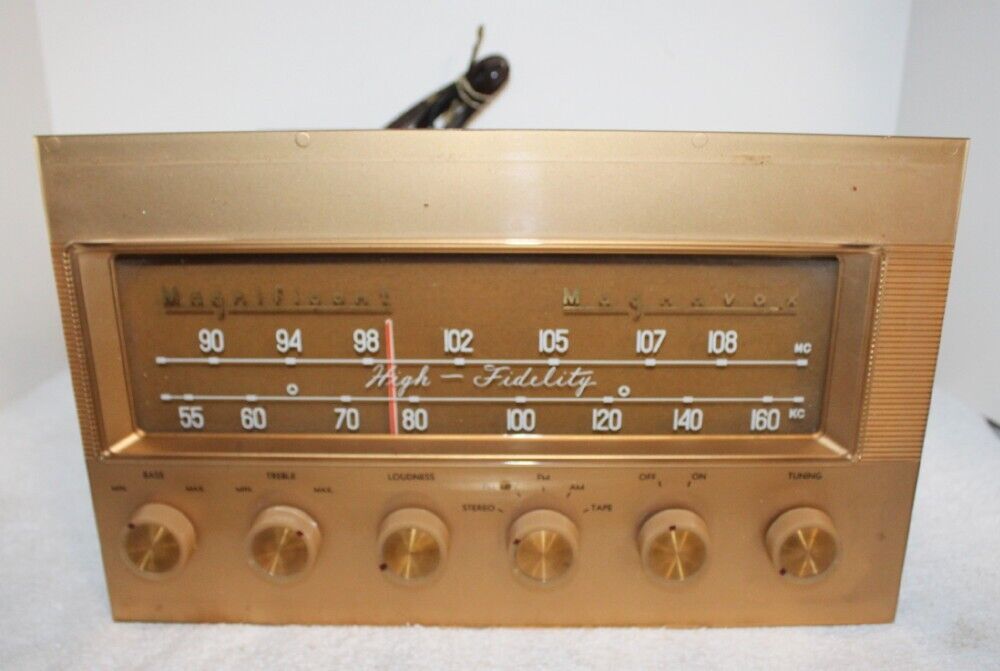
In the golden era of American hi-fi—roughly the late 1950s through the 1970s—manufacturers like Magnavox were not only producing complete audio systems but also pioneering modular design approaches that allowed for flexibility in home entertainment setups. Among these innovations was the Magnavox TUNER-CHASSIS, a standalone tuner module designed to be integrated into larger console systems or custom cabinetry. While not a consumer-facing product in the traditional sense, this chassis played a crucial role in Magnavox’s strategy to dominate the mid-tier hi-fi market with serviceable, reliable, and cost-effective components.
Unlike the flashy receivers or towering console stereos that bore the Magnavox name, the TUNER-CHASSIS was an industrial solution—a behind-the-scenes workhorse meant for OEM use or internal system integration. As such, it rarely carried a model number visible to end users and was often buried within larger furniture-style consoles. Yet, for vintage audio enthusiasts and restorers today, understanding and appreciating this modular component offers insight into how major American electronics companies engineered for scalability, serviceability, and mass production during the analog heyday.
Historical Context: Magnavox in the Hi-Fi Boom
Magnavox, originally founded in 1917 as a maker of military and communications equipment, transitioned into consumer electronics with a strong focus on radio and audio technology. By the 1960s, the brand was well-established in the American living room, known for its console stereos, tabletop radios, and later, color televisions. The company embraced modular construction during this period, allowing them to reuse proven circuits across multiple product lines.
The TUNER-CHASSIS emerged during this era of standardization. It was not sold individually at retail but rather used as a plug-in tuner module in various Magnavox console systems, particularly those from the mid-to-late 1960s. These chassis units typically featured AM/FM reception, a basic tuning dial with analog meter or pointer, and connections for integration with preamplifiers or audio output stages. Their design prioritized reliability, ease of servicing, and compatibility with Magnavox’s broader ecosystem of audio components.
Technical Specifications
While exact model variants of the TUNER-CHASSIS differ slightly depending on production year and host system, the following specifications represent a typical configuration found in Magnavox consoles from 1965–1970.
| Specification | Detail |
| Manufacturer | Magnavox |
| Model Designation | TUNER-CHASSIS (internal module) |
| Production Era | 1965–1972 |
| Tuner Type | AM/FM |
| Frequency Range (FM) | 88–108 MHz |
| Frequency Range (AM) | 530–1710 kHz |
| Tuning Method | Analog dial with calibrated scale and mechanical pointer |
| IF Frequencies | FM: 10.7 MHz, AM: 455 kHz |
| Output Level | ~0.5 mV (typical for tuner modules of the era) |
| Output Impedance | 600Ω (nominal) |
| Power Requirements | 120V AC, 60Hz (powered via host system) |
| Dimensions (approx.) | 12" x 4" x 2.5" (varies by variant) |
| Construction | Steel chassis with discrete transistorized circuitry (late models), earlier versions may use tubes |
| Connectivity | Screw terminals or plug-in connectors for audio output and power |
Note: Some early versions of the TUNER-CHASSIS (pre-1967) may incorporate vacuum tubes in the RF and IF stages, while later models transitioned to all-transistor design, reflecting the broader industry shift during the mid-1960s.
Sound Characteristics and Performance
As a tuner module rather than a standalone receiver, the TUNER-CHASSIS does not amplify sound but instead delivers a low-level audio signal to the host system’s preamp or amplifier. Its sonic character is therefore subtle but influential.
In well-maintained examples, the TUNER-CHASSIS delivers a warm, slightly rounded midrange typical of American-designed tuners of the period. FM reception is generally stable in areas with strong signals, though sensitivity and selectivity are modest by modern standards. The use of analog tuning with mechanical dial linkage provides a tactile experience—smooth but requiring careful calibration over time.
Stereo separation (in FM stereo-capable versions introduced post-1961) is adequate but not exceptional. The multiplex decoding circuitry in later models follows the standard FCC-compliant 1961 CCIR system, but phase coherence and channel balance can drift with age, especially if capacitors in the discriminator or stereo decoder section have degraded.
Notable Features and Design Philosophy
The brilliance of the TUNER-CHASSIS lies not in high performance but in its modularity and serviceability:
- Plug-and-Play Integration: Designed to slide into a chassis bay within a console, it connected via multi-pin plugs or terminal strips, simplifying factory assembly and field replacement.
- Field-Service Friendly: Technicians could remove the entire tuner unit without desoldering, making repairs or upgrades straightforward—a hallmark of American consumer electronics design in the 1960s.
- Consistent Performance Across Models: By using the same tuner module across multiple console lines, Magnavox ensured predictable performance and reduced parts inventory.
- Durable Construction: The steel chassis resists microphonics and provides shielding against RF interference, a common issue in crowded console environments.
Common Issues and Maintenance
Over time, several issues commonly affect surviving TUNER-CHASSIS units:
- Capacitor Degradation: Electrolytic and paper capacitors, especially in power supply and audio coupling roles, dry out or leak. This can cause hum, reduced output, or complete failure.
- Dial String Slack or Breakage: The mechanical tuning dial often uses a thin nylon or silk thread to link the tuning capacitor to the indicator. This can stretch or snap, requiring careful re-threading.
- Tuning Capacitor Dirt or Oxidation: The variable capacitor may develop scratchy tuning or tracking issues. Cleaning with contact cleaner (non-residue) and careful adjustment can restore function.
- Weak RF Stages: In transistorized models, early germanium transistors may fail or drift in performance, affecting sensitivity.
- Misalignment: IF and RF stages may require realignment using a signal generator and output meter—a task for experienced restorers.
Regular cleaning, capacitor replacement (recapping), and alignment are essential for restoring full functionality. Due to the lack of service manuals specific to the TUNER-CHASSIS, technicians often rely on schematic diagrams from comparable Magnavox console models.
Current Market Value and Collectibility
The Magnavox TUNER-CHASSIS is not a standalone collectible in the traditional sense. It rarely appears on the market independently and holds little value outside the context of a complete console restoration. That said, for vintage audio restorers and Magnavox enthusiasts, a working or fully recapped unit can be a rare and valuable find, especially when original replacements are unavailable.
- Market Value: $25–$75 when sold separately (often as part of a parts lot)
- Collectibility: Low as a standalone item; high utility for console restorers
- Rarity: Moderate—many were produced, but few survive outside of consoles
Its true worth lies in its ability to bring a vintage Magnavox console back to life, preserving both sound and historical authenticity.
Conclusion: A Workhorse of the Hi-Fi Era
The Magnavox TUNER-CHASSIS may not have the glamour of a Marantz receiver or the cult status of a McIntosh amplifier, but it represents an important chapter in American audio history. It embodies the industrial logic of modular design, mass production, and service-oriented engineering that defined mid-century consumer electronics.
For the vintage audio enthusiast, the TUNER-CHASSIS is more than just a circuit board in a metal tray—it’s a testament to an era when electronics were built to be repaired, reused, and integrated. While it may never headline a hi-fi show, it quietly powered countless living room stereos and helped bring FM radio into the American mainstream.
Today, as we restore these aging consoles, the TUNER-CHASSIS reminds us that sometimes, the most important components are the ones you never see—but can still hear.
eBay Listings

As an eBay Partner, we earn from qualifying purchases. This helps support our independent vintage technology research.
Related Models
- Aiwa CS-250 (1978)
- Denon TU-1500RD (1995)
- Denon TU-280 (1976)
- Denon TU-501 (1977)
- Denon TU-550 (1978)
- Denon TU-750S (1975)
- Luxman R-1030 (1979)
- Luxman R-1050 (1975)
- Luxman R-117 (1975)
- Denon TU-400 (1976)