Luxman R-406 (1985–1988)
When digital precision met analog soul in a receiver that refused to compromise
Overview
The Luxman R-406 isn’t just another receiver from the mid-80s—it’s a statement. Released between 1985 and 1988, this AM/FM stereo receiver blends the emerging precision of digital synthesis with Luxman’s long-standing commitment to high-fidelity audio. Priced at $600 when new, it targeted serious listeners who wanted more than just a box with knobs: they wanted performance, build quality, and a design that could anchor a full Luxman system. And for those who know, the R-406 delivered.
Unlike many receivers of its era that leaned into flashy styling or gimmicky features, the R-406 kept its cool. It was engineered to be robust, sonically transparent, and built to last. Reviewers noted it sounded “first-rate” with FM broadcasts, LPs, and even early CDs—no small feat in an age when digital audio was still finding its footing. It wasn’t delicate either; one reviewer put it plainly: “The Luxman R-406 is one receiver that does not have to be handled with kid gloves.” With enough power to drive inefficient speakers and still rattle windows with high-efficiency ones, it had the muscle to match its poise.
What sets the R-406 apart is its hybrid soul: a phase-locked-loop (PLL) digital-synthesis tuner paired with an amplifier section that uses Luxman’s proprietary duo-Beta circuit. This design applies different bias frequencies to high and low frequencies, aiming to optimize performance across the spectrum. It’s not just marketing fluff—owners report a smooth, almost tube-like presentation, especially through the phono stage, which is widely praised for its musicality. If you’re into vinyl, this thing can make your records sing.
And yes, it came with a wireless remote—the RC-406—so you could adjust volume or switch sources without leaving your seat. For 1985, that was borderline luxurious.
Specifications
| Manufacturer | Luxman |
| Model | R-406 |
| Product Type | Digital Synthesized AM/FM Stereo Receiver |
| Production Years | 1985–1988 |
| Original Price | $600 |
| Rated Power | 60 watts per channel into 8-ohm loads from 20 to 20,000 Hz with no more than 0.05 percent total harmonic distortion |
| Dynamic Power Ratings | 85, 120, and 132 watts into loads of 8, 4, and 2 ohms, respectively |
| 1,000-Hz Output Power at Clipping | 78 watts per channel into 8 ohms, 105 watts into 4 ohms, 100 watts into 2 ohms |
| Clipping Headroom (8 ohms) | 1.14 dB |
| Dynamic Headroom (8 ohms) | 4.15 dB |
| Distortion | typically measured between 0.01 and 0.02 percent at most audio frequencies and power outputs below clipping |
| A-Weighted Noise Levels | –78.5 dB (high-level inputs) and –77 dB (phono input), referred to 1 watt |
| Phono Input Impedance | 50,000 ohms in parallel with a very small capacitance (less than 10 picofarads) |
| RIAA Phono Equalization Accuracy | within ± 1 dB from 20 to 20,000 Hz |
| FM Mono-Usable Sensitivity | 13.5 dBf (2.6 μV) when retuned for minimum distortion |
| FM Noise Level | –82 dB in mono and –72 dB in stereo (improves to –77 dB at 85 dBf) |
| FM Distortion | 0.14 to 0.15 percent in both mono and stereo |
| FM Stereo Channel Separation | 40 to 45 dB from 130 to 15,000 Hz, falling to 23 dB at 30 Hz |
| FM Capture Ratio | 1.3 dB |
| FM AM Rejection | 66 dB |
| FM Selectivity | averaging 67 dB |
| AM Frequency Response | down 6 dB at 33 and 2,400 Hz |
| Tuner Section | AM/FM |
| Features | Loudness control, tape monitor, headphone jack |
| Dimensions | 17-3/4 inches wide, 13-1/2 inches deep, 4-1/2 inches high |
| Weight | about 17 pounds |
| Input Sensitivity | 2.5mV (MM), 150mV (line) |
| Signal to Noise Ratio | 86dB (MM), 98dB (line) |
| Remote Control | yes, RC-1 |
Key Features
Digital Synthesis Meets Analog Refinement
The R-406’s tuner uses a phase-locked-loop (PLL) digital-synthesis system, a significant step up from the analog tuners of the 70s. This meant precise, stable tuning without drift, and a digital frequency readout on the front panel—flanked by red LED indicators that glow with that warm, retro-tech charm. It wasn’t just about convenience; digital synthesis improved selectivity (averaging 67 dB) and capture ratio (1.3 dB), making it easier to lock onto weak or crowded stations. Still, it wasn’t perfect—some units exhibit tuning errors due to quartz-crystal oscillator tolerance, a known quirk in frequency-synthesis designs of the era.
The Duo-Beta Circuit: Luxman’s Secret Sauce
At the heart of the R-406’s amplifier section is the “famous duo-Beta circuit,” a design that applies different bias frequencies to high and low frequencies to optimize performance. The result? Lower distortion (typically 0.01–0.02%) and a smoother, more natural sound that some describe as “super smooth, almost tube-like.” It’s not just hype—this circuit helped the R-406 stand out in a market full of receivers that prioritized specs over soul.
Liquid-Cooled Output Transistors
Yes, liquid-cooled. The R-406 uses a liquid-filled heat exchanger to cool its output transistors—a rare and clever solution for managing thermal load in a compact chassis. It’s one of those engineering touches that says, “We’re not cutting corners.” Combined with 132 watts of dynamic power into 2 ohms, it gives the receiver the headroom (4.15 dB dynamic headroom into 8 ohms) to handle difficult speaker loads without breaking a sweat.
System Integration Done Right
Luxman designed the R-406 to be the centerpiece of a full system. It has three DIN sockets for connecting a Luxman cassette deck, turntable, and CD player—clean, proprietary connections that reduce clutter and maintain signal integrity. It also includes three switched AC outlets to power associated components, a headphone jack, tape monitor, and loudness control for low-volume listening. The included RC-406 wireless remote (also sold separately for $49 on eBay) lets you control volume, input, and tuner functions from the couch. And if you wanted even more convenience, there’s a jack for the optional RC-101 Remote Sensor.
Build and Aesthetics
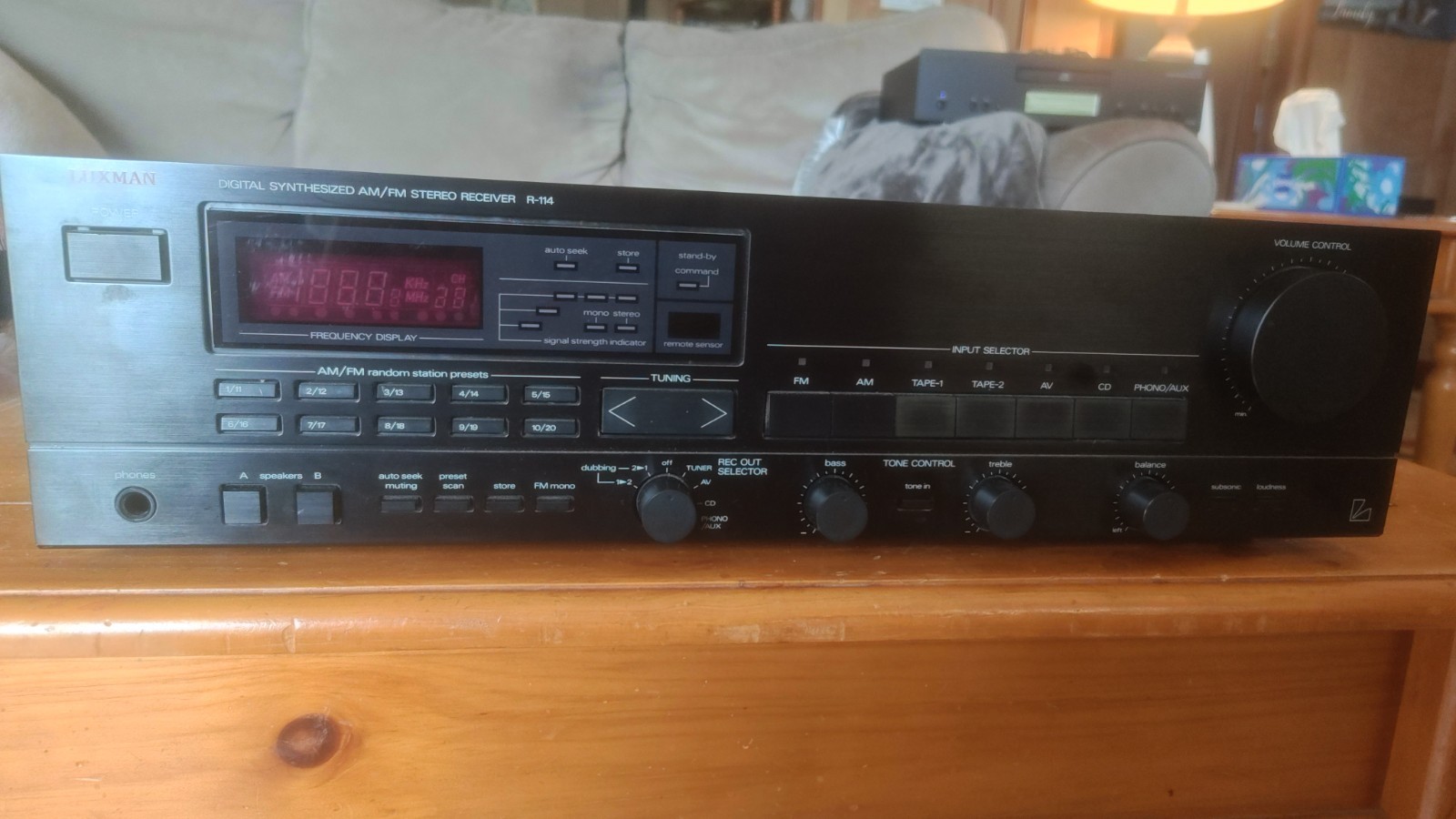
Available in a “champagner, matt gebürstet” finish (translated: brushed champagne), the R-406 has a low-profile, minimalist front panel that’s all business. The digital display is clear, the buttons are well-spaced, and the overall build feels solid—8.5 kg of Japanese engineering packed into a 17.75-inch-wide chassis. It doesn’t scream for attention, but it doesn’t need to. It’s the kind of receiver that looks better the longer you own it.
Collectibility & Value
The Luxman R-406 has quietly gained a following among vintage audio enthusiasts, especially those who appreciate its balanced performance and system-friendly design. It’s not as flashy as some Nakamichi or Sansui receivers, but it’s respected for its reliability and musicality.
Recent market prices vary: a unit in “excellent, custom teak” condition sold for $275 at Cherry Vintage Audio in early 2022, while another listed on HifiShark in 2025 asked CA$450. These fluctuations suggest the market is condition-dependent and not yet overheated—good news for buyers. Original accessories like the remote control (RC-406), owner’s manual, and even purchase receipts can add value, especially if the unit is fully functional.
But be cautious: common problems include a dead right channel—reported across both speaker outputs and the headphone jack—and issues with FM muting and autoseek functions. These are often fixable with servicing, but they’re frequent enough to warrant a thorough test before buying. A service manual (D-5067) is available on eBay for around $54, which helps DIY repairs.
If you’re restoring one, consider a full recapping and cleaning of the DIN connectors and potentiometers. The liquid cooling system is generally reliable, but any sign of leakage should be addressed immediately.
eBay Listings


As an eBay Partner, we earn from qualifying purchases. This helps support our independent vintage technology research.
Related Models
- Luxman R-1030 (1979)
- Luxman R-1050 (1975)
- Luxman R-117 (1975)
- Luxman R-104 (1975)
- Luxman R-105 (1975)
- Aiwa CS-250 (1978)
- Denon TU-1500RD (1995)
- Denon TU-280 (1976)
- Denon TU-501 (1977)
- Denon TU-550 (1978)