Luxman R-114 (1987–1990)
One of the best-sounding receivers ever owned—warm, full, and effortlessly capable, even if the knobs lack index marks.
Overview
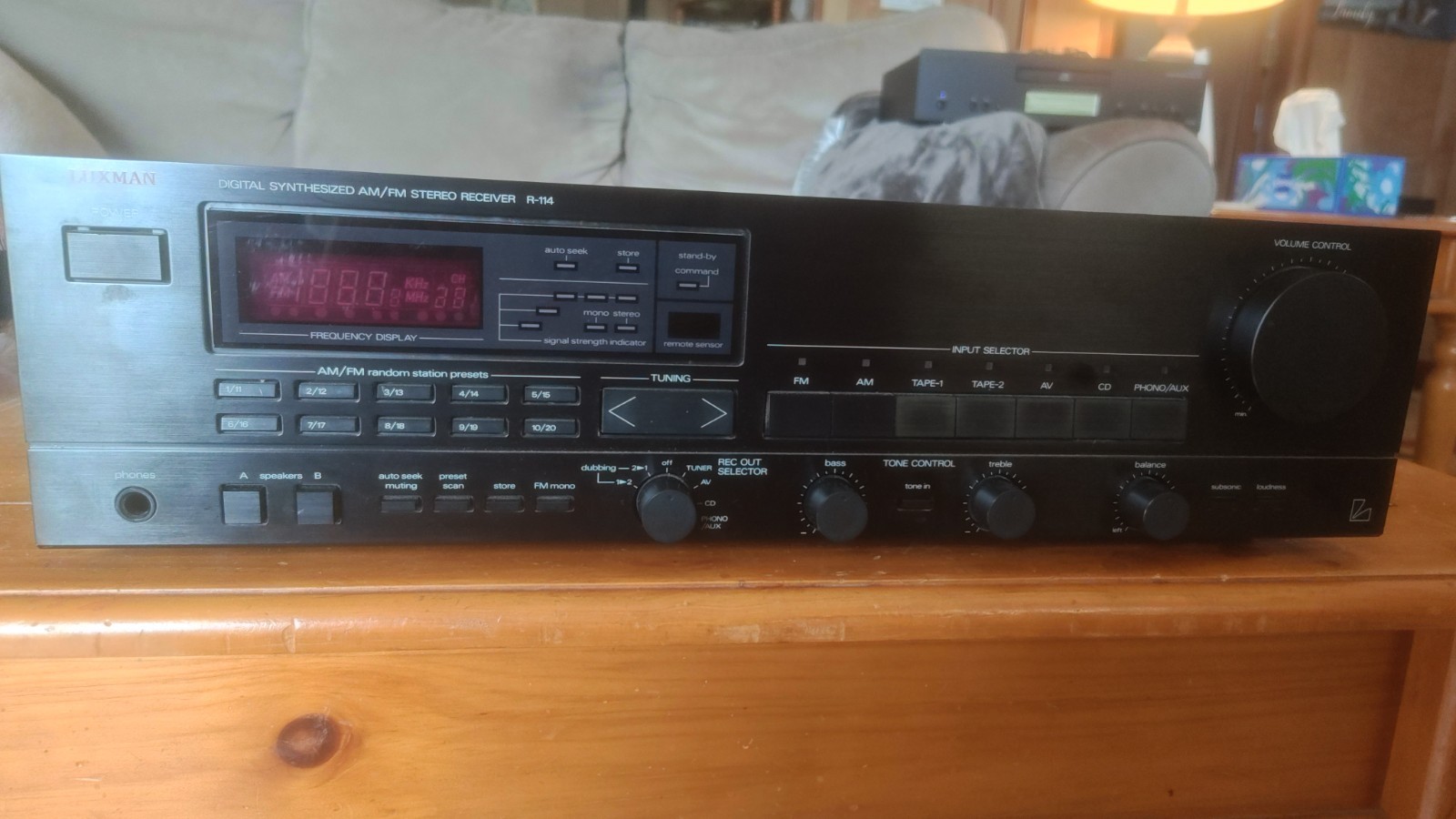
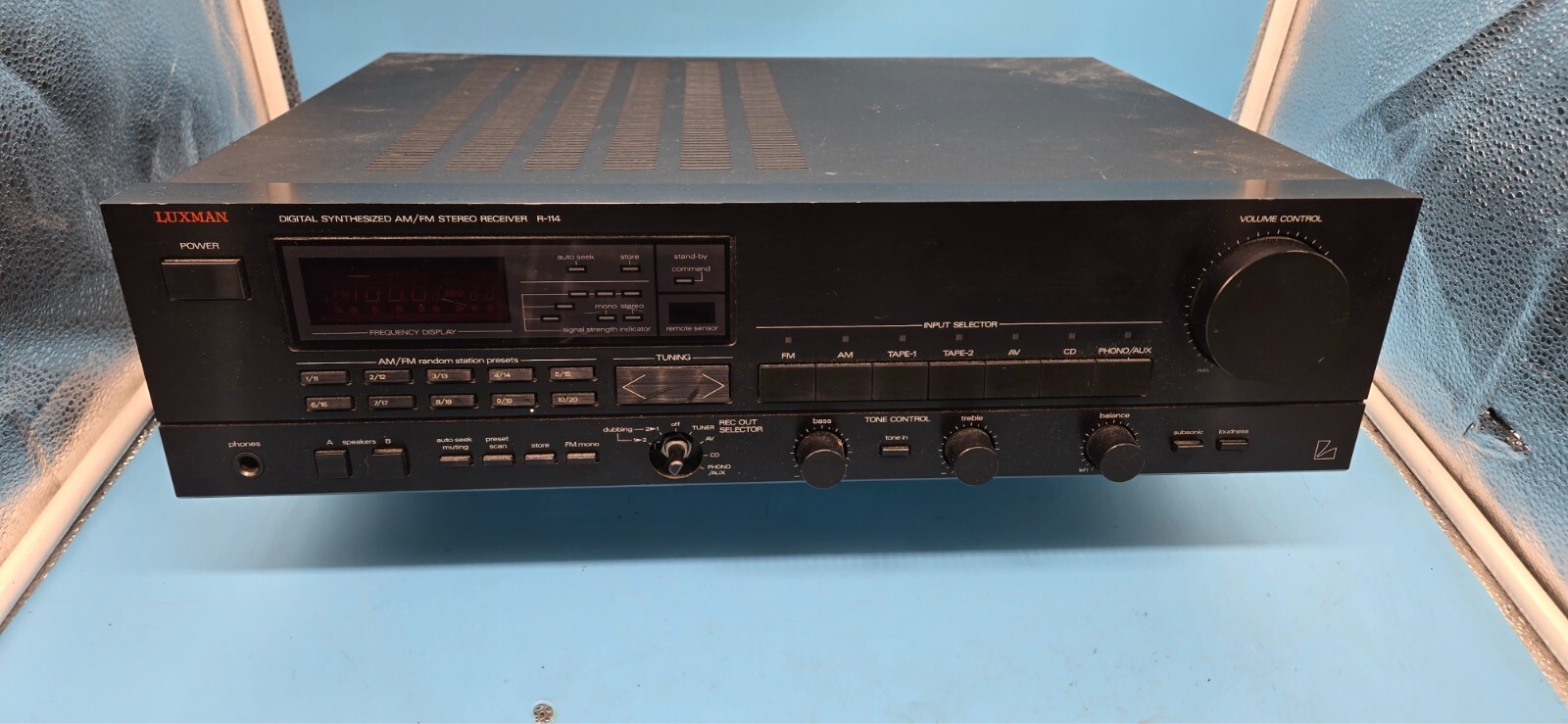
The Luxman R-114 isn’t flashy, but it doesn’t need to be. This digital-synthesized AM/FM stereo receiver, built in 1987 and introduced around 1990, delivers a listening experience that punches far above its original $550 price tag. It’s the kind of component that makes you forget you’re using a receiver at all—no histrionics, no glare, just music served with clarity and soul. Owners report it as one of the best-sounding receivers they’ve ever owned, comparing it favorably to much more expensive separates. And while it may not have the wattage wars pedigree of some contemporaries, its 50 watts per channel into 8 ohms are more than enough for most rooms, especially when you consider how clean and composed it stays under load.
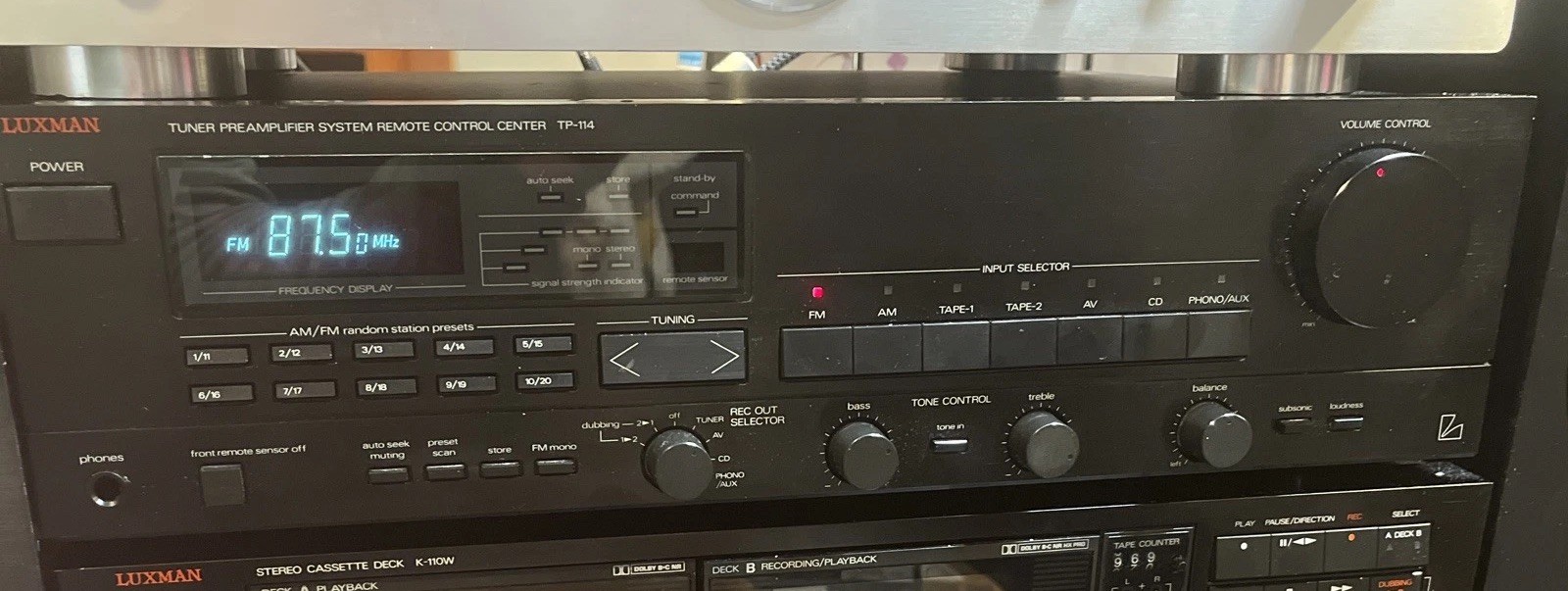
Part of a well-regarded line that includes the R-113, R-115, and R-117, the R-114 was positioned as Luxman’s newest receiver at the time—sleek in its simplicity, yet fully featured. Its front panel is clean and uncluttered, with a minimalist layout that hides a surprising depth of functionality. Everything you need is there: phono (MM), aux, tape, two tape deck loops, and even inputs for AV and CD sources. The remote control wasn’t an afterthought—it was included, infrared, and capable of operating compatible Luxman CD players, record changers, or tape decks via a multiroom system or cable. That kind of integration was thoughtful, not tacked on.
And then there’s the sound. Described as “nice warm, full sound” by those who’ve lived with its siblings, the R-114 carries that same Luxman magic—smooth highs, a present but never aggressive midrange, and bass that’s tight without being lean. It doesn’t shout; it communicates. Whether you’re spinning vinyl or tuning into a local FM station, the presentation feels natural, almost analog in its ease, despite the digital synthesis under the hood.
Specifications
| Manufacturer | Luxman |
| Model | R-114 |
| Product type | Digital synthesized AM/FM Stereo Receiver |
| Amplifier power output | 50 watts per channel into 8 ohms |
| Dynamic power ratings | 70 watts into 8 ohms, 100 watts into 4 ohms, 130 watts into 2 ohms |
| Total harmonic distortion | 0.05% |
| Tuner type | Digital-synthesis AM/FM tuner with twenty preset channels |
| Inputs | Phono (MM), Aux, Tape, plus recording/playback connections for two tape decks and inputs for two high-level sources (AV, CD) |
| Speaker outputs | Two pairs |
| Remote control | Supplied infrared remote control |
| Dimensions | 438 x 144 x 351 mm (17-1/4" x 4-3/4" x 13-13/16") |
| Weight | 9.5 kg (20.9 lbs) |
| Power Supply | 110 - 120, 220 - 240 V 50/60 Hz |
Key Features
Digital Synthesis Tuner with Smart Presets
The R-114’s tuner isn’t just another FM/AM section tacked onto a receiver—it’s a digital-synthesis design with twenty preset channels, selected via ten buttons that store two frequencies each (AM or FM). That means you can lock in your favorite stations with precision, no more drifting or hunting. It’s a feature that feels modern even by late-’80s standards, and it reflects Luxman’s commitment to usability without sacrificing performance.
Integrated Multiroom & System Control
On the back, a dedicated rear apron includes connectors for multiroom installation with other Luxman components—a thoughtful touch for those building out a whole-house system. The included infrared remote doesn’t just control volume or source selection; it can operate compatible Luxman CD players, record changers, or tape decks, either through the multiroom system or via cabling. This level of ecosystem thinking was rare in receivers, especially at this price point.
Flexible Connectivity
The R-114 doesn’t make you choose between vintage and modern sources. It offers a full phono (MM) input with proper RIAA equalization, two tape loops for dubbing or monitoring, and dedicated inputs for AV and CD—essentially covering every analog source you’d want in 1990. The inclusion of main-in and pre-outs adds another layer of versatility, letting you bypass the preamp stage or integrate it into a larger system.
Built Like a Luxman
The speaker outputs use insulated binding posts that accept dual banana plugs—solid, secure, and corrosion-resistant. The chassis feels dense and well-damped, and the overall build quality speaks to Luxman’s reputation for durability. One quirk: most knobs lack visible index marks, which can make precise adjustments in the dark a bit of a guesswork affair. But that’s a minor trade-off for the clean, uncluttered aesthetic.
Circuit Design: R-115 DNA
According to user reports, the R-114 shares the same circuit designs found in the more advanced R-115. That’s significant. It suggests Luxman didn’t just re-badge or down-spec for this model—they brought serious engineering to a receiver format often dismissed as compromised. The result is a unit that performs like a scaled-down integrated amplifier, not a cost-cut receiver.
Historical Context
The R-114 emerged during the Alpine-owned era of Luxman—a period some purists eyed skeptically, fearing a dilution of the brand’s high-end ethos. But as users note, Luxman still produced excellent-sounding gear during this time. The R-114, R-113, R-115, and R-117 line was seen as a sweet spot: well-engineered, sonically rich, and priced for accessibility. At its introduction, the R-114 was billed as Luxman’s newest receiver, a compact but complete solution for audiophiles who wanted quality without complexity.
Collectibility & Value
While exact current market prices for the R-114 aren’t documented, context from the era helps. The R-115 can be found on eBay for $150 to $200, while the R-117 commands $600 to $1,000. Given that the R-114 shares design elements with the R-115 and is part of the same well-liked family, it likely sits in or near that $150–$200 range when functional and clean. More importantly, users report never having had problems with the lower-numbered models like the R-113, R-114, or R-115—unlike the R-117, which some describe as a “maintenance hog.” That reliability, combined with its reputation for superb sound, makes the R-114 a smart pick for vintage buyers who want performance without constant servicing. Service manuals are available for purchase or download, which helps with long-term ownership.
eBay Listings

As an eBay Partner, we earn from qualifying purchases. This helps support our independent vintage technology research.
Related Models
- Luxman R-1030 (1979)
- Luxman R-1050 (1975)
- Luxman R-117 (1975)
- Luxman R-104 (1975)
- Luxman R-105 (1975)
- Aiwa CS-250 (1978)
- Denon TU-1500RD (1995)
- Denon TU-280 (1976)
- Denon TU-501 (1977)
- Denon TU-550 (1978)