Luxman R-1120A: The Pinnacle of Analog Tuning Excellence
In the golden age of high-fidelity audio during the 1970s, Japanese manufacturers like Luxman set new standards for precision, craftsmanship, and sonic refinement. Among their most revered offerings was the Luxman R-1120A, a high-performance FM/AM tuner that exemplified the brand’s unwavering commitment to analog purity and engineering excellence. Released in 1975, the R-1120A stands as a landmark in tuner design—a device crafted not just for functionality, but as a true instrument of musical discovery.
At a time when radio was still a primary source of music and news, Luxman recognized that the tuner deserved the same attention to detail as amplifiers and preamplifiers. The R-1120A was not merely an accessory; it was a core component of a serious audiophile system. With its elegant design, advanced circuitry, and meticulous construction, the R-1120A remains a sought-after classic for collectors and analog enthusiasts who appreciate the warmth, clarity, and presence of FM broadcasts in their purest form.
Technical Specifications
The Luxman R-1120A was engineered with precision components and a signal path optimized for minimal interference and maximum fidelity. While it lacks the power output of amplifiers, its specifications reflect a focus on sensitivity, selectivity, and stability—critical factors in tuner performance.
| Specification | Detail |
| Model | R-1120A |
| Year of Release | 1975 |
| Tuner Type | Analog FM/AM |
| Frequency Range (FM) | 87.5–108 MHz |
| Frequency Range (AM) | 522–1620 kHz |
| Tuning Method | Analog dial with mechanical counter |
| IF Frequency (FM) | 10.7 MHz |
| IF Frequency (AM) | 450 kHz |
| Sensitivity (FM) | 1.8 µV for 26 dB SNR |
| Selectivity (FM) | ±400 kHz: 60 dB |
| Signal-to-Noise Ratio | 70 dB (typical) |
| Harmonic Distortion | <0.5% (1 kHz) |
| Output Level (FM) | 150 mV (100% modulation) |
| Output Impedance | 10 kΩ |
| Input for Accessories | Antenna, External FM Discriminator |
| Power Supply | AC 100V / 50-60 Hz |
| Power Consumption | 25 watts |
| Dimensions (W×H×D) | 430 × 140 × 332 mm |
| Weight | 10.5 kg |
| Finish | Black or silver faceplate with brushed aluminum |
The R-1120A features a dual-gate MOSFET front-end for improved RF amplification and reduced noise—a cutting-edge choice at the time. Its six-tube IF amplifier stage (using discrete transistors in a quasi-tube configuration) ensures smooth filtering and excellent image rejection. The mechanical tuning dial, complete with a precise digital-style mechanical counter, allows for accurate station selection—a rarity in an era before digital synthesis.
Sound Characteristics and Performance
The Luxman R-1120A delivers a listening experience that many modern digital tuners fail to match. Its analog signal path preserves the natural dynamics and spatial qualities of FM broadcasts, rendering music with remarkable warmth, depth, and realism. Classical stations, jazz broadcasts, and live radio concerts benefit from the tuner’s ability to resolve subtle nuances in timbre and ambience.
Unlike today’s compressed digital streams, analog FM—when received well—offers a wide frequency response (up to 15 kHz) and true stereo separation. The R-1120A maximizes this potential with low phase distortion and excellent channel balance, resulting in a stable, three-dimensional soundstage. Its AM performance is equally impressive, with strong rejection of adjacent-channel interference and a rich midrange that brings voice and vintage radio programming to life.
Many users report that the R-1120A imparts a “musical” character to broadcasts—neither overly bright nor dull, but balanced and engaging. This is due in part to Luxman’s use of high-quality capacitors, custom-wound transformers, and a rigid, non-resonant chassis that minimizes microphonic effects.
Notable Features and Innovations
The R-1120A was packed with features that set it apart from contemporaries:
- Mechanical Digital Counter: A rare and sophisticated feature for 1975, this counter provides precise frequency readout without the jitter or stepping of early digital systems.
- High-Gain RF Amplifier: Ensures strong reception even with modest antennas, ideal for urban or fringe-area listeners.
- Quasi-Passive IF Filtering: Uses passive LC filters buffered by active stages to maintain signal integrity while achieving sharp selectivity.
- Stereo Pilot Noise Rejection Circuit: Reduces the high-frequency hiss often associated with weak FM signals.
- External Discriminator Input: Allows integration with external demodulators or test equipment—appealing to engineers and tinkerers.
- Heavy-Duty Chassis and Damping: The 10.5 kg weight isn’t for show; it reflects a rigid, vibration-resistant construction that enhances stability.
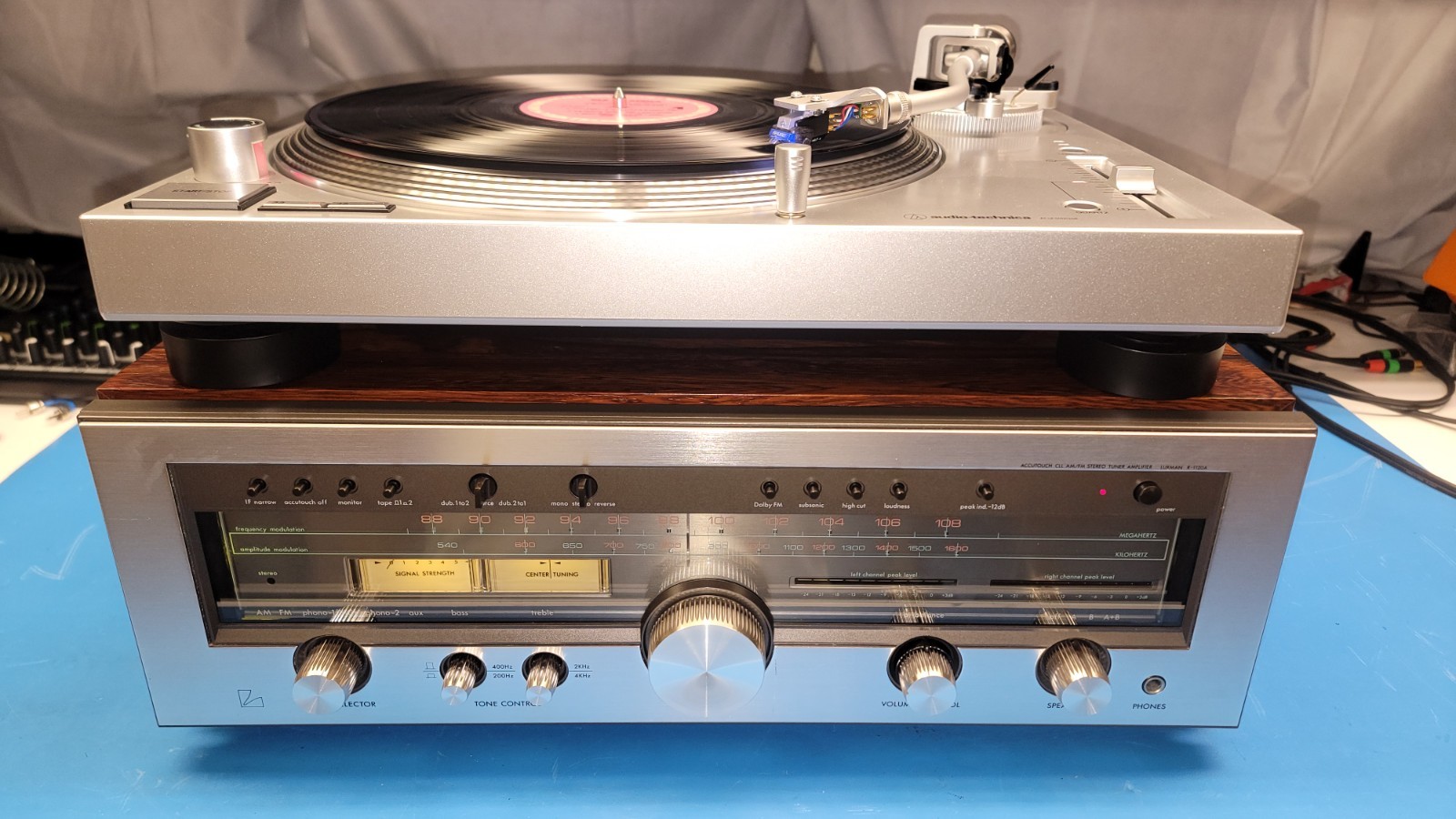
Luxman also paid close attention to aesthetics. The R-1120A features a clean, minimalist front panel with a large tuning dial, illuminated VU-style stereo indicator, and smooth-acting knobs. The fit and finish are exceptional—typical of Luxman’s reputation for building “audio jewelry.”
Common Issues and Maintenance
As with any 50-year-old electronic device, the Luxman R-1120A requires careful evaluation and potential servicing. Common issues include:
- Dried-up Electrolytic Capacitors: The power supply and audio coupling capacitors may need replacement to restore performance and prevent damage.
- Tuning Dial Stiffness: The mechanical counter and tuning shaft can become sticky due to old lubricants; a professional cleaning is recommended.
- Antenna Terminal Corrosion: Especially in coastal areas, terminals may oxidize—cleaning with contact spray helps.
- Worn Potentiometers: The balance and volume controls (if used in integrated systems) may develop noise, though the R-1120A is primarily a line-level output device.
Finding a fully functional, unmodified unit is key. Avoid models with replaced knobs or non-original modifications. When serviced by a qualified technician familiar with vintage Japanese gear, the R-1120A can perform reliably for decades more.
Current Market Value and Collectibility
The Luxman R-1120A has grown in stature among vintage audio collectors. While not as widely known as Luxman’s amplifiers (like the C-05 or M-60), it is highly respected in niche circles. Well-maintained, original units typically sell for $800–$1,500 USD, depending on condition, finish, and provenance.
Factors that increase value:
- Original packaging and manuals
- Silver finish (rarer than black)
- Verified low hours and clean service history
- Complete with original antenna or accessories
Its collectibility is driven by Luxman’s reputation for quality, the tuner’s historical significance, and the resurgence of interest in analog radio and vintage signal sources. As modern broadcasting shifts to digital, the R-1120A represents a vanishing art—the mastery of analog RF design.
Conclusion and Legacy
The Luxman R-1120A is more than a tuner—it’s a testament to an era when every component in a hi-fi system was built to last and designed to inspire. In an age of streaming and satellite radio, it reminds us of the joy of discovering music through the airwaves, with all the warmth and imperfection that analog brings.
For the vintage audio enthusiast, restoring an R-1120A is not just about functionality; it’s about preserving a piece of audio history. Paired with a classic Luxman amplifier and high-efficiency speakers, it completes a system that delivers a listening experience both nostalgic and timeless.
If you’re lucky enough to find one in good condition, consider it a rare treasure. The Luxman R-1120A isn’t just a tuner—it’s a portal to the golden age of radio, built with the soul of a master craftsman.
eBay Listings


As an eBay Partner, we earn from qualifying purchases. This helps support our independent vintage technology research.
Related Models
- Luxman R-1030 (1979)
- Luxman R-1050 (1975)
- Luxman R-117 (1975)
- Luxman R-104 (1975)
- Luxman R-105 (1975)
- Aiwa CS-250 (1978)
- Denon TU-1500RD (1995)
- Denon TU-280 (1976)
- Denon TU-501 (1977)
- Denon TU-550 (1978)