Harman Kardon Citation Tuners (1957)
The Harman Kardon Citation Tuners represent a landmark achievement in the history of high-fidelity audio equipment. Introduced in 1957, these tuners were among the first products released under the Harman Kardon brand and helped establish the company as a leader in precision audio engineering. Designed during a time when FM broadcasting was gaining popularity in the United States, the Citation Tuners brought exceptional reception clarity, advanced circuitry, and elegant design to audiophiles and music lovers.
Historical Context and Development
Harman Kardon was founded in 1953 by Dr. Sidney Harman and Bernard Kardon, both engineers with a passion for high-quality sound reproduction. Their goal was to create audio equipment that combined technical excellence with accessible design. The Citation series, launched in the mid-to-late 1950s, was their flagship line, intended to deliver reference-grade performance. The Citation Tuners were among the earliest offerings in this prestigious series.
At the time, most home audio systems relied on AM radio or phonograph players. FM radio, though technically superior in fidelity, was still emerging. Harman Kardon recognized the potential of FM and developed the Citation Tuners to exploit its full sonic capabilities. These tuners were engineered to provide stable reception, low distortion, and high selectivity—critical factors for clear FM listening.
Design and Engineering
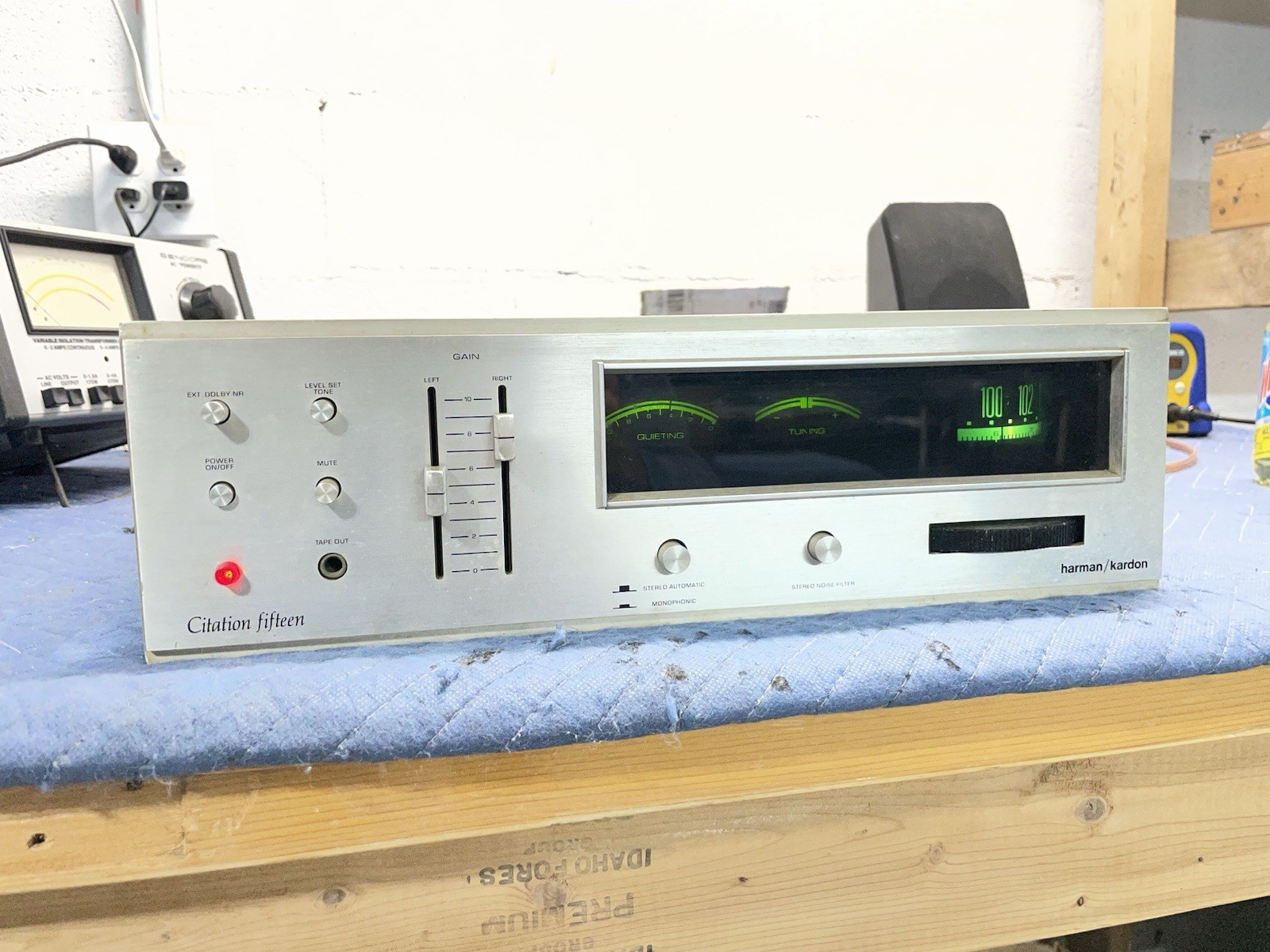
The Citation Tuners were housed in sleek, minimalist cabinets crafted from high-quality wood and metal, reflecting the mid-century modern aesthetic. The front panel featured a large analog dial with a polished chrome bezel, calibrated for precise tuning across the FM band (88–108 MHz). The dial was backlit for visibility in low-light environments, a rare and luxurious feature at the time.
Internally, the tuners employed a superheterodyne receiver design with multiple RF and IF stages to ensure excellent sensitivity and image rejection. They used high-quality vacuum tubes, including dual-triode and pentode configurations, which contributed to their warm, natural sound. The power supply was robust, minimizing hum and ensuring stable operation.
One of the standout features of the Citation Tuners was their use of a phase-locked loop (PLL) tuning system in later models, although early versions relied on mechanical tuning with a vernier dial for fine adjustments. This allowed users to lock onto weak stations with minimal drift. The IF bandwidth was adjustable, enabling listeners to optimize reception based on signal strength and interference.
Performance Specifications
While detailed specifications for every variant of the Citation Tuners are scarce due to their age, surviving units and historical documentation reveal the following key specs:
- Frequency Range: 88–108 MHz (FM broadcast band)
- Tuning Method: Manual analog dial with vernier control
- Sensitivity: Approximately 2 µV for 20 dB quieting
- Selectivity: Better than 60 dB at ±200 kHz spacing
- Signal-to-Noise Ratio: Over 60 dB (A-weighted)
- Harmonic Distortion: Less than 1% at full output
- Audio Output: 1 V RMS (line level)
- Impedance: 600 ohms balanced output (also unbalanced via transformer)
- Tubes Used: 6BA6, 6BE6, 12AT7, 12AV6, 5Y3GT (typical complement)
- Power Requirements: 115 V AC, 60 Hz, approximately 60 watts
The tuners were designed to integrate seamlessly with other components in the Citation series, including the Citation I amplifier and Citation I speaker system. They featured both balanced and unbalanced audio outputs, making them compatible with professional and consumer-grade equipment.
Variants and Evolution
Over time, Harman Kardon released several versions of the Citation Tuner, including the Citation II and Citation III models. These later iterations improved upon the original design with enhanced shielding, better filtering, and refined tuning mechanisms. Some models included a signal strength meter and stereo multiplex decoding capability as FM stereo broadcasting became standardized in the 1960s.
The Citation Tuners were also notable for being among the first consumer tuners to support high-fidelity bandwidths beyond the standard broadcast limits, allowing audiophiles to receive experimental and non-commercial stations with extended audio range.
Legacy and Influence
The Harman Kardon Citation Tuners played a crucial role in defining the high-end audio market. They demonstrated that consumer electronics could deliver performance rivaling professional broadcast equipment. Their success helped solidify Harman Kardon’s reputation for innovation and quality, paving the way for future classics like the HK 330 amplifier and the Citation 24 speakers.
Collectors and vintage audio enthusiasts highly prize surviving Citation Tuners today. Fully functional units in good condition can command high prices at auctions and specialty markets. Their combination of historical significance, elegant design, and sonic performance makes them a centerpiece in any vintage audio collection.
Restoration and Modern Use
Restoring a Citation Tuner requires careful attention to aging components. Over time, capacitors dry out, tube filaments degrade, and connectors oxidize. A proper restoration typically includes replacing electrolytic capacitors, cleaning tube sockets and controls, and recalibrating the tuning circuitry. Due to the use of vacuum tubes, these tuners generate noticeable heat and require adequate ventilation during operation.
Despite their age, Citation Tuners can still outperform many modern budget FM receivers in terms of sound quality and build. When paired with a high-quality amplifier and speakers, they deliver a rich, analog listening experience that many find preferable to digital tuners.
Conclusion
The Harman Kardon Citation Tuners are more than just vintage radio receivers—they are milestones in audio engineering. As one of the first high-fidelity FM tuners available to the public, they set new standards for clarity, design, and performance. Their introduction in 1957 marked the beginning of a golden era in home audio, and their legacy continues to influence high-end audio design today. For collectors and audiophiles alike, the Citation Tuners remain a symbol of innovation, craftsmanship, and the enduring pursuit of perfect sound.
eBay Listings



As an eBay Partner, we earn from qualifying purchases. This helps support our independent vintage technology research.
Related Models
- Harman Kardon kardon-multiplex-adapters (1975)
- Aiwa CS-250 (1978)
- Denon TU-1500RD (1995)
- Denon TU-280 (1976)
- Denon TU-501 (1977)
- Denon TU-550 (1978)
- Denon TU-750S (1975)
- Luxman R-1030 (1979)
- Luxman R-1050 (1975)
- Luxman R-117 (1975)