Denon TU-850: A Vintage FM Tuner from Denon’s Golden Era
In the early 1980s, Japanese audio manufacturers were at the peak of their analog engineering prowess, producing components that balanced technical precision with warm, musical sound. Among these, Denon—long respected for its professional recording equipment and high-end consumer electronics—released the TU-850, a stereo FM tuner that exemplified the company’s commitment to audio fidelity and build quality. Though not as widely discussed as some of its contemporaries from Pioneer or Sony, the Denon TU-850 remains a sleeper hit among vintage audio enthusiasts who appreciate its refined tuning performance, solid construction, and elegant design.
Released in 1982, the TU-850 arrived during a golden age for FM broadcasting and high-end home audio. Stereo FM had matured, and audiophiles were increasingly investing in dedicated tuners to complement their preamps, amplifiers, and turntables. Denon, already known for its direct-drive turntables and high-sensitivity CD players, entered the tuner market with serious intent. The TU-850 was positioned as a mid-to-high-tier component, offering advanced circuitry and precise tuning without the complexity of digital synthesis found in more expensive models.
Technical Specifications
The Denon TU-850 is a stereo FM tuner designed for optimal reception and minimal signal degradation. It features a dual-conversion superheterodyne circuit, a design favored for its selectivity and resistance to interference. While it lacks digital frequency synthesis (a feature found in Denon’s flagship TU-950), the TU-850 uses a phase-locked loop (PLL) system for stable tuning and reduced drift—especially important during long listening sessions.
| Specification | Detail |
| Model | Denon TU-850 |
| Year of Release | 1982 |
| Tuner Type | FM Stereo |
| Tuning Method | Analog dial with mechanical counter |
| Frequency Range | 87.5–108 MHz |
| Tuning Range | 205 stations (mechanical counter) |
| IF Frequency | 10.7 MHz (dual conversion) |
| Sensitivity (Mono) | 1.8 µV for 26 dB SNR |
| Sensitivity (Stereo) | 3.0 µV for 30 dB SNR |
| Selectivity | ±400 kHz: 70 dB |
| Harmonic Distortion | <0.5% (1 kHz, 50% modulation) |
| S/N Ratio (A-weighted) | 72 dB |
| Channel Separation | 40 dB at 1 kHz |
| Output Level | 220 mV (1 mV input, 50% modulation) |
| Output Impedance | 1 kΩ |
| Input Impedance (Antenna) | 75 Ω (unbalanced) |
| Power Requirement | 120 V AC, 60 Hz, 18 W |
| Dimensions (W×H×D) | 430 × 138 × 325 mm |
| Weight | 9.5 kg (20.9 lbs) |
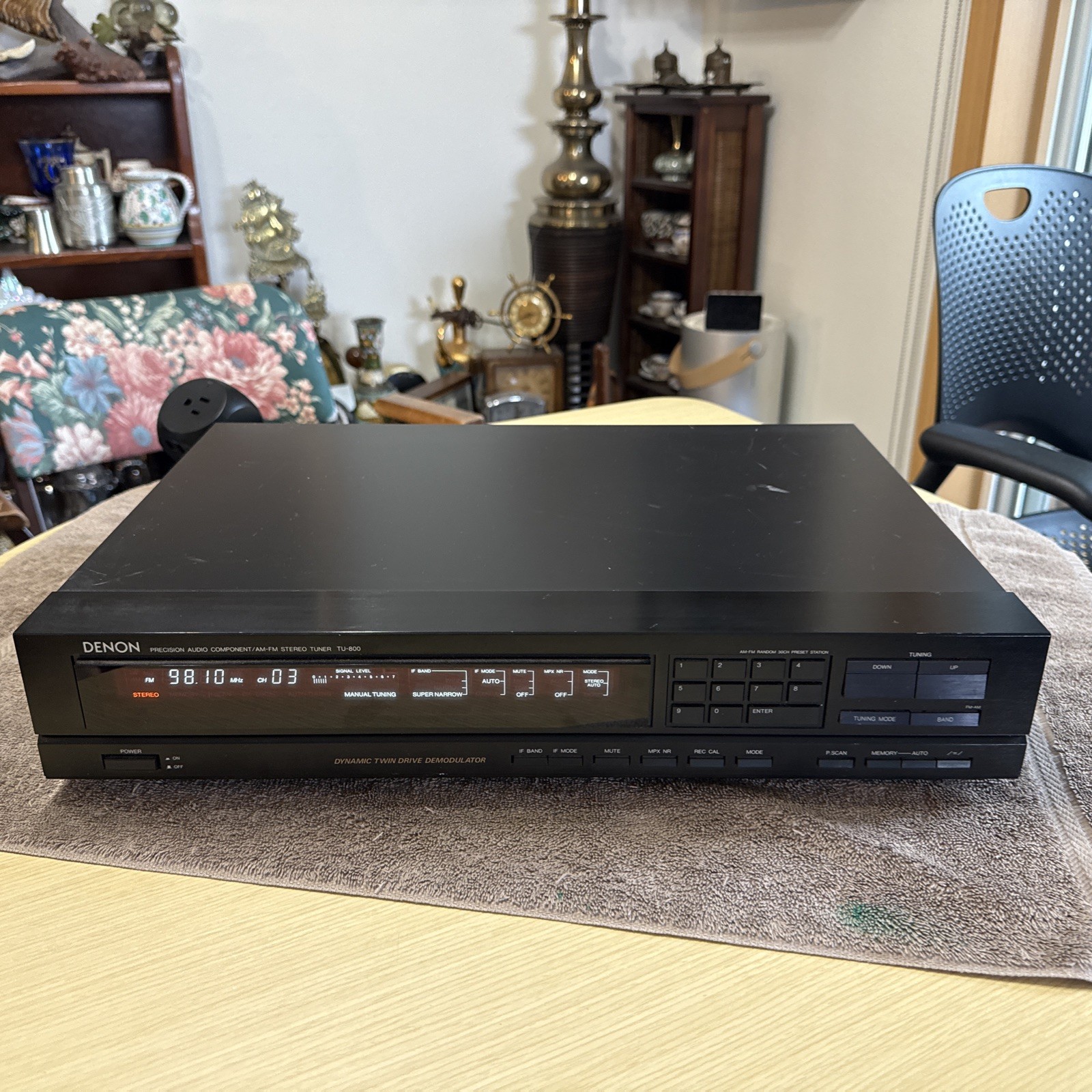
The tuner includes front-panel controls for tuning, band selection (though FM-only), stereo/mono switch, and a tuning meter for peak signal indication. On the rear panel, you’ll find standard RCA audio outputs, a 75-ohm coaxial FM antenna input, and a 300-ohm twin-lead adapter. The build quality is typical of Denon’s early ’80s gear—thick steel chassis, a heavy aluminum faceplate, and high-quality internal wiring.
Sound Characteristics and Performance
The TU-850 delivers a clean, transparent sound that lets the broadcast source shine through. It doesn’t color the audio, which is exactly what a good tuner should do. Its dual-conversion IF stage ensures excellent image rejection and low noise, making it particularly effective in urban environments with strong signal interference.
Listeners often note the TU-850’s strong stereo imaging and wide soundstage, thanks to its high channel separation and low crosstalk. The audio output is dynamic and detailed, with a smooth high-frequency response that avoids the harshness sometimes found in lesser tuners. Bass response is tight and well-controlled, preserving the natural tonality of live broadcasts and classical recordings.
While it lacks the absolute precision of a digitally synthesized tuner, the TU-850’s analog tuning system, paired with its mechanical frequency counter, offers a satisfying, tactile experience. The tuning knob is smooth and well-damped, allowing for fine adjustments. The illuminated tuning meter helps identify signal peaks accurately, and the stereo indicator lights up reliably when a strong stereo signal is locked in.
Notable Features and Innovations
Though not packed with flashy features, the TU-850 stands out for its thoughtful engineering:
- Dual Conversion Circuitry: Enhances selectivity and reduces interference, especially from adjacent channels.
- Mechanical Frequency Counter: Displays station frequency via a rotating drum—simple, reliable, and visually appealing.
- High-Quality RF Front End: Optimized for weak signal reception, making it effective even with basic antennas.
- Discrete Component Design: Avoids integrated circuits in critical signal paths, preserving audio purity.
- Robust Chassis Construction: Minimizes microphonics and electromagnetic interference.
One of the more appreciated aspects of the TU-850 is its modular internal layout. Serviceability is excellent by modern standards—circuit boards are accessible, and critical components like the IF transformers and tuning capacitor are mounted securely and can be aligned with proper tools. This makes the TU-850 a favorite among restorers and DIY audio tinkerers.
Common Issues and Maintenance
Like any 40-year-old electronic device, the Denon TU-850 may require some maintenance to perform at its best. Common issues include:
- Deteriorating Electrolytic Capacitors: The power supply and audio coupling capacitors may need replacement to prevent hum or low output.
- Tuning Knob Stiffness: The tuning capacitor can become sticky over time; cleaning with contact spray (non-residue) can help.
- Faded or Dim Tuning Meter: The analog S-meter may dim with age; replacing the internal bulb restores visibility.
- Antenna Connector Corrosion: Especially on the 300-ohm terminals; cleaning with electrical contact cleaner is recommended.
- Mechanical Counter Jamming: Rare, but the frequency counter gears can gum up; light lubrication may be needed.
A full service typically includes capacitor replacement, contact cleaning, and alignment of the IF and RF stages. With proper care, the TU-850 can deliver decades more of reliable performance.
Current Market Value and Collectibility
The Denon TU-850 is not a rare tuner, but it’s also not commonly found in working condition. As of 2024, a fully functional unit in good cosmetic shape typically sells for $150–$250 on the secondary market. Units with original packaging, manuals, or proven service history may fetch slightly more.
While it doesn’t command the prices of ultra-high-end tuners like the Sony ST-555ES or Kenwood KT-9600, the TU-850 is increasingly recognized for its excellent value. It’s particularly sought after by collectors building complete Denon systems—pairing it with the PMA-750 amplifier or DP-85F turntable creates a cohesive, high-performance vintage setup.
Its appeal lies in its understated elegance, solid engineering, and musical transparency. For FM enthusiasts who still enjoy live broadcasts, jazz radio, or classical stations, the TU-850 offers a nostalgic yet high-fidelity listening experience.
Conclusion and Legacy
The Denon TU-850 may not have the name recognition of some of its peers, but it represents the quiet excellence of early 1980s Japanese audio engineering. It’s a no-nonsense tuner built for performance, reliability, and longevity. In an era where digital streaming dominates, the TU-850 reminds us of the joy of tuning into a live broadcast—crisp, dynamic, and full of human presence.
For vintage audio collectors and analog purists, the TU-850 is a worthy addition to any system. It’s not just a tuner—it’s a window into a time when radio was an art form, and audio components were built to last. If you’re lucky enough to find one in good condition, give it a listen. You might just rediscover the magic of FM.
eBay Listings


As an eBay Partner, we earn from qualifying purchases. This helps support our independent vintage technology research.
Service Manuals & Schematics
- Manual — archive.org
Related Models
- Denon TU-1500RD (1995)
- Denon TU-280 (1976)
- Denon TU-501 (1977)
- Denon TU-550 (1978)
- Denon TU-750S (1975)
- Aiwa CS-250 (1978)
- Luxman R-1030 (1979)
- Luxman R-1050 (1975)
- Luxman R-117 (1975)
- Denon TU-400 (1976)