Denon TU-767: A Vintage FM Tuner of Exceptional Fidelity
In the late 1970s, Japanese audio manufacturers were at the forefront of analog innovation, pushing the boundaries of FM reception, signal clarity, and build quality. Among these, Denon—renowned for its precision engineering and studio-grade audio equipment—crafted a series of high-performance FM tuners that remain highly respected by vintage audio enthusiasts today. The Denon TU-767, introduced in 1978, stands as a shining example of this golden era, offering audiophiles a refined listening experience with a blend of advanced engineering and elegant design.
While not as widely documented as some of Denon’s amplifiers or receivers, the TU-767 occupies a special niche among vintage FM tuners. It was designed for the discerning listener who valued pure signal integrity, excellent selectivity, and the warmth of analog FM broadcasting. In an age before digital streaming, the quality of a tuner could make or break a high-fidelity system—and the TU-767 was built to excel.
Technical Specifications
The TU-767 was engineered with a focus on minimizing noise, maximizing sensitivity, and ensuring stable reception across the FM band. Its circuitry reflects Denon’s commitment to high-end audio principles, with discrete components and a carefully laid-out signal path.
| Specification | Detail |
| Model | Denon TU-767 |
| Year of Release | 1978 |
| Tuner Type | Analog FM Stereo Tuner |
| Frequency Range | 87.5–108 MHz |
| Tuning Method | Analog dial with mechanical counter |
| IF Frequency | 10.7 MHz |
| Sensitivity (Mono) | 1.8 µV for 30 dB SNR |
| Sensitivity (Stereo) | 12 µV for 30 dB SNR |
| Selectivity | 75 dB at ±400 kHz |
| Signal-to-Noise Ratio | 70 dB (weighted, stereo) |
| Total Harmonic Distortion | <0.5% (1 kHz, full output) |
| Output Level | 0.5 V RMS (50 kΩ load) |
| Output Impedance | 1 kΩ |
| Input for Accessories | Tuning meter, remote tuning (optional) |
| Power Supply | 120V AC, 60 Hz (North American model) |
| Dimensions (W×H×D) | 430 × 146 × 325 mm |
| Weight | 9.5 kg (20.9 lbs) |
The TU-767 features a dual-gate MOSFET front-end amplifier for low-noise reception, followed by a series of tuned IF stages and a high-quality quadrature detector for stereo decoding. Its stereo separation is rated at over 40 dB, which was excellent for its time, ensuring a spacious and immersive soundstage. The tuner also includes a high-cut filter to reduce high-frequency noise on weak signals, a useful feature for marginal reception areas.
Sound Characteristics and Performance
The Denon TU-767 is prized for its natural, transparent sound and excellent dynamic range. Unlike many budget tuners of the era that compressed or colored the audio, the TU-767 delivers a clean, uncolored signal that faithfully reproduces the broadcast source. Its low distortion and high signal-to-noise ratio mean that even weaker stations come through with remarkable clarity.
Listeners often note the warmth and presence in the midrange, a hallmark of Denon’s analog design philosophy. The stereo imaging is precise, with well-defined channel separation that brings FM broadcasts—especially classical and jazz programming—to life. When paired with a high-quality amplifier and speakers, the TU-767 reveals nuances in music that lesser tuners simply miss.
Even by modern standards, the TU-767 performs admirably in areas with strong FM coverage. Its analog tuning, while requiring a steady hand, allows for fine adjustments that digital PLL tuners sometimes oversimplify. For purists, this hands-on experience is part of the charm.
Notable Features and Innovations
While the TU-767 may appear modest compared to today’s digital tuners, it incorporates several advanced features for its time:
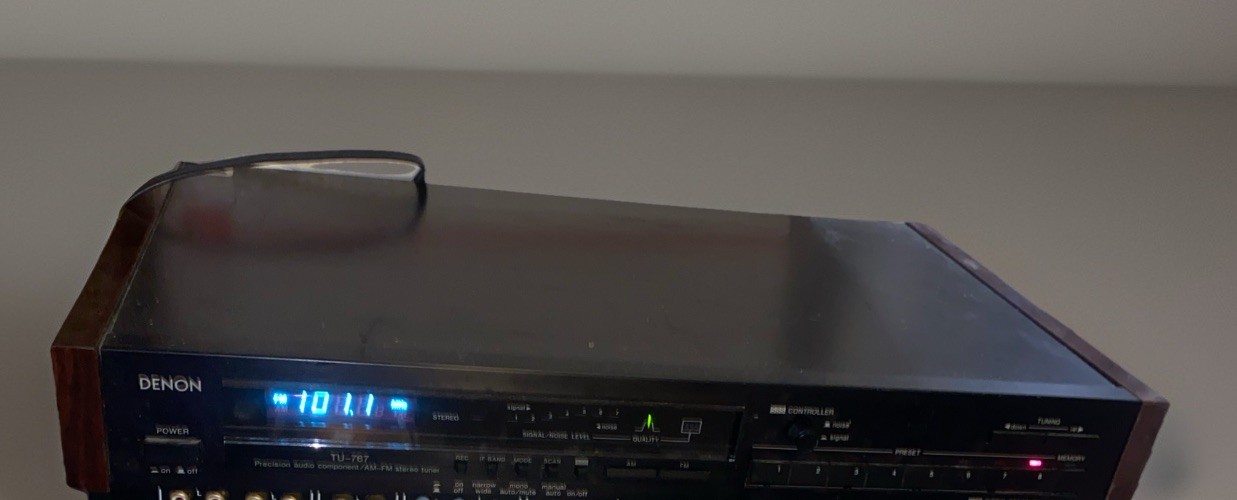
- Mechanical Digital Tuning Display: A rotating drum counter provides precise frequency readout, a significant upgrade over simple analog dials.
- High-Cut Filter: Reduces high-frequency hiss on weak stations, improving listening comfort.
- Stereo/Mono Switch: Allows users to switch to mono for improved reception on distant stations.
- Tuning Meter: A built-in S-meter helps optimize antenna alignment and station tuning.
- Discrete Circuitry: Avoids integrated circuits in critical signal paths, preserving signal purity.
- Heavy-Duty Chassis: A rigid, shielded enclosure minimizes microphonics and RF interference.
Denon also paid close attention to grounding and shielding, critical for preventing interference in sensitive FM reception. The internal layout is clean and well-organized, with high-quality capacitors and resistors throughout.
Common Issues and Maintenance
As with any vintage electronic equipment, the Denon TU-767 may require some maintenance after decades of use. Common issues include:
- Deteriorated Electrolytic Capacitors: The power supply and audio coupling capacitors may dry out over time, leading to hum or reduced performance. A recap by a qualified technician is often recommended.
- Tuning Dial Stiffness: The mechanical tuning dial can become sticky due to dried lubricant. Cleaning and re-lubrication of the tuning capacitor and dial mechanism can restore smooth operation.
- Antenna Terminal Corrosion: Outdoor antennas can introduce moisture, leading to oxidation. Cleaning the 75Ω and 300Ω terminals ensures optimal signal transfer.
- Worn Belts (if applicable): Some units with motorized tuning (in later variants) may have rubber belts that degrade. These are replaceable with modern equivalents.
- Weak Local Oscillator: In rare cases, the oscillator tube or transistor may drift, causing tuning inaccuracies. Alignment by a technician can correct this.
Regular cleaning of controls and connectors with contact cleaner can also help maintain performance. Given its solid build quality, the TU-767 is generally reliable and repairable with proper care.
Current Market Value and Collectibility
The Denon TU-767 is not as common as some of its contemporaries from Sony or Yamaha, which adds to its appeal among collectors. Units in good working condition typically sell for $200–$400, depending on cosmetics, functionality, and included accessories like the original remote or manual.
Fully restored models with recapped power supplies and aligned tuning can command higher prices, especially when paired with other Denon components like the PMA-767 amplifier or DP-767 turntable (part of a potential “767 series” system). Its understated silver-and-black design fits well in classic audio setups, and its performance holds up impressively against modern equipment.
Collectors value the TU-767 not only for its sound but also as a representative of Denon’s engineering excellence during the 1970s—a time when Japanese audio brands were defining high-fidelity standards worldwide.
Conclusion and Legacy
The Denon TU-767 may not be the most famous vintage tuner, but it is undoubtedly a hidden gem in the world of analog audio. It embodies the care, precision, and sonic integrity that Denon brought to its high-end components. For FM enthusiasts, radio archivists, or anyone who appreciates the art of analog reception, the TU-767 offers a listening experience that is both nostalgic and genuinely high-fidelity.
In an era increasingly dominated by digital streaming, the TU-767 reminds us of the beauty of live, over-the-air broadcasting—when tuning into a distant station felt like discovering a secret. With proper care, this tuner can continue delivering musical magic for decades to come.
If you’re building a vintage system or simply want to experience FM the way it was meant to be heard, the Denon TU-767 is a worthy addition to any audio collection.
eBay Listings


As an eBay Partner, we earn from qualifying purchases. This helps support our independent vintage technology research.
Related Models
- Denon TU-1500RD (1995)
- Denon TU-280 (1976)
- Denon TU-501 (1977)
- Denon TU-550 (1978)
- Denon TU-750S (1975)
- Aiwa CS-250 (1978)
- Luxman R-1030 (1979)
- Luxman R-1050 (1975)
- Luxman R-117 (1975)
- Denon TU-400 (1976)