Denon TU-750S: A Vintage FM Tuner from the Golden Age of Hi-Fi
In the mid-1970s, Japanese audio manufacturers were at the forefront of high-fidelity innovation, and Denon—already renowned for its professional recording equipment and precision engineering—brought that same meticulous craftsmanship to the consumer market. Among its lineup of receivers, amplifiers, and turntables, the Denon TU-750S stands out as a dedicated FM stereo tuner that exemplifies the audiophile values of its era: accuracy, musicality, and build quality. Though not as widely discussed as some of its contemporaries, the TU-750S has earned a quiet reputation among vintage audio enthusiasts for its exceptional reception, clean signal path, and timeless design.
Released in the early 1980's, the TU-750S arrived during a golden period for FM broadcasting in the United States and Japan. With stereo FM gaining popularity and stations investing in high-quality programming, audiophiles sought tuners capable of extracting every nuance from the airwaves. Denon answered with a component that balanced advanced circuitry with user-friendly operation—a hallmark of the brand’s engineering philosophy.
Technical Specifications
The TU-750S was designed for serious listeners who demanded more than just basic radio reception. It featured a fully discrete tuner stage with no integrated circuits, emphasizing analog purity and signal integrity. Its design reflects Denon’s commitment to high performance, with attention paid to shielding, grounding, and component selection.
| Specification | Detail |
| Model | TU-750S |
| Manufacturer | Denon (Japan) |
| Year of Release | early 1980's |
| Tuner Type | FM Stereo |
| Frequency Range | 87.5–108 MHz |
| Tuning Method | Analog dial with mechanical counter |
| IF Frequency | 10.7 MHz |
| Signal-to-Noise Ratio | Stereo: 75dB · Mono: 80dB |
| Channel Separation | 40 dB at 1 kHz |
| Output Level | 0.5 V RMS (for 100 mV input) |
| Output Impedance | 1 kΩ |
| Input Impedance (Antenna) | 75 Ω (balanced), 300 Ω (twin-lead) |
| Power Supply | 120V AC, 50/60 Hz (North American spec) |
| Power Consumption | 25 watts |
| Dimensions (W×H×D) | 430 × 146 × 342 mm (17 × 5.75 × 13.5") |
| Weight | 12 kg |
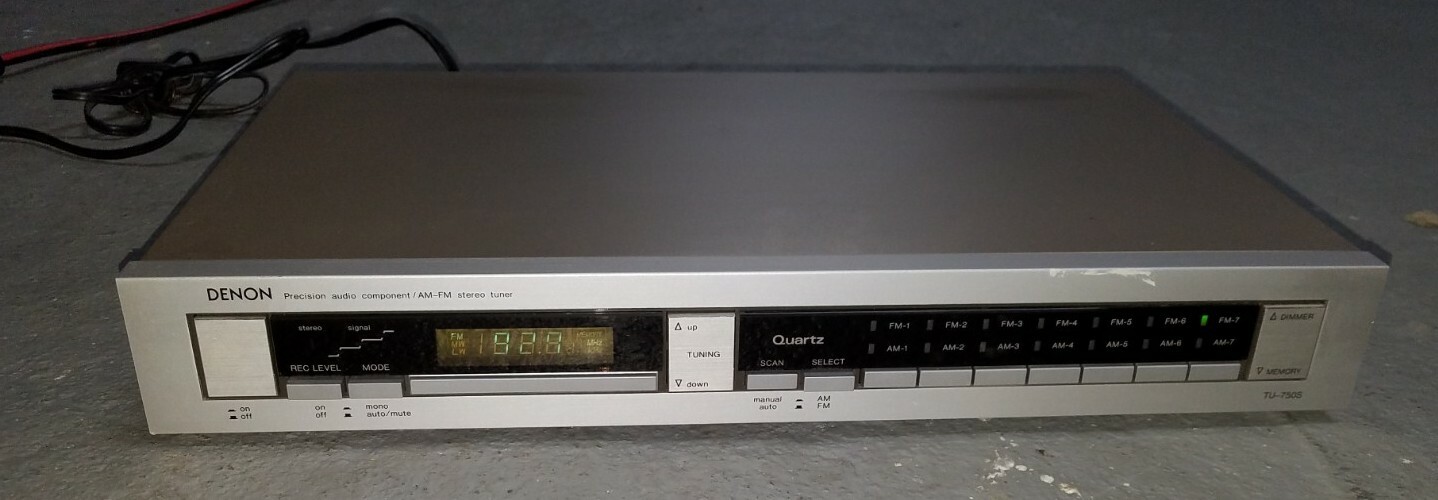
The tuner’s front panel features a large, easy-to-read analog dial with a polished aluminum bezel, a hallmark of 1970s Denon design. A stereo indicator light, bandswitch, and antenna selector are neatly arranged, emphasizing functionality without clutter. The rear panel includes both 75Ω coaxial and 300Ω twin-lead antenna inputs, offering flexibility for different antenna setups.
Sound Characteristics and Performance
The Denon TU-750S delivers a sound signature that many vintage tuner enthusiasts describe as "smooth, detailed, and effortlessly natural." Unlike some tuners of the era that leaned toward brightness or harshness, the TU-750S presents a balanced frequency response with a slightly warm midrange—ideal for vocal and acoustic programming.
Its stereo separation is impressive for its time, creating a spacious soundstage that brings FM broadcasts to life. Whether listening to classical music from a public radio station or a jazz program with deep bass lines, the TU-750S handles dynamic content with composure. The signal-to-noise ratio ensures quiet backgrounds, minimizing hiss and interference even on weaker stations.
One of the standout qualities of the TU-750S is its tuning precision. The mechanical tuning dial, while not digital, offers smooth operation and accurate station placement. The flywheel mechanism provides a satisfying, damped feel, allowing for fine adjustments. The illuminated tuning meter aids in peaking stations for optimal reception, a feature that was considered high-end at the time.
Notable Features and Innovations
While the TU-750S may appear modest compared to modern digital tuners, it incorporates several thoughtful design elements that reflect Denon’s engineering excellence:
- Discrete Component Design: The absence of ICs in the RF and IF stages ensures a pure analog signal path, favored by purists.
- Dual Antenna Inputs: Supports both modern coaxial and traditional twin-lead antennas, accommodating various installation scenarios.
- High-Quality Shielding: Internal metal shielding minimizes interference from nearby components, crucial in multi-unit stereo systems.
- Sturdy Chassis Construction: The heavy steel chassis and thick faceplate reduce microphonics and vibration, contributing to signal clarity.
- Adjustable IF Bandwidth: Some versions of the TU-750S include a selectable bandwidth filter (wide/narrow), allowing users to optimize reception in weak-signal or high-interference areas.
These features made the TU-750S a favorite among serious listeners who treated FM radio as a legitimate high-fidelity source—not just background noise.
Common Issues and Maintenance
Like all vintage electronics, the Denon TU-750S benefits from periodic maintenance. After nearly 50 years, certain components may degrade:
- Electrolytic Capacitors: The power supply and audio coupling capacitors should be checked or replaced if the unit has been unused for years. Dried-out caps can cause hum or reduced performance.
- Tuning Dial Lubrication: The mechanical tuning mechanism may stiffen over time. A light application of synthetic lubricant can restore smooth operation.
- Antenna Terminals: Corrosion on the 300Ω screw terminals is common. Cleaning with contact cleaner and a small brush is recommended.
- Rubber Drive Belts: If the tuning dial uses a rubber coupling (in some variants), it may have perished. Replacement belts are available from vintage audio suppliers.
It’s also wise to verify that the stereo pilot circuit is functioning, as this can affect stereo decoding. A qualified technician familiar with vintage tuners can perform alignment and calibration for optimal performance.
Current Market Value and Collectibility
The Denon TU-750S is not as common on the vintage market as receivers or amplifiers from the same era, which adds to its appeal among collectors. Units in excellent cosmetic and working condition typically sell for $150–$300, depending on region and included accessories.
While not yet a "grail" item, the TU-750S is increasingly sought after by:
- Audiophiles building period-correct 1970s systems
- Denon collectors focusing on the brand’s golden era
- FM enthusiasts who appreciate analog tuning precision
Its value is likely to rise as interest in vintage tuners grows, particularly among younger audiophiles discovering the charm of FM radio’s heyday.
Conclusion and Legacy
The Denon TU-750S may not have the fame of a Marantz receiver or a Sansui amplifier, but it represents a high point in analog tuner design. It embodies the care and precision that defined Japanese hi-fi during the 1970s—a time when manufacturers competed on sound quality, not just features.
For those who appreciate the art of radio reception, the TU-750S offers a rewarding listening experience. It reminds us that FM broadcasting, at its best, can deliver music with warmth, depth, and emotional impact—especially when played through a tuner engineered with passion and purpose.
Today, the TU-750S stands as a quiet testament to Denon’s legacy of excellence. It’s not just a piece of vintage gear; it’s a window into an era when listening to the radio was an act of audiophile devotion.
eBay Listings



As an eBay Partner, we earn from qualifying purchases. This helps support our independent vintage technology research.
Related Models
- Denon TU-1500RD (1995)
- Denon TU-280 (1976)
- Denon TU-501 (1977)
- Denon TU-550 (1978)
- Denon TU-400 (1976)
- Aiwa CS-250 (1978)
- Luxman R-1030 (1979)
- Luxman R-1050 (1975)
- Luxman R-117 (1975)
- Denon TU-660 (1978)