Denon TU-750: The Forgotten Tuner with Hi-Fi Soul
In the late 1970s, Japanese audio manufacturers were locked in a quiet arms race to deliver the most precise, musical, and technically advanced components to the burgeoning high-fidelity market. While Denon is perhaps best known today for its legendary turntables and amplifiers of the era—like the DP-62L or the PMA-S1—its lineup of FM tuners, including the Denon TU-750, quietly set a high bar for broadcast reception and audio fidelity. Released in 1978, the TU-750 may not have had the flash of a full separates receiver, but it was a serious tuner built for audiophiles who demanded more from their radio experience.
At a time when FM broadcasting was hitting its stride—offering stereo programming, classical music, jazz, and progressive rock with increasing clarity—the TU-750 arrived as a precision instrument designed to extract every nuance from the airwaves. It was part of Denon’s broader push into the high-end component market, where build quality, measured performance, and sonic transparency were paramount.
Though not as widely documented as some of its contemporaries from Sony, Yamaha, or Pioneer, the TU-750 has developed a quiet reputation among vintage tuner enthusiasts as a “sleeper” performer—underrated, well-constructed, and capable of delivering a listening experience that rivals more famous models.
Technical Specifications
The Denon TU-750 was engineered with a focus on stability, selectivity, and low distortion—key metrics for any serious FM tuner. While original brochures are scarce today, surviving units and service manuals reveal a component built to exacting standards.
| Specification | Detail |
| Model | TU-750 |
| Year of Release | 1978 |
| Tuner Type | FM Stereo |
| Frequency Range | 87.5–108 MHz |
| Tuning Display | Analog dial with illuminated pointer |
| Tuning Method | Manual (rotary knob) |
| IF Frequency | 10.7 MHz |
| Sensitivity | Approx. 1.5 µV for 30 dB SNR |
| Selectivity | Excellent (sharp filter response) |
| Stereo Separation | >40 dB at 1 kHz |
| Total Harmonic Distortion | <0.5% |
| Output Level | 200 mV (typical) |
| Output Impedance | 1 kΩ |
| Input for Accessories | Antenna (75Ω unbalanced) |
| Power Requirements | 120V AC, 60 Hz, 20W |
| Dimensions (W×H×D) | 420 × 140 × 318 mm |
| Weight | 7.8 kg (17.2 lbs) |
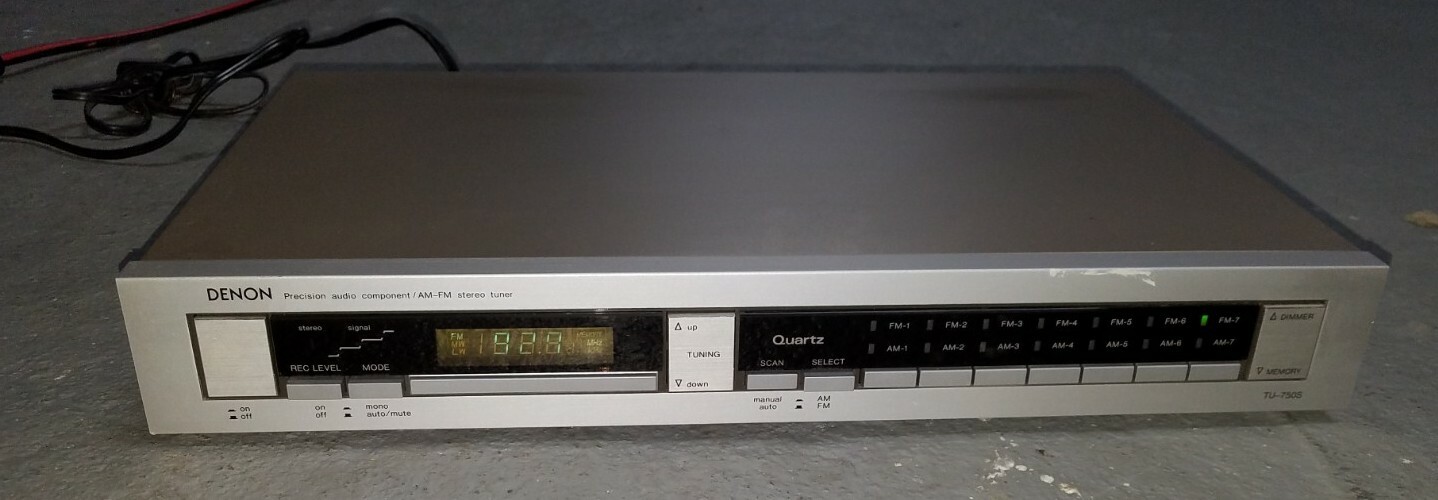
The TU-750 features a dual-ganged tuning capacitor and a well-shielded RF stage to minimize interference—a hallmark of Denon’s engineering philosophy. Its front panel includes a large, smooth-rotating tuning knob, a stereo indicator LED, and basic controls for bandwidth (wide/narrow) and muting. The back panel offers standard RCA audio outputs, a 75-ohm coaxial antenna input, and a 300-ohm twin-lead terminal for compatibility with older antenna systems.
Sound Characteristics and Performance
The TU-750 doesn’t amplify or color the signal—it reveals it. Tuners are often overlooked in vintage audio chains, but a great one like the TU-750 can make FM broadcasts sound startlingly lifelike.
Sonically, the TU-750 delivers a clean, open midrange with excellent stereo imaging. Its strong stereo separation ensures that left and right channels remain distinct, giving orchestral broadcasts and live jazz recordings a spacious, three-dimensional quality. The high frequencies are smooth and detailed without harshness, while the bass response remains tight and well-controlled—critical for maintaining clarity during dynamic passages.
One of the standout traits of the TU-750 is its ability to reject adjacent-channel interference. In urban environments with crowded FM bands, this makes a significant difference. The narrow/wide bandwidth switch allows users to cut through noise when signals are weak or adjacent stations are overpowering, without sacrificing too much high-frequency detail.
When paired with a high-quality antenna—such as a directional Yagi or even a well-placed dipole—the TU-750 can pull in distant stations with remarkable clarity, making it a favorite among DX (long-distance reception) hobbyists.
Notable Features and Innovations
While the TU-750 doesn’t boast digital tuning or memory presets (features that would become common in the 1980s), it excels in analog refinement:
- High-Quality RF Front End: The tuner uses discrete transistors in its RF and IF stages, avoiding the cost-cutting integrated circuits found in lesser tuners of the era.
- Precision Mechanical Tuning: The large tuning knob is damped for smooth operation, allowing fine adjustments to lock onto weak or fringe stations.
- Illuminated Tuning Dial: A soft incandescent backlight makes the analog scale easy to read in dim environments.
- Muting Circuit: Automatically silences noise when tuning between stations, improving the listening experience.
- Robust Chassis Construction: A heavy steel chassis reduces microphonics and shields sensitive circuitry from external interference.
Denon also paid attention to grounding and internal layout, minimizing crosstalk and ensuring long-term reliability. The circuit board is cleanly laid out, with point-to-point wiring in critical signal paths—a sign of Denon’s commitment to audio purity.
Common Issues and Maintenance
Like all vintage electronics from the late 1970s, the TU-750 benefits from careful maintenance. While generally reliable, several issues may arise after decades of storage or use:
- Dried-up Electrolytic Capacitors: The power supply and audio coupling capacitors may need replacement to restore optimal performance and prevent hum or distortion.
- Tuning Knob Stiffness: The tuning capacitor can become sticky over time. A careful cleaning with contact-safe lubricant can restore smooth operation.
- Faded Dial Lighting: The original incandescent bulb may burn out. Modern LED replacements are available but should be low-voltage and dimmable to avoid glare.
- Antenna Terminal Corrosion: Especially in coastal areas, the 300-ohm screw terminals can corrode. Cleaning with electrical contact spray is recommended.
- Weak RF Tubes (if applicable): While the TU-750 is solid-state, some early production runs may have used hybrid designs—verify with a service manual.
For best results, a full recapping and cleaning by a qualified technician is advised before extended use. Additionally, using a high-quality FM antenna and keeping the unit in a well-ventilated area will extend its life.
Current Market Value and Collectibility
The Denon TU-750 remains relatively obscure compared to more iconic tuners like the Sony ST-555 or the Kenwood KT-9500. This obscurity, however, works in its favor: it’s often overlooked in auctions and estate sales, making it a potential bargain for discerning collectors.
As of 2024, a fully functional TU-750 in good cosmetic condition typically sells for $150–$250, depending on region and included accessories. Units with original boxes, manuals, or rare finishes may fetch slightly more, especially in Japan or among Denon completists.
Its collectibility is growing slowly, particularly among enthusiasts restoring full Denon systems. When paired with a Denon PMA-200 or DP-3000, the TU-750 completes a cohesive, high-performance analog chain that showcases the brand’s engineering prowess.
Conclusion and Legacy
The Denon TU-750 may not be a household name, but it represents the quiet excellence that defined Denon’s approach to high-fidelity audio in the 1970s. It wasn’t built for show—it was built for sound. In an era when FM radio was a primary source of high-quality music and cultural programming, the TU-750 gave listeners a window into that world with clarity, precision, and musicality.
Today, it stands as a testament to analog tuner design at its peak: simple, well-constructed, and sonically rewarding. For vintage audio enthusiasts, the TU-750 is more than just a tuner—it’s a reminder that sometimes, the most unassuming components deliver the most profound listening experiences.
If you stumble upon one in a thrift store or online listing, don’t overlook it. With a little care, the Denon TU-750 can still bring the world’s best broadcasts—old and new—into your listening room with grace and fidelity.
eBay Listings



As an eBay Partner, we earn from qualifying purchases. This helps support our independent vintage technology research.
Related Models
- Denon TU-1500RD (1995)
- Denon TU-280 (1976)
- Denon TU-501 (1977)
- Denon TU-550 (1978)
- Denon TU-750S (1975)
- Aiwa CS-250 (1978)
- Luxman R-1030 (1979)
- Luxman R-1050 (1975)
- Luxman R-117 (1975)
- Denon TU-400 (1976)