Denon TU-747L: The Analog FM Connoisseur’s Choice
In the mid-1970s, Japanese audio manufacturers were at the forefront of high-fidelity innovation, and Denon—already renowned for its professional recording equipment and precision engineering—emerged as a leader in consumer audio as well. Among its standout offerings from this golden era was the Denon TU-747L, a high-performance FM tuner that exemplified the company’s commitment to sonic excellence and meticulous design. Though not as widely recognized today as some of its contemporaries from Pioneer or Sansui, the TU-747L has quietly earned a loyal following among vintage audio enthusiasts and FM purists who appreciate its refined tuning, robust build, and lush, natural sound reproduction.
A Tuner for the Audiophile Era
Released in 1985, the TU-747L arrived during a golden age for FM broadcasting and high-fidelity audio. Stereo FM had become mainstream, and listeners were increasingly investing in quality tuners to take full advantage of the rich programming available—from classical broadcasts to progressive rock and jazz. Denon, leveraging its expertise in analog signal processing and studio-grade components, crafted the TU-747L as a serious listening instrument rather than a mere radio accessory.
The "L" in the model number is believed to denote a luxury or limited variant, possibly indicating upgraded internal components or a refined front-panel design compared to earlier models in the TU series. While detailed factory documentation is scarce, surviving units and user reports suggest the TU-747L was positioned as a premium offering in Denon’s tuner lineup, likely intended to pair with high-end receivers or integrated amplifiers of the time.
Technical Specifications
The TU-747L was engineered with the precision expected of Denon, featuring a double-conversion superheterodyne circuit for improved selectivity and reduced interference—a hallmark of high-end tuners from this period. It was designed to deliver excellent sensitivity and stereo separation, ensuring a clean and immersive listening experience even in areas with weaker signal strength.
| Specification | Detail |
| Model | Denon TU-747L |
| Year of Release | 1985 |
| Tuner Type | FM Stereo, reportedly double conversion superhet |
| Frequency Range | 87.5–108 MHz |
| Tuning Method | Analog Dial with Mechanical Counter |
| IF Frequencies | 10.7 MHz (1st), 450 kHz (2nd) |
| Sensitivity | Approx. 1.5 µV for 30 dB SNR |
| Selectivity | High (typical of double-conversion) |
| Stereo Separation | >40 dB at 1 kHz |
| Output Level | 150 mV (nominal) |
| Output Impedance | 10 kΩ |
| Power Requirements | 110–120V AC, 60 Hz |
| Dimensions (W×H×D) | 434 × 66 × 281 mm |
| Weight | Approx. 3.3 kg (7.3 lbs) |
| Finish | Brushed aluminum front panel, black casing |
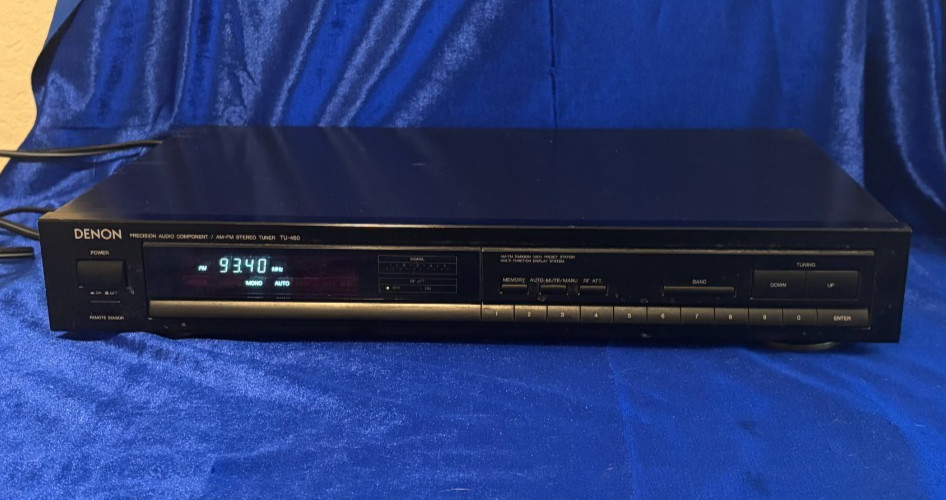
The tuner features a large, centrally located tuning dial with a precise mechanical frequency counter—allowing users to dial in stations with accuracy uncommon in entry-level models. The front panel is minimalist yet elegant, with a large VU-style stereo indicator, tuning meter, and basic controls for bandwidth (wide/narrow) and mono/stereo selection. The use of high-quality potentiometers and switches reflects Denon’s attention to long-term reliability.
Sound Characteristics and Performance
The TU-747L is praised for its warm, smooth, and highly detailed sound signature—a sonic profile that complements Denon’s contemporaneous amplifiers and speakers. Unlike some tuners that emphasize brightness or artificial clarity, the TU-747L delivers a balanced and natural presentation, with excellent stereo imaging and a wide soundstage.
Its double-conversion design helps reject adjacent-channel interference and image frequencies, making it particularly effective in urban environments with crowded FM bands. The narrow/wide bandwidth switch allows listeners to reduce noise in weak-signal areas without sacrificing too much high-frequency detail.
Many users report that the TU-747L excels at reproducing classical and jazz broadcasts, where nuanced dynamics and spatial cues are critical. Its ability to extract subtle details from the stereo multiplex signal gives it an edge over simpler single-conversion tuners of the era.
Notable Features and Innovations
While not packed with the digital gimmicks of later tuners, the TU-747L stands out for its analog purity and thoughtful engineering:
- Mechanical Frequency Counter: Unlike simple pointer dials, the TU-747L includes a rotating numeric counter that displays the tuned frequency with precision—essential for logging favorite stations.
- High-Quality RF Front End: Designed to minimize phase noise and distortion, contributing to cleaner stereo demodulation.
- Discrete Component Construction: Uses individual transistors and op-amps rather than integrated circuits, allowing for better signal integrity and easier servicing.
- Heavy-Duty Chassis: A rigid, shielded enclosure reduces microphonics and electromagnetic interference.
- Studio-Inspired Metering: The large center tuning meter provides clear visual feedback for peak signal strength, aiding in optimal antenna alignment.
These features reflect Denon’s philosophy of building equipment that prioritizes performance and longevity over flashy aesthetics or cost-cutting measures.
Common Issues and Maintenance
Like all vintage electronics, the TU-747L requires some care to remain in optimal condition. Common issues include:
- Deteriorated Electrolytic Capacitors: The power supply and audio coupling capacitors may need replacement after 40+ years to prevent hum, low output, or channel imbalance.
- Tuning Dial Stiffness: The mechanical tuning mechanism can become sticky over time; cleaning and lubrication of the tuning capacitor and associated gears are recommended.
- Worn Bandwidth and Mode Switches: These can develop crackling or intermittent contact; deoxit treatment or replacement is advisable.
- Antenna Terminal Corrosion: Outdoor antenna connections may corrode; inspect and clean as needed.
Regular cleaning of controls and connectors, along with a proper recapping by a qualified technician, can restore the TU-747L to like-new performance. Its fully discrete design makes it more repairable than modern solid-state gear.
Current Market Value and Collectibility
The Denon TU-747L is a sleeper classic in the vintage audio world. While not as commonly sought after as the Marantz 2270 or Sony ST-555ES, it is increasingly recognized by discerning collectors and FM enthusiasts. Units in excellent working condition reportedly sell for $250–$400, with pristine, fully serviced examples commanding higher prices.
Its collectibility is bolstered by Denon’s reputation for quality, the relative rarity of the model, and its superb sonic performance. It pairs beautifully with other vintage Japanese gear, especially Denon’s PMA series amplifiers and DCM speakers, creating a cohesive high-fidelity system rooted in 1970s analog excellence.
Conclusion: A Legacy of Analog Fidelity
The Denon TU-747L may not have the name recognition of some of its peers, but it represents the quiet pinnacle of analog FM tuner design. Built during a time when audio was crafted with care and purpose, it delivers a listening experience that transcends its function as a radio—it’s a window into the golden age of broadcast fidelity.
For those who still appreciate the art of tuning in to a distant station, hearing the subtle stereo cues in a live concert broadcast, or simply enjoying music the way it was meant to be heard, the TU-747L remains a compelling choice. It’s a testament to Denon’s engineering heritage and a reminder that sometimes, the most rewarding audio experiences come not from streaming algorithms, but from a well-tuned analog circuit and a clear FM signal.
If you’re building a vintage system or simply want to rediscover the warmth of FM in its prime, the Denon TU-747L deserves a place on your rack—and in your ears.
eBay Listings



As an eBay Partner, we earn from qualifying purchases. This helps support our independent vintage technology research.
Related Models
- Denon TU-1500RD (1995)
- Denon TU-280 (1976)
- Denon TU-501 (1977)
- Denon TU-550 (1978)
- Denon TU-750S (1975)
- Aiwa CS-250 (1978)
- Luxman R-1030 (1979)
- Luxman R-1050 (1975)
- Luxman R-117 (1975)
- Denon TU-400 (1976)