Denon TU-720: The Forgotten Gem of 1970s FM Tuning Excellence
In the golden age of high-fidelity audio during the mid-1970s, Japanese manufacturers like Denon, Pioneer, and Sansui were locked in a quiet arms race to deliver the most accurate, musical, and reliable components for the discerning audiophile. While receivers and amplifiers often stole the spotlight, the unsung hero of any high-end system was the FM tuner—responsible for capturing the increasingly popular stereo broadcasts of the era with clarity and precision. Among Denon’s offerings from this period, the TU-720 stands out as a remarkable example of analog tuner engineering, combining advanced circuitry, meticulous build quality, and a distinctly musical character that continues to impress today.
Though not as widely celebrated as some of its contemporaries like the Yamaha T-700 or the Kenwood KT-9000, the Denon TU-720 earned a quiet reputation among audiophiles and broadcast engineers for its stable reception, excellent signal-to-noise ratio, and smooth, natural tonal balance. Released in 1975, it arrived at a time when FM radio was transitioning from a niche medium to a primary source of high-quality music programming, making accurate, high-fidelity tuners more important than ever.
Technical Specifications
The TU-720 was designed with a focus on performance and reliability, featuring a fully discrete design with no integrated circuits in the critical signal path—a hallmark of Denon’s engineering philosophy at the time. Its front-end employed a high-gain, low-noise RF amplifier stage, followed by dual-conversion superheterodyne circuitry to minimize interference and improve selectivity.
| Specification | Detail |
| Model | Denon TU-720 |
| Year of Release | 1975 |
| Tuner Type | FM Stereo, Dual Conversion Superheterodyne |
| Frequency Range | 87.5–108 MHz |
| Tuning Display | Analog Dial with Digital Frequency Counter |
| IF Frequencies | 1st: 10.7 MHz, 2nd: 450 kHz |
| Sensitivity (Mono) | 1.5 µV for 30 dB SNR |
| Sensitivity (Stereo) | 2.5 µV for 30 dB SNR |
| Selectivity | ±400 kHz: 60 dB |
| Signal-to-Noise Ratio | 70 dB (A-weighted) |
| Harmonic Distortion | <0.5% at 1 kHz |
| Output Level | 0.5 V RMS (50 kΩ load) |
| Output Impedance | 1 kΩ |
| Input for Remote Control | Yes (via Denon’s optional RM series) |
| Power Consumption | 25 watts |
| Dimensions (W×H×D) | 430 × 146 × 342 mm |
| Weight | 10.5 kg (23.1 lbs) |
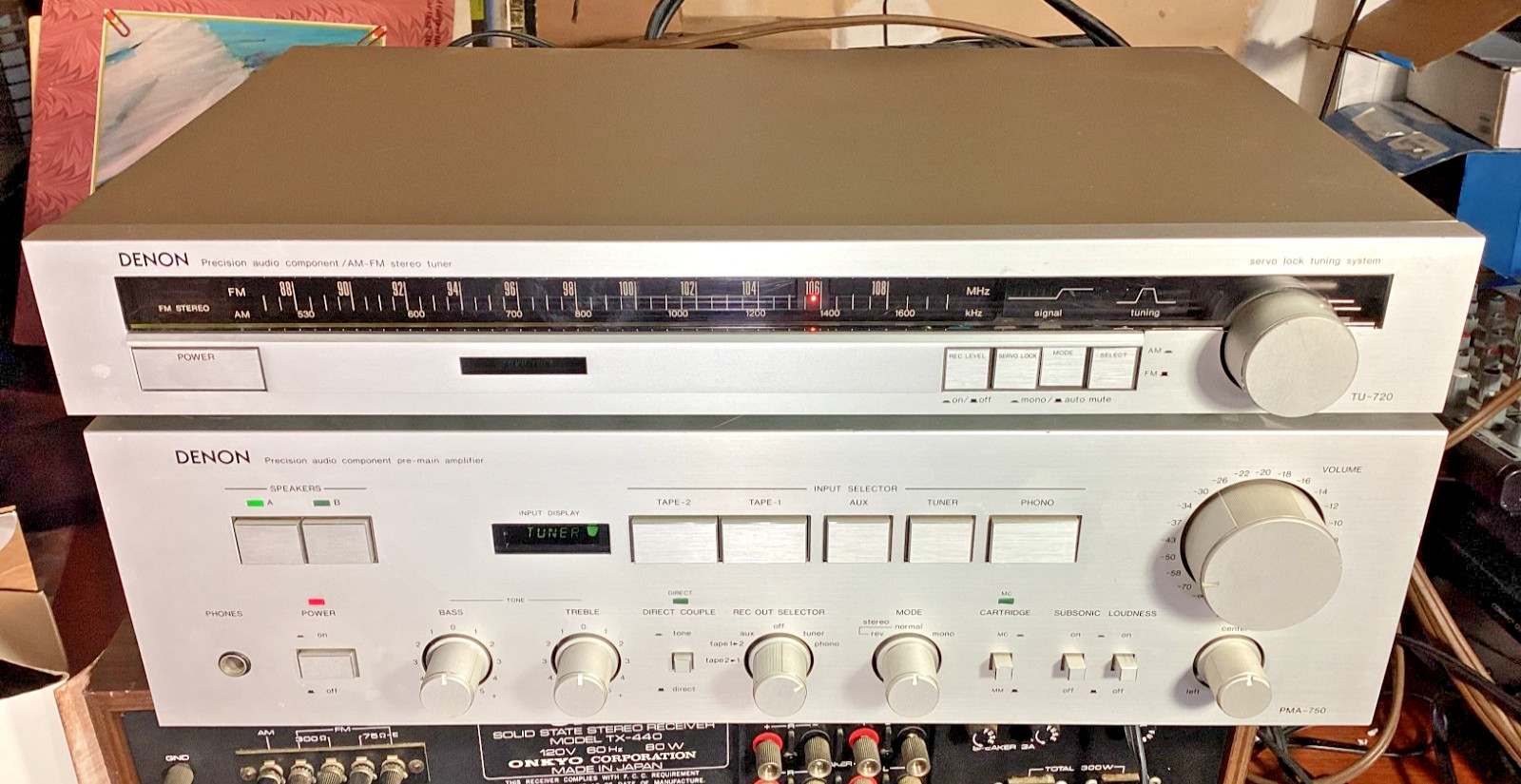
The TU-720 featured a large, easy-to-read analog tuning dial paired with a digital frequency counter—a relatively advanced feature for its time—allowing for precise station selection. This hybrid display system combined the tactile satisfaction of analog tuning with the accuracy of digital readout, a design choice that Denon used across several of its high-end tuners in the mid-to-late 1970s.
Sound Characteristics and Performance
The Denon TU-720 is often praised for its warm, rich, and balanced sound signature—a characteristic that aligns with Denon’s broader design ethos during this era. Unlike some tuners that leaned toward clinical precision, the TU-720 delivered a smooth high end, well-defined midrange, and solid stereo imaging that made FM broadcasts sound remarkably lifelike.
Its dual-conversion design minimized image interference and local oscillator leakage, resulting in cleaner reception even in urban environments with crowded frequency bands. The tuner handled weak signals with grace, thanks to its high-gain RF stage and well-tuned limiter circuitry, which prevented distortion during signal fluctuations.
Stereo separation was excellent for its time—typically around 40 dB—and the stereo pilot tone detection was highly stable, reducing the “hunting” effect common in lesser tuners. The result was a listening experience that felt expansive and immersive, especially when paired with Denon’s contemporaneous amplifiers like the PMA-720 or DRA-720.
Notable Features and Innovations
What set the TU-720 apart from many of its peers was its hybrid tuning system. While most tuners of the era used either fully analog dials or rudimentary digital counters, the TU-720 combined both, offering the user a seamless blend of precision and analog charm. The digital counter, displayed via green or amber LED digits, updated in real time as the tuning knob was turned, eliminating guesswork when dialing in a station.
Another standout feature was its high-quality mechanical construction. The tuner used a heavy-gauge steel chassis to reduce microphonics and electromagnetic interference, and the front panel was crafted from brushed aluminum, giving it a luxurious, industrial feel. The tuning knob itself was large, damped, and smooth-rotating, providing excellent control for fine-tuning.
Denon also included a defeat switch for the de-emphasis network, allowing users to bypass the standard 50 µs de-emphasis for specialized listening or test purposes—a feature typically found on professional broadcast equipment. Additionally, the rear panel offered both 75-ohm coaxial and 300-ohm twin-lead antenna inputs, making it compatible with a wide range of antenna systems.
Common Issues and Maintenance
Like all vintage electronics, the Denon TU-720 benefits from careful maintenance. Over time, the most common issues include:
- Deterioration of electrolytic capacitors: The power supply and audio coupling capacitors should be checked and replaced if necessary, especially if the unit has been in storage for decades.
- Tuning knob stiffness: The precision tuning mechanism can dry out, requiring lubrication with a light-grade synthetic grease.
- LED display failure: The digital frequency counter uses early-generation LEDs that may dim or fail. Replacement modules are rare, but skilled technicians can sometimes retrofit modern displays.
- Antenna relay corrosion: The internal relays that switch between antenna inputs can develop oxidation, leading to weak signal reception.
Regular cleaning of the controls and connectors with contact cleaner is recommended. For long-term reliability, a full recapping and alignment by a qualified technician is highly advisable before extended use.
Current Market Value and Collectibility
The Denon TU-720 is not as widely collected as some of its flashier contemporaries, but it has developed a loyal following among vintage tuner enthusiasts and Denon aficionados. Units in excellent cosmetic and working condition typically sell for $250–$400 on the secondary market, with mint, boxed examples occasionally fetching higher prices.
Its collectibility is enhanced by its rarity—Denon produced fewer tuners than integrated amplifiers or receivers—and its exemplary build quality. As FM broadcasting nostalgia grows and vinyl enthusiasts seek complete analog signal chains, high-performance tuners like the TU-720 are gaining renewed appreciation.
Conclusion and Legacy
The Denon TU-720 may not have the name recognition of a Marantz or a Luxman, but it represents the quiet excellence of Denon’s 1970s engineering team. It was built for listeners who valued accuracy without sterility, precision without pretension. In an era when FM radio was a primary source of high-fidelity music, the TU-720 delivered performance that rivaled or exceeded many more expensive tuners.
Today, it stands as a testament to a time when every component in an audio system was crafted with care, designed to last, and engineered to sound beautiful. For the vintage audio enthusiast, the TU-720 is more than just a tuner—it’s a portal to the golden age of FM broadcasting, and a reminder that sometimes, the quietest components make the most lasting impression.
eBay Listings


As an eBay Partner, we earn from qualifying purchases. This helps support our independent vintage technology research.
Related Models
- Denon TU-1500RD (1995)
- Denon TU-280 (1976)
- Denon TU-501 (1977)
- Denon TU-550 (1978)
- Denon TU-750S (1975)
- Aiwa CS-250 (1978)
- Luxman R-1030 (1979)
- Luxman R-1050 (1975)
- Luxman R-117 (1975)
- Denon TU-400 (1976)