Denon TU-660 ()
Not the flashiest tuner of its era, but one that earns your trust by pulling in clean, stable signals even when the airwaves get messy.
Overview
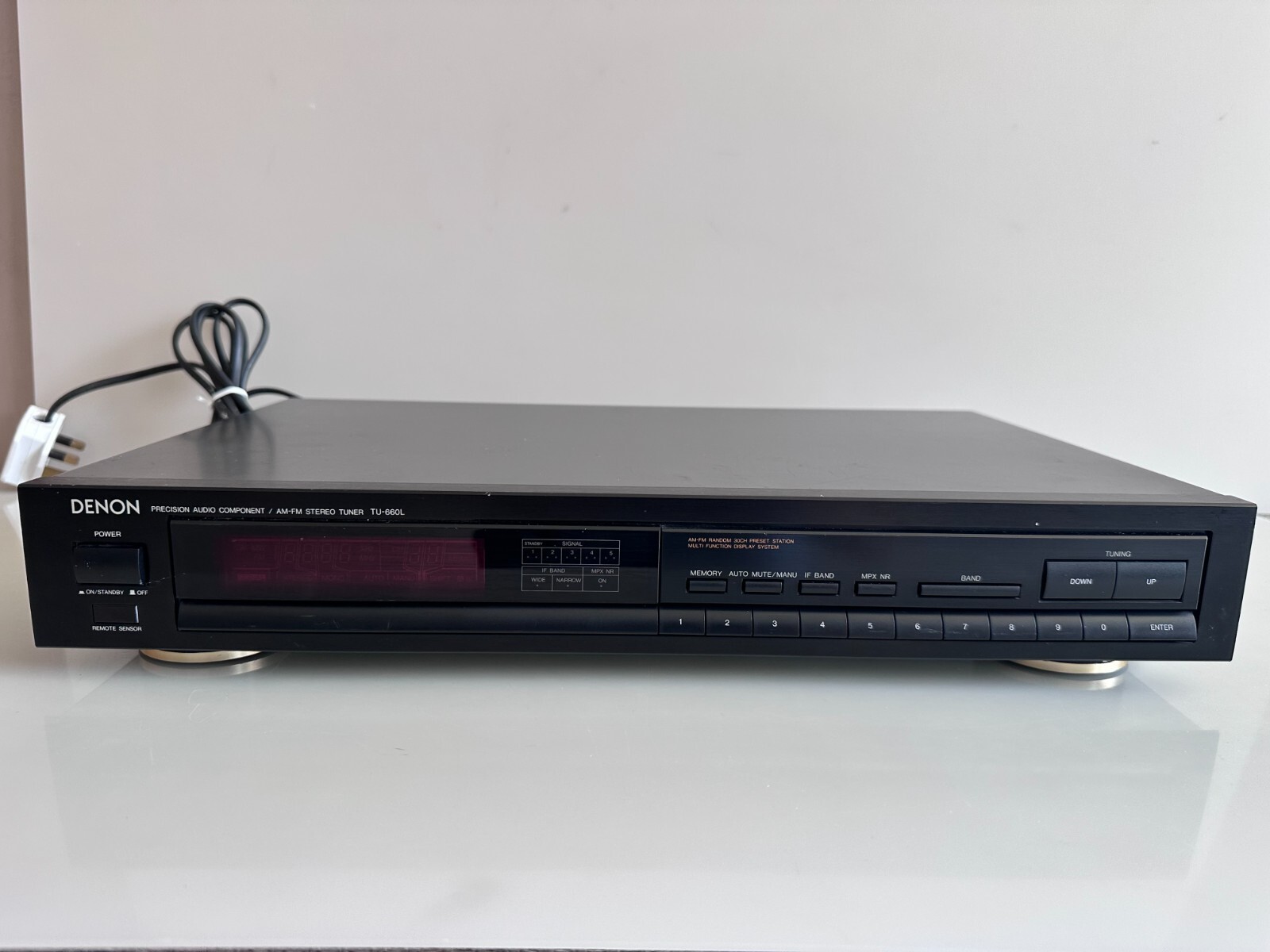
The Denon TU-660 isn’t a showstopper at first glance—no glowing VU meters, no sweeping analog dial, no heft that makes you grunt when lifting it. But don’t let its modest presence fool you: this is an audiophile-grade FM/AM tuner built during a time when digital tuning was becoming standard, and manufacturers were refining how well receivers handled real-world broadcast conditions. , the TU-660 sits in that late-analog, early-digital transition period where solid-state design matured into something quietly reliable. It wasn’t Denon’s flagship, but it wasn’t a budget model either—it was engineered for listeners who wanted strong performance without paying a premium for bells and whistles.
What defines the TU-660 is its no-nonsense approach to signal integrity. It’s described as an "Audiophile" tuner, and while that term gets thrown around a lot, in this case it means measurable performance: good sensitivity, strong rejection of interference, and solid stereo separation. It won’t dazzle with warmth like some tube-influenced designs, nor does it aim for clinical neutrality. Instead, it delivers a transparent window into the broadcast, letting you hear what’s actually on the air—warts and all. And if your local stations are well-transmitted, that can be a very good thing.
It shares DNA with the more affordable TU-260L, though interestingly, one review calls the TU-660L (a likely variant) a "cheaper sibling" of itself—a confusing label that may point to regional differences or a typo in the source. Either way, the TU-660 stands as a step above entry-level tuners, offering features like 30 presets and switchable IF bandwidth, which lets users tweak reception based on signal strength and interference. It came with the Denon RC-126 remote control as standard, a nice touch for a tuner in its class, giving full access to presets and tuning functions from the couch.
Specifications
| Manufacturer | Denon |
| Model | TU-660 |
| Production Years | |
| Type | Mono/Stereo Tuner |
| Tuning Bands | FM, AM (MW) |
| Tuning Scale | Digital |
| FM Tuning Range | 87.5 to 108 MHz |
| AM Tuning Range | 520 to 1710 kHz |
| Sensitivity (FM mono) | 1.0 µV |
| Sensitivity (FM stereo) | 50 µV |
| Signal to Noise Ratio (FM mono) | 82 dB |
| Signal to Noise Ratio (FM stereo) | 65 dB |
| Signal to Noise Ratio (AM) | 53 dB |
| Total Harmonic Distortion (FM mono) | 0.1% |
| Total Harmonic Distortion (FM stereo) | 0.6% |
| Selectivity (FM) | 75 dB |
| IF Frequency | 10.7 MHz (FM), 455 kHz (MW) |
| Capture Ratio | 1.5 dB |
| Image Rejection | 70 dB |
| IF Rejection | 90 dB |
| Output | 650 mV |
| Power Supply | 110 / 120 / 220 / 240 V, 50/60 Hz |
| Power Consumption | 12 W |
| Dimensions (W×H×D) | 434 × 74 × 287 mm |
| Weight | 3.1 kg |
| Semiconductors | 1 x FET, 4 x IC, 28 x transistors, 18 x diodes |
Key Features
Digital Tuning with Real Utility
The TU-660 uses a digital tuning scale—no more hunting for stations with a twitchy needle. Instead, you get precise frequency readout and 30 presets, which was generous for the time. This wasn’t just about convenience; digital tuning improved stability, eliminating the drift that plagued analog dials. The front-end uses a 5-gang tuning capacitor, a design choice that enhances tracking accuracy across the FM band. Combined with the phase-locked-loop (PLL) IC in the stereo decoder, this setup ensures stable stereo reception and reduces the "pumping" effect during marginal signal conditions.
Denon’s Own RF Design
While much of the signal path relies on common integrated circuits—especially in the decoding and demultiplexing sections—the RF front-end is Denon’s own design. That matters. A proprietary RF stage means Denon could optimize for noise performance and selectivity rather than relying on off-the-shelf solutions. Lab results confirm this paid off: the TU-660 shows good RF sensitivity and strong rejection of interference, including solid image and IF rejection (70 dB and 90 dB, respectively). In real-world terms, that means fewer ghost stations bleeding into your favorite frequency, especially in urban areas where the band is crowded.
Switchable IF Bandwidth and Remote Control
One of the more practical features is the switchable IF bandwidth. This lets users choose between a narrower bandwidth (for strong, clean signals) and a wider one (to maintain stereo lock in weak or multipath-heavy environments). It’s a subtle but effective tool—some tuners automate this, but having manual control means you can tailor the response to your listening conditions. And with the included RC-126 remote control, adjusting bandwidth, tuning, or switching presets doesn’t require getting up. The remote wasn’t an afterthought; it was standard equipment, a sign Denon expected people to use this daily.
Signal Strength Indicator – Clever, But Flawed
The TU-660 includes a signal strength indicator, which fully illuminates at 200 µV. On paper, that sounds useful. In practice, one reviewer notes this threshold is “nearly useless” because 200 µV is already a strong signal—by the time the meter maxes out, you’re well beyond the point where stereo decoding or noise becomes an issue. A more graduated or sensitive indicator would’ve been more helpful for fine-tuning antenna placement. Still, it’s better than nothing, and at least gives a rough idea of relative signal strength.
Build and Aesthetics
Housed in a 434 × 74 × 287 mm chassis weighing just 3.1 kg, the TU-660 is compact and lightweight compared to the heavy, wide components of the 1970s. It came in black or champagne finishes—clean, understated colors that fit into minimalist or modern-era racks. The circuit board is described as fairly conventional but cramped, suggesting Denon prioritized cost and size efficiency without sacrificing core performance. It’s not a showpiece, but it’s well-organized enough that servicing isn’t a nightmare.
Collectibility & Value
The Denon TU-660 isn’t a high-demand collector’s item, but it holds steady appeal among those who value functional vintage gear. It’s the kind of tuner you buy not to display, but to use. Current asking prices reflect that: one listing on US Audio Mart shows $120.00, while VintageChief.com lists it at €149.00. These figures suggest it’s neither rare nor disposable—just a solid performer at a fair price.
Original units often include the Denon RC-126 remote control, which adds value. Losing the remote would be a real loss, since it’s integral to the user experience. The original price was approximately 800 DM (Deutsche Mark), which, adjusted for inflation, puts it in the mid-tier range for its time—not cheap, but not extravagant.
There’s no documented data on common failures or maintenance needs, which is unusual for a unit this age. That could mean it’s generally reliable, or simply that the community hasn’t reported issues widely. Given its use of standard semiconductors and absence of rubber belts or mechanical counters, it’s likely more durable than analog-tuned predecessors. Still, electrolytic capacitors in the power supply may need replacement after decades of storage, and contact cleaner on the switches wouldn’t hurt.
eBay Listings


As an eBay Partner, we earn from qualifying purchases. This helps support our independent vintage technology research.
Related Models
- Denon TU-1500RD (1995)
- Denon TU-280 (1976)
- Denon TU-501 (1977)
- Denon TU-550 (1978)
- Denon TU-750S (1975)
- Aiwa CS-250 (1978)
- Luxman R-1030 (1979)
- Luxman R-1050 (1975)
- Luxman R-117 (1975)
- Denon TU-400 (1976)