Denon TU-550: The Precision FM Tuner from Denon’s Golden Era
In the late 1970s, Japanese audio manufacturers were locked in a quiet arms race to deliver the most accurate, musical, and technically advanced FM tuners. Denon, already renowned for its high-end turntables and amplification, entered this arena with quiet confidence—and the Denon TU-550, introduced in 1989, stands as a testament to their engineering philosophy during this golden age of analog audio.
Though not as widely celebrated as some of its contemporaries from Sansui or Pioneer, the TU-550 carved out a loyal following among audiophiles who valued precision, build quality, and a natural, warm sound signature. As a dedicated FM stereo tuner, it was designed to be the centerpiece of a high-fidelity system, extracting every nuance from broadcast signals with a level of refinement that belied its understated appearance.
Technical Specifications
The TU-550 was engineered to meet the demanding standards of critical listeners, featuring a dual-conversion superheterodyne circuit, quartz-locked tuning, and a high-selectivity IF stage. Its design prioritized signal clarity and resistance to interference—essential traits for urban listeners or those in fringe reception areas.
| Specification | Detail |
| Model | Denon TU-550 |
| Year Introduced | 1989 |
| Type | FM Stereo Tuner |
| Tuning System | Quartz-Locked Digital Synthesis |
| Frequency Range | 87.5–108 MHz |
| Tuning Steps | 50 kHz (0.05 MHz) |
| IF Frequency | 10.7 MHz (Double Conversion) |
| Signal-to-Noise Ratio | Stereo: DIN 73 dB |
| Stereo Separation | 45 dB at 1 kHz |
| Output Level | 600 mV (RCA) |
| Output Impedance | 600 Ω |
| Dimensions (W×H×D) | 430 × 146 × 335 mm (17 × 5.75 × 13.2 in) |
| Weight | 9.5 kg (20.9 lbs) |
| Finish | Black or Silver (depending on market) |
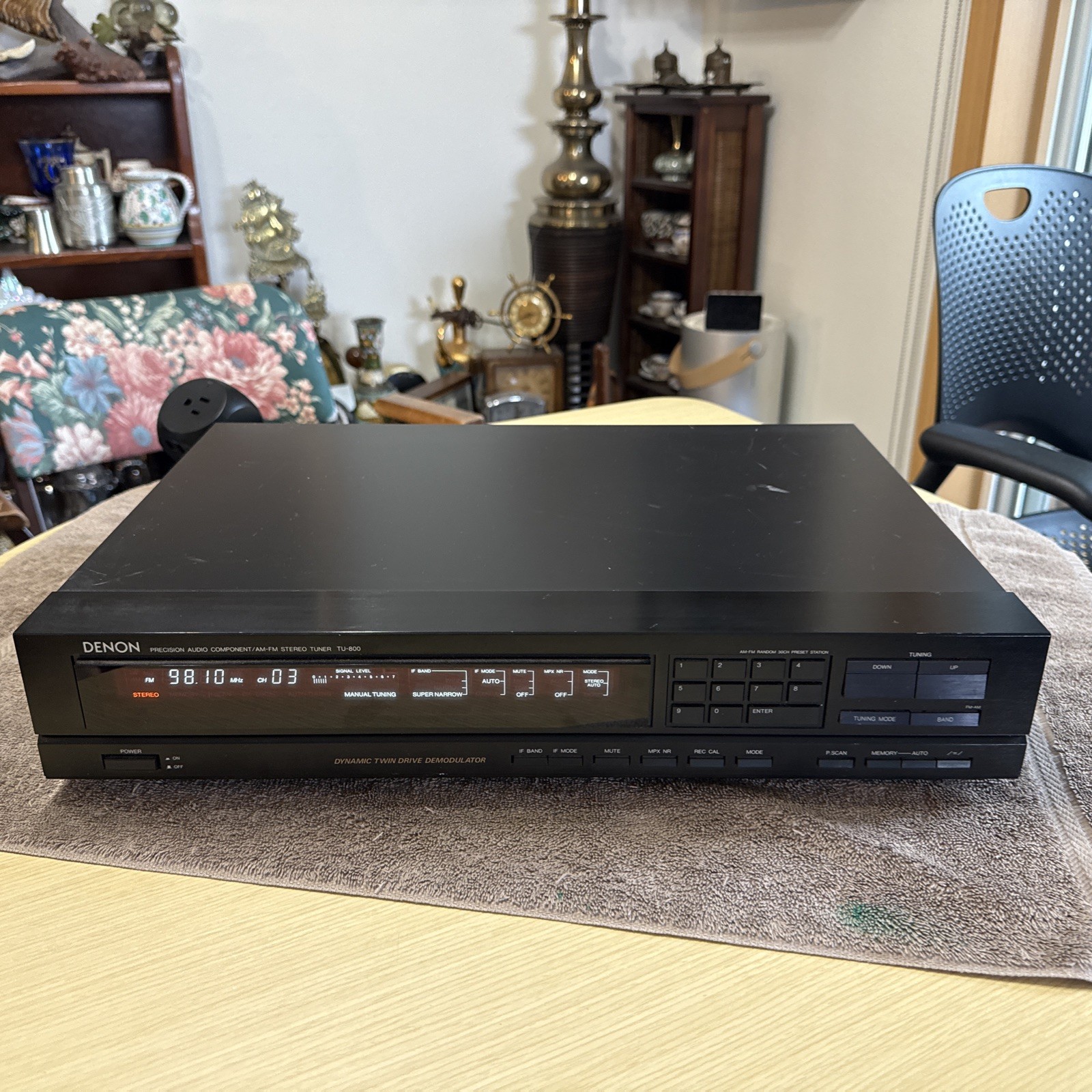
One of the TU-550’s standout features was its digital frequency display using red LED readouts—a relatively advanced feature for its time—offering clear, immediate feedback during tuning. This, combined with a precision mechanical tuning knob, gave users both tactile and visual control, bridging the gap between analog tradition and emerging digital convenience.
Sound Characteristics and Performance
The TU-550 was not just a technical marvel—it was a musical one. Denon’s engineers tuned the audio circuitry to deliver a smooth, natural midrange with excellent stereo imaging. Unlike some tuners of the era that leaned toward clinical precision, the TU-550 preserved the warmth and presence of live broadcasts, making it especially well-suited for classical, jazz, and vocal performances.
Its dual-conversion IF system minimized image interference and local oscillator leakage, resulting in a clean, stable signal even in crowded frequency bands. The high stereo separation (40 dB) ensured that left and right channels remained distinct, enhancing the sense of space and realism.
Listeners often praise the TU-550 for its low noise floor and excellent weak-signal performance. When paired with a good outdoor antenna, it could pull in distant stations with surprising clarity. Its limiter circuit effectively tamed multipath distortion, a common issue in urban environments, without squashing dynamic content.
Notable Features and Innovations
While Denon didn’t radically reinvent the tuner with the TU-550, they refined the formula with thoughtful engineering:
- Quartz-Locked Synthesis: This ensured exceptional frequency stability. Once tuned, the station stayed locked without drift—ideal for long listening sessions.
- Dual Antenna Inputs: The inclusion of both 75Ω coaxial and 300Ω twin-lead inputs made it adaptable to a wide range of antenna systems, from modern rooftop setups to older dipole antennas.
- Defeat Stereo Button: A useful feature for reducing noise when listening to weak mono stations, allowing the tuner to operate in mono mode for improved signal-to-noise ratio.
- Tuning Meter and Signal Strength Indicator: An analog S-meter provided real-time feedback on signal strength, helping users optimize antenna positioning.
- Solid Build Quality: Housed in a heavy-gauge steel chassis with a brushed aluminum front panel, the TU-550 exuded durability. Internal layout was clean, with high-quality capacitors and discrete components throughout.
Unlike some tuners that prioritized flashy displays or gimmicks, the TU-550 focused on core performance—tuning accuracy, signal integrity, and audio fidelity.
Common Issues and Maintenance
As with any vintage electronic equipment, the Denon TU-550 benefits from careful maintenance after decades of service. While generally reliable, a few issues are commonly reported:
- Deteriorating Electrolytic Capacitors: Over time, the power supply and audio coupling capacitors can dry out, leading to hum, reduced output, or power failure. A full recapping by a qualified technician is recommended for units that haven’t been serviced in years.
- LED Display Fading: The red LED frequency display can dim with age. While not always repairable, some technicians can replace individual segments or retrofit modern LED modules.
- Tuning Knob Wear: The mechanical potentiometer behind the tuning knob may develop crackling or uneven response. Cleaning with contact cleaner can help, but replacement may be necessary in severe cases.
- Antenna Terminal Corrosion: Especially in coastal areas, the 300Ω screw terminals can corrode. Regular inspection and cleaning ensure optimal signal transfer.
Despite these age-related concerns, the TU-550 is relatively straightforward to service. Its modular design and widespread use of standard components make repairs more accessible than some of its contemporaries.
Current Market Value and Collectibility
The Denon TU-550 is not a rare unicorn, but it’s not common either. It occupies a sweet spot for collectors who appreciate understated, high-performance gear from the late 1970s. In working condition, with a bright display and clean casing, the TU-550 typically sells for $200–$350 on the secondary market. Fully restored units with upgraded capacitors and cleaned controls can command higher prices, especially when sold with original packaging or manuals.
While it doesn’t carry the cult status of a Sony ST-5555 or a Kenwood KT-9100, the TU-550 is increasingly recognized for its balanced performance and build quality. It’s particularly sought after by enthusiasts building period-correct Denon systems—paired with amplifiers like the PMA-550 or DRA-550.
Conclusion and Legacy
The Denon TU-550 may not have made headlines in its day, but it exemplifies Denon’s commitment to engineering excellence during a pivotal era in audio history. It wasn’t about flash or marketing—it was about delivering a tuner that performed with accuracy, stability, and musicality.
Today, the TU-550 stands as a quiet achiever among vintage FM tuners. For those who still enjoy the art of radio—whether it’s a late-night jazz broadcast or a live orchestral performance—it remains a compelling choice. Its blend of analog warmth and digital precision makes it more than a relic; it’s a functional piece of audio heritage.
In an age of streaming and digital silence, the Denon TU-550 reminds us that there’s still magic in the airwaves—if you have the right receiver to hear it.
eBay Listings


As an eBay Partner, we earn from qualifying purchases. This helps support our independent vintage technology research.
Related Models
- Denon TU-1500RD (1995)
- Denon TU-280 (1976)
- Denon TU-501 (1977)
- Denon TU-750S (1975)
- Denon TU-400 (1976)
- Aiwa CS-250 (1978)
- Luxman R-1030 (1979)
- Luxman R-1050 (1975)
- Luxman R-117 (1975)
- Denon TU-660 (1978)