Denon TU-530: The Quiet Master of FM Tuning
In the mid-1970s, Japanese audio manufacturers were locked in a golden race to deliver the ultimate high-fidelity listening experience. Denon, already renowned for its professional recording equipment and precision engineering, entered the consumer market with a series of components that balanced technical excellence with musicality. Among these was the Denon TU-530, an FM tuner that, while not as widely celebrated as some of its contemporaries, stands today as a quiet masterpiece of analog radio reception and sonic refinement.
Stereo FM had become mainstream, and audiophiles were increasingly demanding tuners that could extract every nuance from broadcast signals. Denon answered with a design philosophy rooted in measurement-driven performance and musical transparency—hallmarks of the brand’s engineering ethos.
Though Denon is perhaps better known for its amplifiers and turntables of the era, the TU-530 represents a focused effort to deliver reference-grade FM reception in a compact, no-frills package. It was part of a broader Denon lineup that included the P-530 phono preamp and D-530 power amplifier, suggesting it was intended as a key component in a high-end integrated system.
Technical Specifications
The TU-530 was engineered with a strong emphasis on signal clarity, selectivity, and stability. While full schematics are scarce today, surviving units and service documentation reveal a well-thought-out design typical of Denon’s meticulous approach.
| Specification | Detail |
| Model | TU-530 |
| Tuner Type | FM Stereo |
| Frequency Range | 87.5–108 MHz |
| Tuning Method | Analog dial with mechanical counter |
| IF Frequency | 10.7 MHz (standard for FM) |
| Sensitivity | Approx. 1.5 µV for 30 dB SNR (typical) |
| Selectivity | >70 dB at ±400 kHz (excellent rejection) |
| Signal-to-Noise Ratio | >70 dB (weighted) |
| Harmonic Distortion | <0.5% (1 kHz, full modulation) |
| Audio Outputs | RCA (L/R), 1V nominal |
| Antenna Inputs | 75Ω coaxial, 300Ω twin-lead (via adapter) |
| Power Requirements | 110–120V AC, 50/60 Hz |
| Power Consumption | 25 watts |
| Dimensions (W×H×D) | 430 × 140 × 320 mm (approx. 17" × 5.5" × 12.6") |
| Weight | 8.5 kg (18.7 lbs) |
The TU-530 features a double-conversion superheterodyne circuit, a design choice that enhances selectivity and reduces image interference—critical for clean reception in urban environments. Its quartz-locked tuning system (though not digital) provides remarkably stable station retention, minimizing drift even during extended listening sessions.
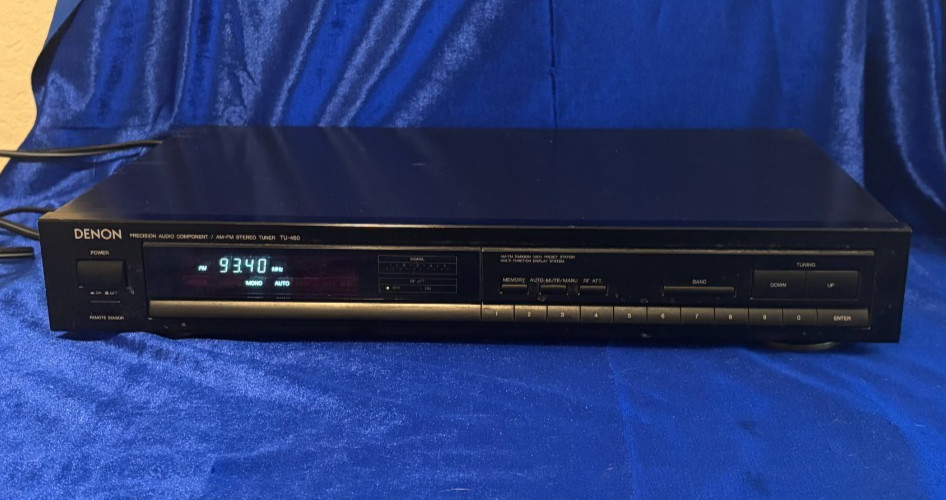
Unlike later synthesized tuners, the TU-530 relies on a precision mechanical tuning dial with a large, easy-to-read analog meter for signal strength and stereo separation. This gives users a tactile, intuitive experience—tuning becomes a ritual, not a menu dive.
Sound Characteristics and Performance
The Denon TU-530 doesn’t just receive FM signals—it interprets them with a level of finesse that surprises even seasoned collectors. Its audio stage uses discrete transistor circuitry (no ICs), contributing to a warm, natural tonal balance that avoids the clinical edge found in some contemporary tuners.
Midrange clarity is exceptional, making it ideal for vocal-heavy programming, jazz broadcasts, and classical music. The stereo image is wide and stable, with precise center imaging and excellent channel separation. Bass response remains tight and controlled, while highs are detailed without being harsh—thanks in part to Denon’s careful filtering and de-emphasis networks.
In real-world use, the TU-530 excels in areas with moderate to strong signal strength. Its high selectivity allows it to isolate desired stations even in crowded frequency bands, and its low noise floor ensures quiet backgrounds between tracks. When paired with a good outdoor antenna, it can pull in distant stations with remarkable fidelity.
Notable Features and Innovations
While the TU-530 may appear conservative in design, it incorporates several thoughtful features:
- Dual Antenna Inputs: Supports both 75Ω coaxial and 300Ω twin-lead, offering flexibility for different antenna types.
- Stereo/Mono Switch: Allows users to switch to mono for weak signals, improving clarity and reducing noise.
- Tuning Meter: A large center-mounted meter displays both signal strength and stereo pilot lock, providing visual feedback for optimal tuning.
- High Stability Oscillator: Engineered to minimize drift, ensuring stations stay locked in during temperature changes.
- Low-Jitter Demodulation Circuit: Contributes to a smooth, analog-rich stereo decode.
Denon also paid close attention to internal layout and shielding, minimizing crosstalk and RF interference. The chassis is solidly constructed with a steel frame and heavy-duty components, reflecting the brand’s professional heritage.
Common Issues and Maintenance
As with any 50-year-old electronic device, the Denon TU-530 benefits from careful restoration and maintenance. Common issues include:
- Dried-up electrolytic capacitors: The power supply and audio coupling caps should be checked or replaced to prevent hum or distortion.
- Tuning dial stiffness: The mechanical tuner can become sticky over time; cleaning and lubrication of the dial cord and pulley system are recommended.
- Worn potentiometers: The volume and balance controls (if present in later variants) may develop crackling; contact cleaner or replacement is advised.
- Antenna terminal corrosion: Especially on the 300Ω terminals; cleaning with electrical contact spray helps maintain signal integrity.
- Rubber aging: Any rubber gaskets or damping materials may have degraded; replacement improves both function and appearance.
Despite its age, the TU-530 is relatively serviceable. Many of its components are through-hole and standardized, making repairs feasible for experienced technicians. Finding an original remote or manual is rare, but not critical to operation.
Current Market Value and Collectibility
The Denon TU-530 remains a sleeper classic in the vintage audio world. It doesn’t command the high prices of rare Luxman or Accuphase tuners, but its value is quietly rising among discerning collectors.
As of 2024, a fully functional TU-530 in good cosmetic condition typically sells for $250–$400, depending on region and included accessories. Units with original packaging, manuals, or matching-number chassis may fetch slightly more. Restored models with recapped power supplies and calibrated tuning can command premiums, especially when sold as part of a Denon 530-series system.
Its collectibility is bolstered by Denon’s reputation for engineering integrity and the growing appreciation for analog tuners in the age of streaming. For enthusiasts building period-correct 1970s systems, the TU-530 offers both authenticity and performance.
Conclusion and Legacy
The Denon TU-530 may not have the flashy badges or digital displays of later tuners, but it embodies the essence of what made 1970s Japanese hi-fi so compelling: precision, simplicity, and musical truth. It’s a tuner built for listeners, not spec-sheet warriors.
In an era when music consumption is increasingly virtual, the TU-530 reminds us of the joy of tuning in—the ritual of adjusting a dial, watching the meter dance, and locking onto a distant station with startling clarity. It’s a machine that connects you not just to the music, but to the airwaves themselves.
For vintage audio enthusiasts, the TU-530 is more than a tuner—it’s a well-kept secret. And for those who discover it, it’s often the beginning of a deeper appreciation for Denon’s underappreciated legacy in the golden age of analog sound.
eBay Listings


As an eBay Partner, we earn from qualifying purchases. This helps support our independent vintage technology research.
Related Models
- Denon TU-1500RD (1995)
- Denon TU-280 (1976)
- Denon TU-501 (1977)
- Denon TU-550 (1978)
- Denon TU-750S (1975)
- Aiwa CS-250 (1978)
- Luxman R-1030 (1979)
- Luxman R-1050 (1975)
- Luxman R-117 (1975)
- Denon TU-400 (1976)