Denon TU-500: The Quiet Giant of 1970s FM Tuning
In the golden age of high-fidelity audio during the mid-1970s, Japanese manufacturers like Denon were pushing the boundaries of performance, precision, and engineering excellence. While Denon is perhaps best known today for its high-end CD players and AV receivers, its legacy in analog audio—particularly in FM tuners—is both deep and impressive. The Denon TU-500, introduced in 1975, stands as a testament to the company’s commitment to broadcast fidelity during a time when FM radio was experiencing a renaissance in music programming and stereo broadcasting.
Though not as widely discussed as some of its contemporaries from Yamaha, Pioneer, or Sansui, the TU-500 carved out a quiet but respected reputation among audiophiles and broadcast enthusiasts for its clean tuning, stable reception, and Denon’s signature build quality. It represents a period when FM tuners were not just accessories to receiver systems but standalone components worthy of careful design and critical listening.
Technical Specifications
The TU-500 was engineered with a focus on signal clarity, selectivity, and low noise—hallmarks of Denon’s engineering philosophy. While detailed service manuals are scarce today, surviving units and user reports confirm its robust internal architecture and thoughtful circuit design.
| Specification | Detail |
| Model | Denon TU-500 |
| Year Introduced | 1975 |
| Tuner Type | FM Stereo |
| Tuning Method | Analog dial with mechanical counter |
| Frequency Range | 87.5 – 108 MHz |
| IF Frequency | 10.7 MHz |
| Sensitivity | Approx. 1.8 µV for 30 dB SNR |
| Selectivity | High (typical of dual-conversion designs) |
| Signal-to-Noise Ratio | >70 dB (weighted) |
| Harmonic Distortion | <0.5% |
| Audio Outputs | RCA (L/R), unbalanced |
| Antenna Inputs | 75Ω coaxial, 300Ω twin-lead (via adapter) |
| Power Requirement | 120V AC, 60 Hz, ~15W |
| Dimensions (W×H×D) | 430 × 140 × 320 mm |
| Weight | 9.5 kg (approx. 21 lbs) |
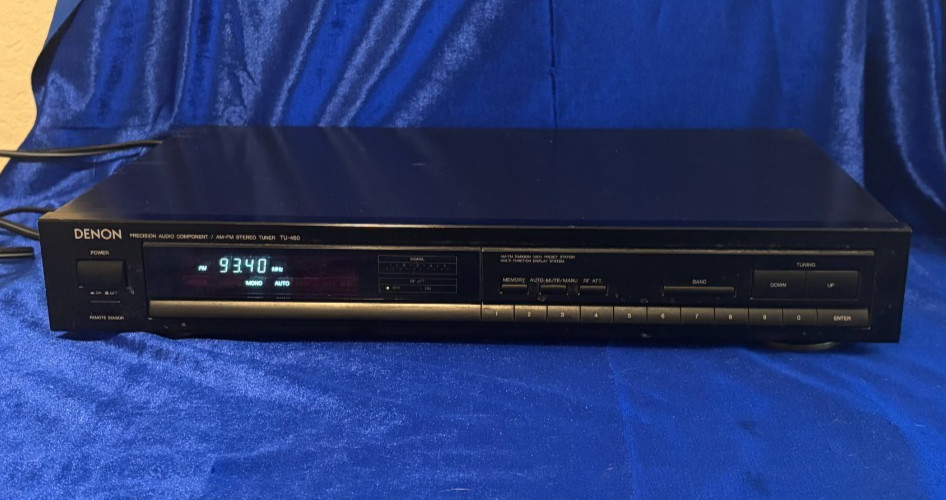
The TU-500 features a dual-conversion superheterodyne circuit, a design favored in high-end tuners of the era for its superior image rejection and stability. This topology reduces interference and improves reception in urban environments where strong adjacent signals can overwhelm lesser tuners. Its front panel includes a large, easy-to-read analog tuning dial with a mechanical digital frequency counter—a hallmark of precision in the pre-digital-display age.
Sound Characteristics and Performance
The Denon TU-500 delivers a sound signature that is best described as neutral, detailed, and dynamically expressive. Unlike some tuners that color the sound with excessive brightness or bass bloat, the TU-500 aims for transparency, letting the broadcast signal speak for itself. When paired with a strong antenna and a clean signal, it reveals subtle nuances in orchestral decay, vocal presence, and stereo imaging that many modern digital tuners still struggle to match.
Its stereo decoder circuitry ensures accurate channel separation—often exceeding 40 dB—resulting in a spacious and well-defined soundstage. Bass response is tight and controlled, while highs remain smooth without edginess, even on over-modulated stations. The low noise floor means quiet passages are truly quiet, enhancing the listening experience during classical or jazz broadcasts.
Many users report that the TU-500 excels in weak-signal areas, thanks to its high sensitivity and excellent front-end filtering. Its ability to reject adjacent-channel interference makes it particularly effective in crowded FM bands.
Notable Features and Innovations
While the TU-500 may appear modest compared to flashier tuners with illuminated meters and digital readouts, it packs several features that were advanced for its time:
- Mechanical Digital Frequency Counter: Unlike simple analog dials, the TU-500 uses a rotating drum counter that displays the exact frequency in 0.1 MHz increments. This allowed for precise tuning and easy station recall—especially useful before the advent of synthesized tuning.
- High-Stability Local Oscillator: Engineered to minimize drift, the oscillator ensures that once tuned, the station stays locked in, even during extended listening sessions or temperature fluctuations.
- Dual Antenna Inputs: The inclusion of both 75Ω coaxial and 300Ω twin-lead inputs provides flexibility for various antenna setups, from rooftop Yagis to indoor dipoles.
- Stereo/Mono Switch: Allows users to manually switch to mono for weak signals, improving intelligibility and reducing noise—a thoughtful touch for fringe-area listeners.
- Tape Loop and Fixed Output: The rear panel includes a tape output for recording and a fixed-level output option, making it easy to integrate with preamps or integrated amplifiers.
Denon also paid close attention to internal layout and shielding. The tuner chassis is heavily shielded to prevent RF leakage and external interference, and the power supply is well-regulated to avoid introducing hum or noise into the sensitive RF stages.
Common Issues and Maintenance
As with any vintage electronic equipment, the Denon TU-500 benefits from periodic maintenance, especially after decades of use.
- Deteriorating Capacitors: Electrolytic capacitors in the power supply and audio coupling circuits may dry out over time. Replacing them (recapping) is often recommended to restore performance and prevent potential damage.
- Tuning Dial Stiffness: The mechanical tuning dial and counter can become stiff due to dried lubricants. A careful cleaning and relubrication with appropriate grease can restore smooth operation.
- Oxidized Controls and Switches: The volume and function controls may develop crackling due to oxidation. Contact cleaner (applied carefully) can resolve this, though potentiometers may need replacement if worn.
- Antenna Terminal Corrosion: Outdoor antenna connections are prone to corrosion. Inspecting and cleaning these terminals ensures optimal signal transfer.
- Rubber Belt (if applicable): Some units may use a rubber belt for counter drive. If present, it may have perished and require replacement.
Given Denon’s high build standards, most TU-500 units that have been stored properly remain functional. The use of through-hole components and robust PCB construction makes repairs more accessible than in modern surface-mount gear.
Current Market Value and Collectibility
The Denon TU-500 is not a rare unicorn, but it’s also not commonly seen on the vintage market. It occupies a niche space—appreciated by tuner enthusiasts and Denon collectors, but often overlooked by casual buyers.
As of 2024, a fully functional TU-500 in good cosmetic condition typically sells for $150–$250 USD. Units with working counters, clean dials, and verified performance can command higher prices, especially when part of a matching Denon separates system (such as those paired with the PMA-500 amplifier or DRA-500 receiver).
Its collectibility is moderate. While it lacks the celebrity status of the TU-1500 or the later digital-synthesized TU-800, the TU-500 is recognized as a solid performer from Denon’s analog heyday. It appeals to listeners who value analog tuning feel, mechanical precision, and the ritual of FM discovery.
Conclusion and Legacy
The Denon TU-500 may not have made headlines in its day, but it exemplifies the quiet excellence that defined Denon’s approach to high-fidelity audio. In an era when many manufacturers cut corners, Denon invested in engineering integrity, and the TU-500 reflects that philosophy.
Today, it stands as a capable and musical FM tuner that can still hold its own against modern alternatives—especially when fed a good antenna signal. For vintage audio enthusiasts, it’s a rewarding component that brings warmth, clarity, and authenticity to FM broadcasting. Whether you're building a classic separates system or simply appreciate the art of analog tuning, the TU-500 deserves a place on your rack.
It’s a reminder that sometimes, the most enduring gear isn’t the flashiest—it’s the one that simply works, beautifully, year after year.
eBay Listings


As an eBay Partner, we earn from qualifying purchases. This helps support our independent vintage technology research.
Service Manuals & Schematics
- Manual — archive.org
Related Models
- Denon TU-1500RD (1995)
- Denon TU-280 (1976)
- Denon TU-501 (1977)
- Denon TU-550 (1978)
- Denon TU-750S (1975)
- Aiwa CS-250 (1978)
- Luxman R-1030 (1979)
- Luxman R-1050 (1975)
- Luxman R-117 (1975)
- Denon TU-400 (1976)