Denon TU-300: The Quiet Master of Vintage FM Tuning
Picture the late 1970s: turntables spinning, reel-to-reel decks humming, and FM radio emerging as the audiophile’s medium of choice. Into this golden era stepped the Denon TU-300, a stereo FM tuner launched in 1978 that quietly redefined what analog broadcast reception could be. Not flashy, never loud, the TU-300 was built for listeners who cared more about clarity than credentials. It didn’t chase trends—it refined them. With its precise tuning, clean signal path, and understated elegance, this Denon tuner became a silent partner in countless high-fidelity systems, delivering music with a fidelity that still impresses today.
While it never reached the iconic status of Denon’s PMA-250 amplifier or DP-6000 turntable, the TU-300 embodies the brand’s quiet confidence during a pivotal moment. As Japanese audio engineering surged ahead, Denon carved a niche with components that married technical rigor with musical soul. At a time when FM stereo broadcasts were revealing new depths in recordings, the TU-300 stood ready—engineered to extract every nuance, every breath of stereo separation, from the airwaves.
Technical Specifications
| Specification | Detail |
| Model | Denon TU-300 |
| Year Introduced | 1978 |
| Tuner Type | FM Stereo |
| Frequency Range | 87.5–108 MHz |
| Tuning Method | Analog dial with mechanical counter |
| IF Frequency | 10.7 MHz |
| Sensitivity (Mono) | Approx. 1.5 µV for 30 dB SNR |
| Sensitivity (Stereo) | Approx. 2.5 µV for 30 dB SNR |
| Selectivity | ~75 dB at ±400 kHz |
| S/N Ratio (Stereo) | >60 dB (weighted) |
| Harmonic Distortion | <0.5% |
| Audio Output | 0.5 V (RCA, line level) |
| Input Impedance | 47 kΩ |
| Antenna Input | 75 Ω (coaxial), 300 Ω (twin-lead) |
| Power Supply | AC 120V / 60Hz (North American version) |
| Power Consumption | ~15 watts |
| Dimensions (W×H×D) | 430 × 140 × 330 mm |
| Weight | 7.5 kg (16.5 lbs) |
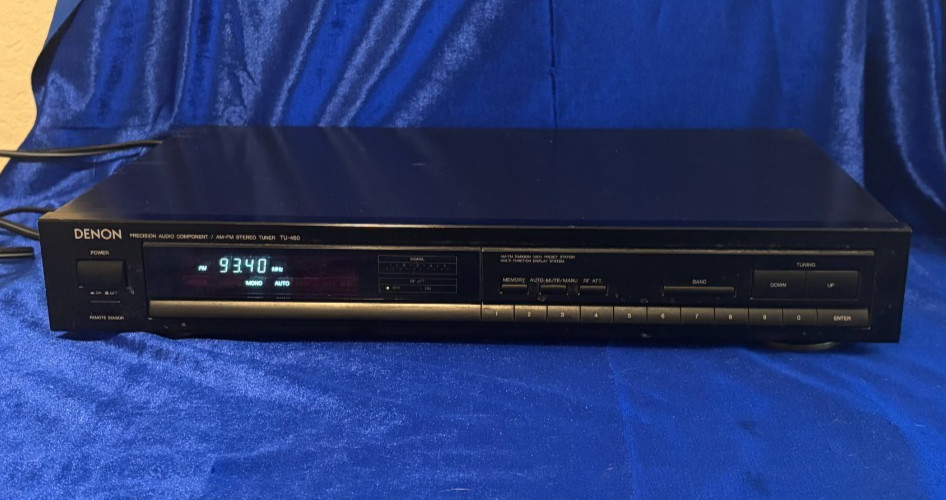
Turn the knob, watch the mechanical counter click into place—this is tuning as ritual. The TU-300’s large, knurled dial and precise 0.1 MHz mechanical readout harken back to an age when finding a station was an act of intention, not automation. No digital presets, no memory banks—just direct, tactile control. The brushed aluminum front panel keeps things elegant and uncluttered: a central dial, a small frequency window, a glowing stereo indicator, and a responsive signal strength meter. Every detail serves the mission: pulling pristine audio from the ether.
Sound Characteristics and Performance
Listen to the TU-300, and you hear why analog FM still has devotees. Its sound is clear, balanced, and alive—a far cry from the cold precision of later digital tuners. There’s warmth here, especially in the upper mids and treble, smoothing out harsh broadcasts without dulling detail. Vocals cut through with presence, instruments retain their natural texture, and bass stays tight, never bloated.
The secret lies in its well-tuned IF stage and robust noise rejection. In cities with crowded airwaves, the TU-300 holds its ground, shutting out adjacent channels with ~75 dB of selectivity. Its stereo decoder locks on cleanly, delivering 35–40 dB of separation under good conditions—a wide, stable soundstage that makes FM feel immersive. With a decent antenna and a clear night, it can pull in distant stations with startling clarity, revealing the quiet magic of over-the-air radio.
And then there’s the experience. Twisting the dial, watching the S-meter respond, hearing the stereo light flick on—it’s a sensory loop digital tuning can’t replicate. For many, this is the heart of vintage audio: not convenience, but connection.
Notable Features and Innovations
The TU-300 doesn’t shout, but it speaks with authority. Its design choices reflect Denon’s no-compromise ethos:
- Dual Antenna Inputs: Whether you’re using coaxial cable or 300Ω twin-lead, the TU-300 adapts. That flexibility made it a favorite for both apartment dwellers and suburban hobbyists with rooftop antennas.
- Mechanical Digital Frequency Counter: A major step up from analog needles, this counter delivers repeatable tuning—essential for locking onto weak or fringe stations.
- High-Quality RF Front End: Shielding, precision transistors, and careful layout minimize noise and oscillation, giving the TU-300 its exceptional sensitivity.
- Discrete Audio Circuitry: No ICs in the output stage—just discrete components preserving the analog signal path, contributing to its rich, organic tone.
Inside, the build is pure 1970s Denon: point-to-point wiring, high-grade capacitors, and a heavy steel chassis that resists microphonics and interference. This isn’t just a tuner—it’s a component built to last.
Common Issues and Maintenance
After 45 years, a little TLC is expected. But the TU-300’s straightforward design makes it one of the more serviceable vintage tuners around.
- Deteriorating Capacitors: Electrolytics in the power supply and audio path can dry out, causing hum or failure. A full recapping is often all an old unit needs to come back to life.
- Tuning Dial Stiffness: Old lubricants gum up over time. Cleaning and relubricating the tuning capacitor restores that smooth, buttery feel.
- Worn Antenna Terminals: The 300Ω screw terminals may corrode or loosen. A quick clean with contact spray and a snug tightening can revive weak reception.
- Signal Meter Drift: The analog S-meter can lose calibration, but a trimmer pot on the board usually brings it back in line.
Regular use of contact cleaner on jacks and controls keeps everything responsive. For vintage technicians, the TU-300 is a welcome project—simple, well-documented, and rewarding to restore.
Current Market Value and Collectibility
The TU-300 isn’t a blue-chip collector’s item, but it’s far from forgotten. Among FM tuning enthusiasts and Denon loyalists, it’s appreciated for what it is: a well-engineered, sonically satisfying component. On the market, working units typically sell for $100–$200 USD, with price depending on condition and region. Fully restored models—recapped, calibrated, and cosmetically cleaned—often fetch premiums.
Its real value? Usability. For someone assembling a vintage Denon stack—say, a PMA-350 amp and DRA-1000 receiver—the TU-300 isn’t just a match in looks. It’s a match in sound, completing a system that feels cohesive, authentic, and alive.
Conclusion and Legacy
The Denon TU-300 didn’t make headlines. It didn’t win awards. But in the quiet corners of listening rooms across the world, it earned something better: trust. It’s a tuner built for the long haul, for listeners who valued subtlety over spectacle. In today’s world of lossless streams and silent silence, the TU-300 reminds us of FM’s golden promise—music arriving on airwaves, full of life and surprise.
It’s not just a piece of gear. It’s a ritual. A moment. A reminder that sometimes, the quietest components speak the loudest.
eBay Listings


As an eBay Partner, we earn from qualifying purchases. This helps support our independent vintage technology research.
Related Models
- Denon TU-1500RD (1995)
- Denon TU-280 (1976)
- Denon TU-501 (1977)
- Denon TU-550 (1978)
- Denon TU-750S (1975)
- Aiwa CS-250 (1978)
- Luxman R-1030 (1979)
- Luxman R-1050 (1975)
- Luxman R-117 (1975)
- Denon TU-400 (1976)