Denon TU-1500RD: The Audiophile's Tuner from the Golden Era of Hi-Fi
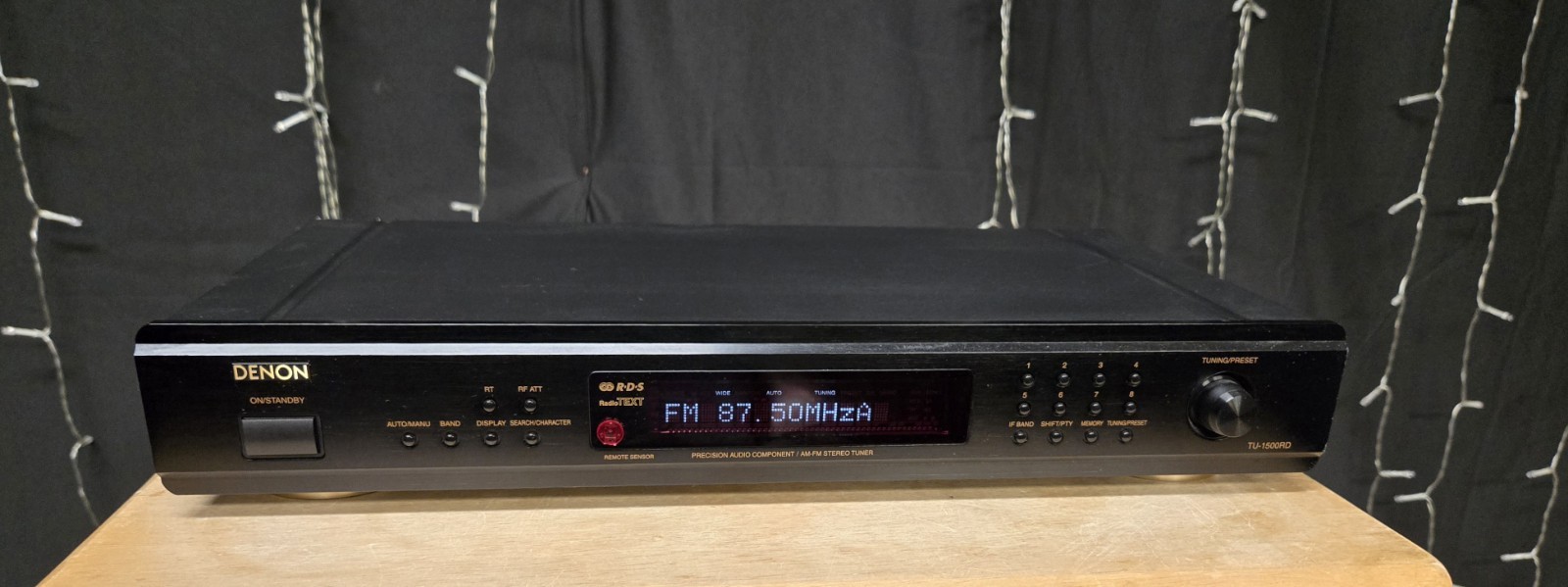
In the mid-1990s, as digital audio began to take hold and compact discs dominated the music landscape, Denon quietly released a masterpiece of analog radio reception: the TU-1500RD. Though often overshadowed by the era’s flashy receivers and CD players, this standalone FM/AM tuner exemplifies Denon’s commitment to high-fidelity sound and precision engineering. Designed for discerning listeners who still valued the warmth and serendipity of broadcast radio, the TU-1500RD stands as a testament to the art of tuning in — literally and figuratively.
Part of Denon’s premium component lineup, the TU-1500RD was built during a transitional period in audio history, when manufacturers still invested heavily in analog circuitry while beginning to incorporate digital control systems. The result is a hybrid design that marries the sonic purity of analog signal paths with the convenience and accuracy of digital tuning — a balance that continues to attract vintage audio enthusiasts today.
Technical Specifications
The TU-1500RD was engineered for performance, not compromise. Its specifications reflect Denon’s pursuit of low noise, high selectivity, and exceptional signal clarity.
| Specification | Detail |
| Model | TU-1500RD |
| Year Introduced | 1998 |
| Tuner Type | FM/AM Stereo |
| FM Frequency Range | 87.5–108.0 MHz |
| AM Frequency Range | 530–1710 kHz (10 kHz steps) |
| Tuning Steps (FM) | 50 kHz, 100 kHz, 200 kHz selectable |
| IF Filters | Four IF filters |
| Signal-to-Noise Ratio | 74 dB (FM), 53 dB (MW) |
| Total Harmonic Distortion | Mono 0.08 %, Stereo 0.12 % |
| Stereo Separation | >50 dB (FM, 1 kHz) |
| Output Level | 200 mV (FM), 3 mV (AM) |
| Output Impedance | 100 Ω |
| Tuning Display | Fluorescent 2-line alphanumeric display |
| Presets | 40 total (AM/FM) |
| Inputs | None |
| Outputs | Fixed stereo RCA, 75Ω FM antenna out |
| Power Requirement | 120V AC, 60 Hz, 15W |
| Dimensions (W×H×D) | 435 × 134 × 334 mm (17.1 × 5.3 × 13.1 in) |
| Weight | 9.5 kg (20.9 lbs) |
The TU-1500RD features a sophisticated double-conversion superheterodyne FM section with dual intermediate frequency (IF) stages, which significantly improves image rejection and adjacent channel selectivity. This design reduces interference and enhances reception in urban environments where signal crowding is common. The AM section benefits from a high-performance ferrite bar antenna and advanced filtering to minimize noise and deliver clear medium-wave reception — a rarity in many tuners of the era.
Sound Characteristics and Performance
While tuners are often judged solely on their ability to lock onto stations, the TU-1500RD goes further by delivering a listening experience that rivals dedicated audio components. Its FM stage is exceptionally transparent, with a wide, stable stereo image and a neutral tonal balance. Bass response is tight and well-defined, while highs remain smooth and detailed without harshness — a hallmark of Denon’s analog design philosophy.
One of the standout qualities of the TU-1500RD is its low noise floor. Even with weaker signals, the background remains quiet, allowing subtle musical nuances to come through. The tuner’s stereo decoder is highly accurate, preserving the spatial cues broadcast in stereo FM, making it ideal for classical, jazz, and live radio broadcasts.
AM reception is equally impressive. Thanks to its advanced IF filtering and low-distortion circuitry, the TU-1500RD can extract remarkable clarity from AM signals, often revealing detail that cheaper tuners bury in static and hum. Talk radio, news, and sports broadcasts gain a new level of intelligibility, and vintage music stations on AM take on a surprisingly full-bodied character.
Notable Features and Innovations
The TU-1500RD was packed with features that set it apart from both budget tuners and even some high-end competitors:
- Digital Synthesizer Tuning with Analog Feel: Using a phase-locked loop (PLL) system, the TU-1500RD offers precise frequency control with minimal drift. Yet, Denon retained a smooth, responsive tuning knob that gives users a tactile connection to the process — a thoughtful nod to traditionalists.
- Selectable IF Bandwidth: A rare feature in consumer tuners, this allows users to narrow or widen the IF filter to optimize reception based on signal strength and interference. Narrow mode improves selectivity in crowded bands; wide mode preserves full stereo bandwidth for strong local stations.
- High-Visibility Fluorescent Display: The dual-line display shows frequency, station name (user-programmable), tuning mode, and signal strength. It’s bright, easy to read, and retains a classic Denon aesthetic.
- Premium Build Quality: Housed in a rigid steel chassis with a brushed aluminum front panel, the TU-1500RD feels substantial and well-damped. Internal layout emphasizes short signal paths and shielding to prevent crosstalk and RF interference.
Common Issues and Maintenance
As with any 30-year-old electronic equipment, the TU-1500RD may require some attention to remain in top condition. Fortunately, Denon’s build quality means most units still function well if properly maintained.
- Capacitor Aging: The most common issue is drying or leaking electrolytic capacitors, particularly in the power supply. Replacing these as a preventive measure can extend the tuner’s life and improve performance.
- Display Dimming: The fluorescent display may dim over time. While not easily replaceable, some technicians have successfully refurbished them or substituted with modern equivalents.
- Tuning Knob Stiffness: The mechanical tuning knob can become stiff due to dried lubricant. A careful disassembly and re-lubrication with appropriate grease usually resolves this.
- Antenna Connections: Ensure the 75Ω FM antenna output and AM loop connections are secure. Using a high-quality outdoor FM antenna dramatically improves reception, especially in weak signal areas.
Regular cleaning of controls and connectors with contact cleaner is recommended, especially if the unit has been in storage.
Current Market Value and Collectibility
The Denon TU-1500RD is not as widely collected as some of Denon’s legendary amplifiers or CD players, but it has a dedicated following among FM enthusiasts and vintage tuner aficionados. In excellent working condition, prices typically range below $200, depending on geographic location and included accessories like the original remote.
Units with bright displays, smooth tuning action, and full functionality command a premium. While not a "blue chip" vintage component like a Marantz 2270 or Sansui G-3300, the TU-1500RD is increasingly recognized for its engineering excellence and sonic performance.
Its collectibility is bolstered by its relative rarity — Denon produced fewer standalone tuners than integrated receivers — and its role as one of the last high-end analog tuners before digital radio began to dominate.
Conclusion and Legacy
The Denon TU-1500RD may not have the fame of a flagship receiver, but it represents the pinnacle of what a dedicated FM/AM tuner can achieve. In an age when most people stream music or use internet radio, the TU-1500RD reminds us of the joy of scanning the dial, discovering new stations, and experiencing broadcast audio at its finest.
For the vintage audio enthusiast, it’s a rewarding addition to any system — especially when paired with a high-quality amplifier and speakers. It proves that even in a digital world, there’s still magic in the airwaves, and Denon, with the TU-1500RD, gave us one of the best tools to capture it.
If you’re lucky enough to find one in good condition, don’t hesitate. The TU-1500RD isn’t just a tuner — it’s a window into the golden age of high-fidelity radio.
eBay Listings



As an eBay Partner, we earn from qualifying purchases. This helps support our independent vintage technology research.
Service Manuals & Schematics
- Owner's Manual — archive.org
- Owner's Manual — archive.org
Related Models
- Denon TU-280 (1976)
- Denon TU-501 (1977)
- Denon TU-550 (1978)
- Denon TU-750S (1975)
- Denon TU-400 (1976)
- Aiwa CS-250 (1978)
- Luxman R-1030 (1979)
- Luxman R-1050 (1975)
- Luxman R-117 (1975)
- Denon TU-660 (1978)