Denon DVD-5000
The $1,999 flagship that made "universal" a word audiophiles actually meant.
Overview
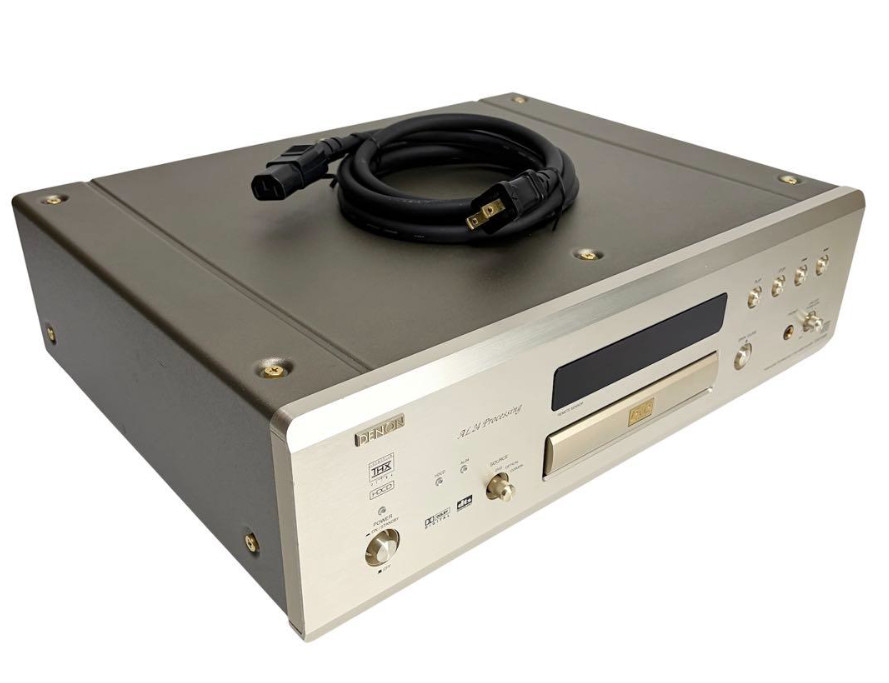
In the late 1990s the DVD format was still sorting itself out. The question was which player to buy, and whether one box could handle CD, DVD-Video, DVD-Audio, and SACD without embarrassing itself in any of them. Denon's answer was the DVD-5000, positioned at the very top of its lineup and priced at $1,999 when it landed (Audioholics). That is serious audiophile money, and the build backs it up. Owners describe a unit that weighs a ton and is built like a tank.
The DVD-5000 is best understood as a statement piece. Stereo Times called it Denon's flagship universal player, and the company used the phrase "state of the art" in its own materials. That's a bold claim for a first-generation universal disc spinner, but the spec sheet backed it up: Faroudja's DCDi video processing, a 108MHz/12-bit video DAC, and 24-bit/192kHz audio DACs across all channels. This was not a budget compromise in a nice chassis. Denon threw everything it had at the format wars.
The DVD-5000 largely succeeded. It wasn't a jack-of-all-trades that did everything poorly. Stereo Times noted it "sounds better than most CD players I've heard." That's a remarkable thing to say about a DVD player, and collectors still hunt for these today, laser issues and all.
Key Features
Faroudja DCDi Video Processing
The video section is built around Faroudja's DCDi processing. DCDi (Directional Correlational Deinterlacing) was designed to solve one of the hardest problems in early progressive-scan playback: rebuilding a full-resolution frame from interlaced source material without jagged edges on diagonals. The DVD-5000's implementation, combined with progressive scan and 3:2 pulldown detection, meant film-based DVDs could be watched at 480p without the combing artifacts that plagued cheaper players (Audioholics). HiFi-Stereo (January 1999, p.61) listed "topnotch audio and video performance" among the player's high points.
108MHz/12-Bit Video DAC
Feeding that DCDi processor was a 108MHz/12-bit video DAC, which was aggressive for the era. The 108MHz sampling rate allowed cleaner reconstruction of the analog video signal, which mattered for component video output in particular. Many players were still using 10-bit DACs at lower clock rates, so the 12-bit/108MHz combination gave the DVD-5000 headroom that videophiles could see on a good display. It translated to better grayscale and fewer visible artifacts in difficult material (Audioholics).
24-Bit/192kHz Audio DACs with AL24 Processing
The audio side is where the DVD-5000 separated itself from the pack. Denon fitted 24-bit/192kHz DACs for all channels - not just the stereo pair, but every channel in the 5.1 system. Many "universal" players were cutting corners on the surround channels at the time. Denon's AL24 processing was also applied to the audio path. It was designed to reconstruct low-level signal details lost in digital conversion, and Denon described the result as a more analog-like, less digital sound (Audioholics). Analog-like or just clean, the player could stand in for a dedicated CD player, a claim Stereo Times was willing to endorse.
Universal Disc Compatibility
The "universal" label meant the player could handle DVD-Video, DVD-Audio, SACD, and plain old CD (Audioholics). That list seems modest today, but in 1999 it was a real achievement. DVD-Audio and SACD were competing high-resolution formats, each backed by a different camp, and most players committed to one or the other. Denon built a machine that played both, plus everything else. The HiFi-Stereo review (January 1999, p.61) specifically noted the "full variety of inputs and outputs" as a high point, which counted for a player that had to feed both a video display and a multichannel audio system.
5.1-Channel Analog Outputs
The DVD-5000 predated the widespread adoption of HDMI, so it needed another way to deliver the high-resolution multichannel audio of DVD-Audio and SACD to an external processor or receiver. The answer was a full set of 5.1-channel analog audio outputs (Audioholics). It was the only way to get that audio out of the player without downconverting it to PCM or Dolby Digital. It let the player feed a high-end preamp or receiver's multichannel analog input directly, and it put the internal 24-bit/192kHz DACs to work. For owners with serious analog audio systems, this was the feature that justified the asking price.
Historical Context
The DVD-5000 arrived when DVD-Video had established itself, but DVD-Audio and SACD were still fighting for survival. One player that handled all three, plus CD, was novel. Denon positioned the DVD-5000 as the top of its DVD player lineup. Stereo Times noted that Denon itself called the player "state of the art," and the US version was identical to the Japanese version except for the AC voltage (Stereo Times). Denon didn't dumb down the export model.
The $1,999 price (Audioholics) meant this was not a mass-market machine. It was aimed at early adopters who wanted the best possible playback of every disc format then in existence. AVS Forum users have called it "the original to all those flagship universal players that followed, and in its day it was the benchmark," and noted that it was "the last great player not to have" DVI or HDMI.
HiFi-Stereo's review (January 1999, p.58) wasn't entirely uncritical. The reviewer flagged the flimsy plastic disc drawer as a disappointment at this price. The reviewer also found the display less distinctive than the rest of the design.
Today, the DVD-5000 is remembered as a classic — a machine that defined a category before the category even had a name. It wasn't the first DVD player, and it wasn't the last universal player, but it was the one that proved the concept could be executed at a genuinely high level. In its day, it was the benchmark (AVS Forum). That's not nostalgia talking; that's the assessment of people who were there.
eBay Listings


As an eBay Partner, we earn from qualifying purchases. This helps support our independent vintage technology research.
eBay Listings


As an eBay Partner, we earn from qualifying purchases. This helps support our independent vintage technology research.