Carver TX-11A: The Forgotten Tuner That Defined FM Clarity
In the golden era of high-fidelity audio during the late 1970s, few names carried the weight of innovation and sonic excellence quite like Carver Corporation. Founded by the legendary engineer Bob Carver, the company quickly earned a reputation for pushing the boundaries of what affordable audio equipment could achieve. While Carver is best known for its powerful amplifiers and receivers like the iconic M-400 and the celebrated CT-3, the Carver TX-11A stands as a lesser-known but equally important piece of the brand’s legacy — a high-performance FM tuner that brought broadcast fidelity to audiophile levels.
Released in 1978, the TX-11A was part of Carver’s early lineup of separates designed to deliver exceptional performance without the premium price tag. At a time when many manufacturers treated tuners as afterthoughts—tacked onto receivers with mediocre results—Carver took FM reception seriously. The TX-11A was engineered to extract every nuance from FM broadcasts, offering audiophiles a window into the world of live concerts, classical broadcasts, and high-quality stereo programming with remarkable clarity and stability.
Technical Specifications
| Specification | Detail |
| Model | Carver TX-11A |
| Year of Release | 1978 |
| Type | FM Stereo Tuner |
| Tuning System | Analog needle dial with illuminated pointer |
| Frequency Range | 87.5–108 MHz |
| Tuning Range | 205 kHz IF bandwidth |
| Sensitivity | 1.8 µV for 30 dB SNR (typical) |
| Selectivity | Excellent adjacent channel rejection |
| Signal-to-Noise Ratio | >70 dB (weighted) |
| Stereo Separation | >40 dB at 1 kHz |
| Harmonic Distortion | <0.5% at full output |
| Output Level | 0.5 V RMS (standard) |
| Output Impedance | 1 kΩ |
| Input for Antenna | 75Ω coaxial and 300Ω twin-lead |
| Power Requirement | 120V AC, 60 Hz, 25 watts |
| Dimensions (W×H×D) | 17" × 5.5" × 14" |
| Weight | 14 lbs (6.4 kg) |
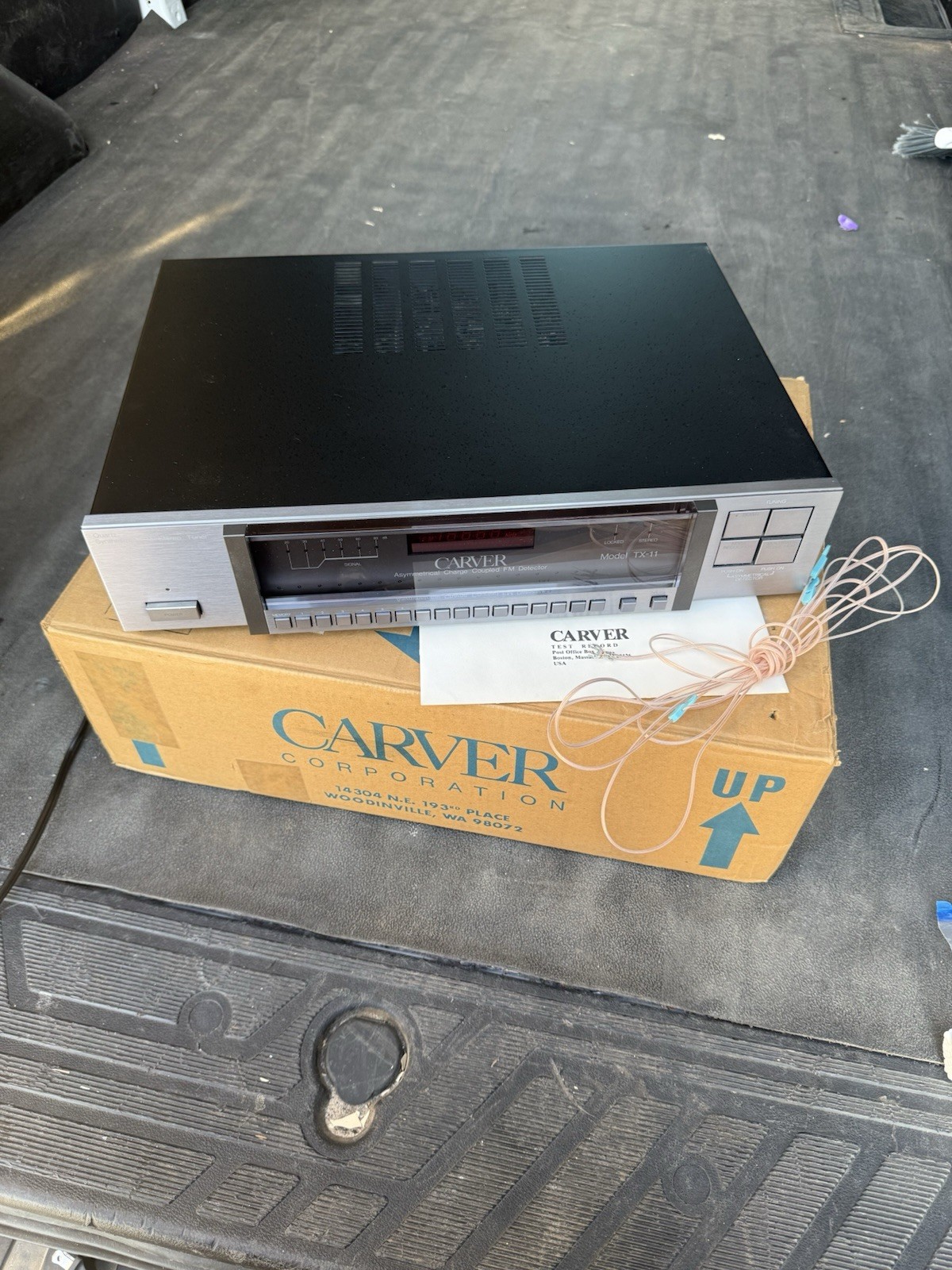
The TX-11A features a dual-conversion superheterodyne design, a hallmark of high-end tuners of the era, which greatly improved image rejection and frequency stability. Its phase-locked loop (PLL) local oscillator minimized drift, ensuring that once tuned, stations stayed locked in place—even during extended listening sessions. The front panel boasts Carver’s signature minimalist aesthetic: a large, smooth-tuning dial with a glowing red pointer, flanked by power and stereo indicator lights, and a single knob for volume or mute (depending on system integration).
Sound Characteristics and Performance
The Carver TX-11A was not just about technical specs—it was built to sound incredible. When paired with a quality antenna and a well-matched preamplifier, the TX-11A delivered FM broadcasts with a level of openness and detail that rivaled far more expensive units from brands like Sony, Pioneer, and Harman Kardon.
Listeners often describe the TX-11A’s sound as clean, transparent, and dynamically expressive. The tuner excelled at reproducing the spatial cues embedded in FM stereo broadcasts, offering a wide and stable soundstage. Classical music broadcasts revealed fine instrumental textures, while jazz and rock stations came through with punchy bass and crisp highs—free from the harshness or muddiness that plagued lesser tuners.
One of the TX-11A’s standout traits was its low noise floor. Thanks to its advanced IF filtering and quiet amplifier stages, background hiss was nearly nonexistent, even when tuned between stations. This made the listening experience immersive, especially during quiet passages or late-night broadcasts when atmospheric noise could otherwise dominate.
Notable Features and Innovations
While the TX-11A may appear modest compared to modern digital tuners, it packed several advanced features for its time:
- Dual-Gate MOSFET Front End: This contributed to ultra-low noise reception and improved weak-signal handling, allowing the TX-11A to pull in distant or low-power stations with surprising reliability.
- Precision Tuning Knob with Vernier Control: Though not motorized, the tuning knob offered smooth, precise adjustment—critical for zeroing in on weak stations without overshooting.
- Stereo/Blend/Mono Switching: Listeners could switch between full stereo, blended mono (to reduce noise), or pure mono for the weakest signals, preserving intelligibility.
- Defeatable De-emphasis: A small toggle switch allowed users to bypass the 50µs de-emphasis network, useful for non-standard or international broadcasts.
- High-Quality RCA Outputs: The unbalanced outputs were designed to drive long cable runs without signal degradation, making the TX-11A ideal for integration into complex systems.
Carver also included thoughtful touches like gold-plated antenna terminals and internal shielding to minimize RF interference—a nod to the company’s obsession with signal purity.
Common Issues and Maintenance
As with any vintage electronic gear, the Carver TX-11A benefits from proper care and occasional servicing. Over four decades, several issues may arise:
- Deteriorating Electrolytic Capacitors: The power supply and audio coupling caps may dry out, leading to hum, low output, or power failure. A full recapping is recommended for units that haven’t been serviced.
- Tuning Dial Stiffness: The mechanical tuning assembly can become sticky due to dried lubricant. Cleaning and relubrication with appropriate grease can restore smooth operation.
- Antenna Terminal Corrosion: Especially in coastal areas, the 300Ω screw terminals may corrode. Cleaning with contact spray and applying dielectric grease helps prevent future issues.
- Weak Tubes or Transistors: While solid-state, early production units used discrete transistors that can drift or fail. Testing and replacement with modern equivalents can restore peak performance.
Owners are advised to use a high-quality outdoor antenna—the TX-11A deserves it. Even a simple dipole or folded antenna can dramatically improve reception over indoor "rabbit ears."
Current Market Value and Collectibility
The Carver TX-11A is rarely seen on the vintage market, making it a sought-after piece for Carver collectors and tuner enthusiasts. Unlike mass-produced receivers, the TX-11A was produced in limited numbers, and few have survived in working condition.
As of 2024, a fully functional TX-11A in good cosmetic condition typically sells for $250–$400, with pristine, boxed units commanding higher prices at auction. Its value is rising slowly as interest in vintage FM tuners grows—especially among vinyl and broadcast purists who appreciate the art of live, unedited radio.
While not as flashy as Carver’s later "Cube" amplifiers or the Magnetic Field Power amplifiers, the TX-11A represents the engineering integrity that defined Bob Carver’s early work: no gimmicks, just smart, effective design aimed at maximizing performance per dollar.
Conclusion and Legacy
The Carver TX-11A may not be the most famous product from the Carver stable, but it stands as a testament to the company’s commitment to high-fidelity for the real world. In an age when streaming dominates, the TX-11A reminds us of the magic of FM radio—live orchestras, jazz from distant cities, and the thrill of discovering a clear signal from a faraway station on a quiet night.
It’s a tuner built for serious listeners, not just spec-sheet enthusiasts. And while modern digital tuners offer convenience, few match the analog warmth and immediacy of the TX-11A when fed a clean signal.
For the vintage audio collector, the TX-11A is more than a tuner—it’s a piece of Carver history, a quiet innovator that helped define what high-performance FM reception could be. If you’re lucky enough to find one in good condition, power it up, connect a proper antenna, and tune in. You might just rediscover the joy of radio—all over again.
eBay Listings



As an eBay Partner, we earn from qualifying purchases. This helps support our independent vintage technology research.
Related Models
- Carver TX-11 (1978)
- Aiwa CS-250 (1978)
- Denon TU-1500RD (1995)
- Denon TU-280 (1976)
- Denon TU-501 (1977)
- Denon TU-550 (1978)
- Denon TU-750S (1975)
- Luxman R-1030 (1979)
- Luxman R-1050 (1975)
- Luxman R-117 (1975)