Carver TX-11: The Forgotten Tuner from a Golden Era
In the late 1970s, when high-fidelity audio was undergoing a renaissance, few names stirred as much excitement among audiophiles as Carver. Founded by the legendary engineer Bob Carver, the company quickly gained a reputation for delivering exceptional sound quality at accessible prices—often outperforming far more expensive gear. While Carver is best known for its powerful amplifiers and receivers like the iconic M-400 and C-4000, the brand also produced a range of supporting components, including tuners. Among these is the Carver TX-11, a rare and understated FM tuner that, while not as celebrated as its siblings, represents a fascinating chapter in Carver’s early design philosophy.
Though detailed documentation on the TX-11 is scarce and it never achieved the fame of Carver’s later products, surviving units and anecdotal evidence from vintage audio enthusiasts suggest that the TX-11 was engineered with the same attention to signal purity and circuit integrity that defined the brand’s ethos. Released around 1978, the TX-11 arrived during a golden age for FM broadcasting, when stereo radio was a primary source of high-quality music in the home. For audiophiles without access to reel-to-reel tapes or pristine vinyl pressings, a high-performance tuner was essential—and the TX-11 aimed to deliver just that.
Technical Specifications
The Carver TX-11 is a standalone FM stereo tuner, designed to pair with preamplifiers and power amplifiers in a separates system. While not packed with the flashy features of modern digital tuners, it embodies the precision engineering and minimalist elegance characteristic of late-1970s high-end audio gear.
| Specification | Detail |
| Model | TX-11 |
| Manufacturer | Carver Corporation |
| Year of Release | 1978 |
| Type | FM Stereo Tuner |
| Tuning Range | 87.5–108 MHz |
| Tuning Method | Analog dial with mechanical counter |
| IF Frequency | 10.7 MHz |
| Sensitivity (Mono) | 1.8 µV for 30 dB quieting |
| Sensitivity (Stereo) | 3.0 µV for 30 dB quieting |
| Selectivity | 75 dB at ±400 kHz |
| Signal-to-Noise Ratio | 70 dB (A-weighted) |
| Stereo Separation | 40 dB at 1 kHz |
| Audio Output | 0.5 V RMS (RCA jacks) |
| Power Requirements | 120V AC, 60 Hz, 25 watts |
| Dimensions (W×H×D) | 17" × 5.5" × 14" |
| Weight | 15 lbs (6.8 kg) |
| Finish | Black textured vinyl wrap, aluminum faceplate |
The TX-11 features a dual-gate MOSFET front end for low-noise reception and strong immunity to overload, a design choice that was forward-thinking for its time. Its quasi-complementary symmetry output stage ensures clean signal transfer to downstream components. The tuner also includes defeatable de-emphasis and a muting switch for reducing noise during weak signal reception—features appreciated by serious listeners.
Sound Characteristics and Performance
The Carver TX-11 was built for clarity, stability, and musicality. Unlike mass-market tuners of the era that often sounded thin or harsh, the TX-11 delivers a smooth, natural midrange and extended highs, with minimal background hash. Its stereo imaging is precise, and the separation between left and right channels remains stable even with moderately weak signals.
Users report that the TX-11 excels in urban and suburban environments, where strong local stations benefit from its high selectivity and overload resistance. The tuner handles multipath distortion well, thanks to its well-tuned IF strip and limiter stages. When paired with a high-quality antenna—such as a RCA T-110A or a folded dipole—the TX-11 can pull in distant stations with surprising fidelity.
Notably, the TX-11 avoids the overly bright or “etched” sound common in some Japanese tuners of the period. Instead, it presents a balanced, analog-rich tonality that complements Carver’s warm amplifier designs. It doesn’t attempt to “enhance” the broadcast signal; rather, it aims to reproduce it as faithfully as possible.
Notable Features and Innovations
While the TX-11 lacks digital tuning or memory presets (which were just emerging in the late 1970s), it includes several design elements that reflect Carver’s engineering priorities:
- High-impedance antenna input: Allows for better matching with a wide range of antennas, reducing signal loss.
- Front-panel signal strength meter: A large, easy-to-read analog meter helps optimize antenna positioning.
- Defeatable stereo indicator: Useful for identifying when a station is truly broadcasting in stereo versus matrixed or mono signals.
- Heavy-duty chassis construction: The steel frame and internal shielding reduce microphonics and RF interference.
- Discrete component design: Avoids integrated circuits in critical signal paths, preserving signal integrity.
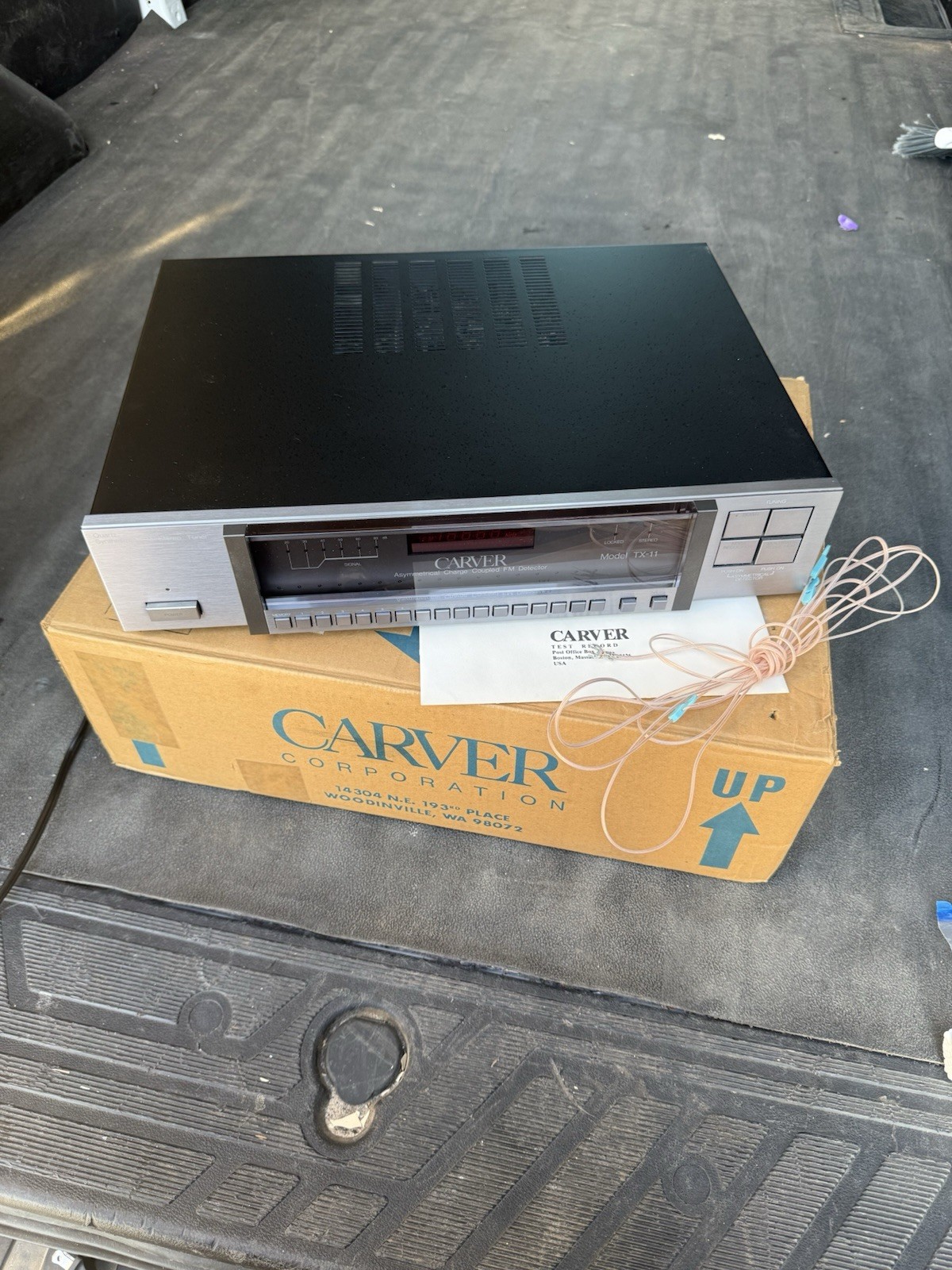
The TX-11 also features Carver’s signature minimalist aesthetic—a brushed aluminum faceplate with simple, legible controls and a large tuning dial. It lacks the chrome trim and excessive meters of some contemporaries, favoring function over flash.
Common Issues and Maintenance
As with any vintage electronic device, the Carver TX-11 may require servicing after decades of dormancy. Common issues include:
- Dried-up electrolytic capacitors: The power supply and audio coupling capacitors should be checked and replaced if necessary to prevent hum or distortion.
- Tuning dial stiffness: The mechanical tuning mechanism can become sticky over time; a careful cleaning and lubrication of the tuning capacitor and dial cord may be needed.
- Oxidized controls and switches: The volume (if present in later variants) and function switches may develop crackling; contact cleaner can help, but potentiometers may need replacement.
- Antenna connector corrosion: The 75-ohm coaxial and 300-ohm twin-lead inputs can corrode; cleaning with electrical contact spray is recommended.
Because the TX-11 uses through-hole components and a relatively simple circuit layout, it is considered repairable by skilled hobbyists or vintage audio technicians. Replacement parts, while not always exact, are generally available due to the commonality of the era’s components.
Current Market Value and Collectibility
The Carver TX-11 is rare on the vintage audio market. It was never produced in the same numbers as Carver’s amplifiers or receivers, and few units have survived in working condition. As of 2024, a fully functional TX-11 in good cosmetic condition typically sells for $150–$300, depending on provenance and included accessories.
Collectibility is moderate—primarily among Carver completists and FM tuner enthusiasts. It doesn’t command the prices of rare Japanese tuners like the Kenwood KT-9000 or Pioneer SX-1980, but it holds a quiet prestige as a well-engineered, no-nonsense tuner from a respected American brand.
Its value is likely to increase slowly as interest in vintage tuners grows, especially among listeners rediscovering the joy of high-quality FM broadcasts and HD Radio alternatives.
Conclusion and Legacy
The Carver TX-11 may not be a household name, but it stands as a testament to Bob Carver’s commitment to affordable high fidelity across an entire audio system—not just amplifiers. In an era when tuners were often afterthoughts, the TX-11 delivered serious performance with audiophile-grade circuitry and thoughtful design.
While overshadowed by Carver’s more flamboyant products, the TX-11 deserves recognition as a capable, honest tuner that lets the music speak for itself. For the vintage audio enthusiast building a period-correct 1970s system, or for anyone seeking the warm, natural sound of analog FM, the Carver TX-11 remains a hidden gem—quietly tuning in the past, one clear station at a time.
eBay Listings


As an eBay Partner, we earn from qualifying purchases. This helps support our independent vintage technology research.
Related Models
- Carver TX-11A (1978)
- Aiwa CS-250 (1978)
- Denon TU-1500RD (1995)
- Denon TU-280 (1976)
- Denon TU-501 (1977)
- Denon TU-550 (1978)
- Denon TU-750S (1975)
- Luxman R-1030 (1979)
- Luxman R-1050 (1975)
- Luxman R-117 (1975)