Bose 901 (1968–2017)
At 42 pounds and nine drivers per side, these towers don’t just fill a room—they redefine how sound moves through it.
Overview
The Bose 901® DIRECT/REFLECTING® Speaker System wasn’t introduced to blend in. From its 1968 debut, it challenged every assumption about how stereo speakers should behave. Instead of aiming for tight, focused imaging like most high-fidelity systems, the 901 embraced diffusion—flooding the listening space with reflected sound to mimic the acoustics of a live performance. The result? A sonic experience that feels less like you're listening to speakers and more like you're standing inside the music. That approach polarized critics from day one. Audiophiles accustomed to precision localization dismissed it as blurry or artificial, while others found its enveloping presentation uniquely compelling. What’s undeniable is that the 901 became one of the best-selling speaker models of all time, staying in continuous production across six series for nearly five decades.
Each cabinet houses nine identical full-range drivers—eight firing rearward onto an angled baffle, one facing forward—engineered to deliver approximately 11% direct sound and 89% reflected energy. This radical configuration demands specific placement: the speakers are meant to be positioned well away from walls, allowing the rear-directed sound to interact with room boundaries as intended. But the real magic—and necessity—lies in the included active equalizer. Without it, the 901s sound unnaturally thin, especially in the bass. The equalizer applies up to 18 dB of bass lift to compensate for the physics of the design, correcting the system’s natural response and offering user-adjustable room compensation. Owners report that the pairing of speaker and EQ is non-negotiable; the system functions as a complete electro-acoustic unit, not just a set of cabinets.
Despite their longevity and commercial success, the 901s were never universally loved by purists. Their sound signature prioritizes spatial immersion over detail retrieval and timing accuracy. Some describe the midrange as slightly veiled, and the lack of a traditional crossover network means each driver handles the full frequency spectrum, which can lead to distortion at higher volumes. Still, collectors note that when properly set up—with a robust amplifier capable of handling the EQ’s power demands and the original equalizer in circuit—the 901s produce a uniquely expansive soundstage that few conventional designs replicate.
Specifications
| Manufacturer | Bose Corporation, Framingham, MA, USA |
| Product type | Direct/reflecting loudspeaker system |
| Release year | 1968 |
| Driver count/size | Nine identical full-range drivers per cabinet |
| Acoustic energy distribution goal | Approximately 11% direct sound, 89% reflected sound |
| Impedance | 8 Ω (nominal) |
| External dimensions (example, Series VI) | 30.75" H x 21" W x 13" D |
| Weight (example, contemporary series) | 42.0 lbs |
| Required component | Dedicated Active Equalizer (included with system) |
| Warranty | 5 Years (for contemporary series at time of sale) |
Key Features
Nine Full-Range Drivers with Asymmetric Firing Pattern
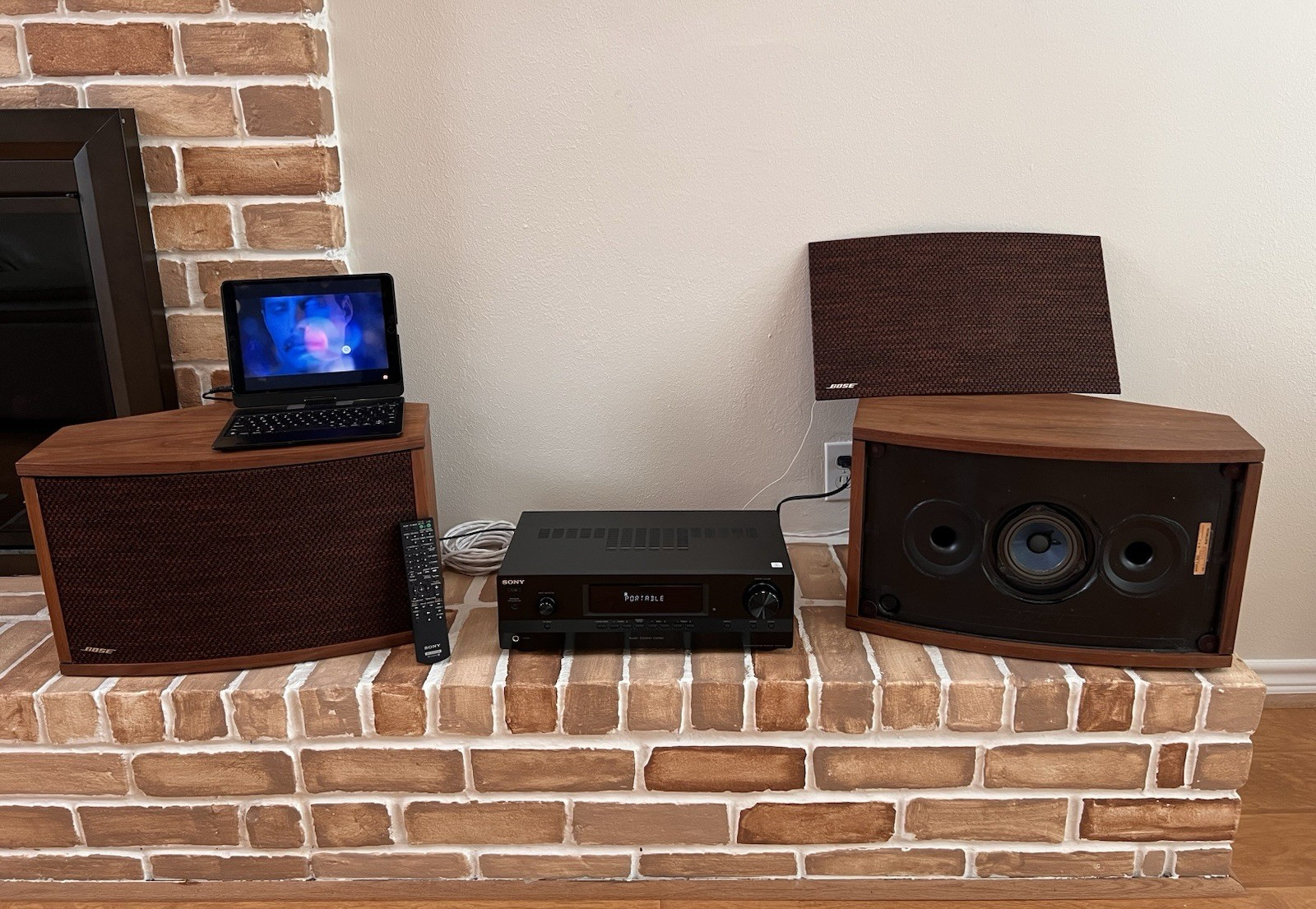
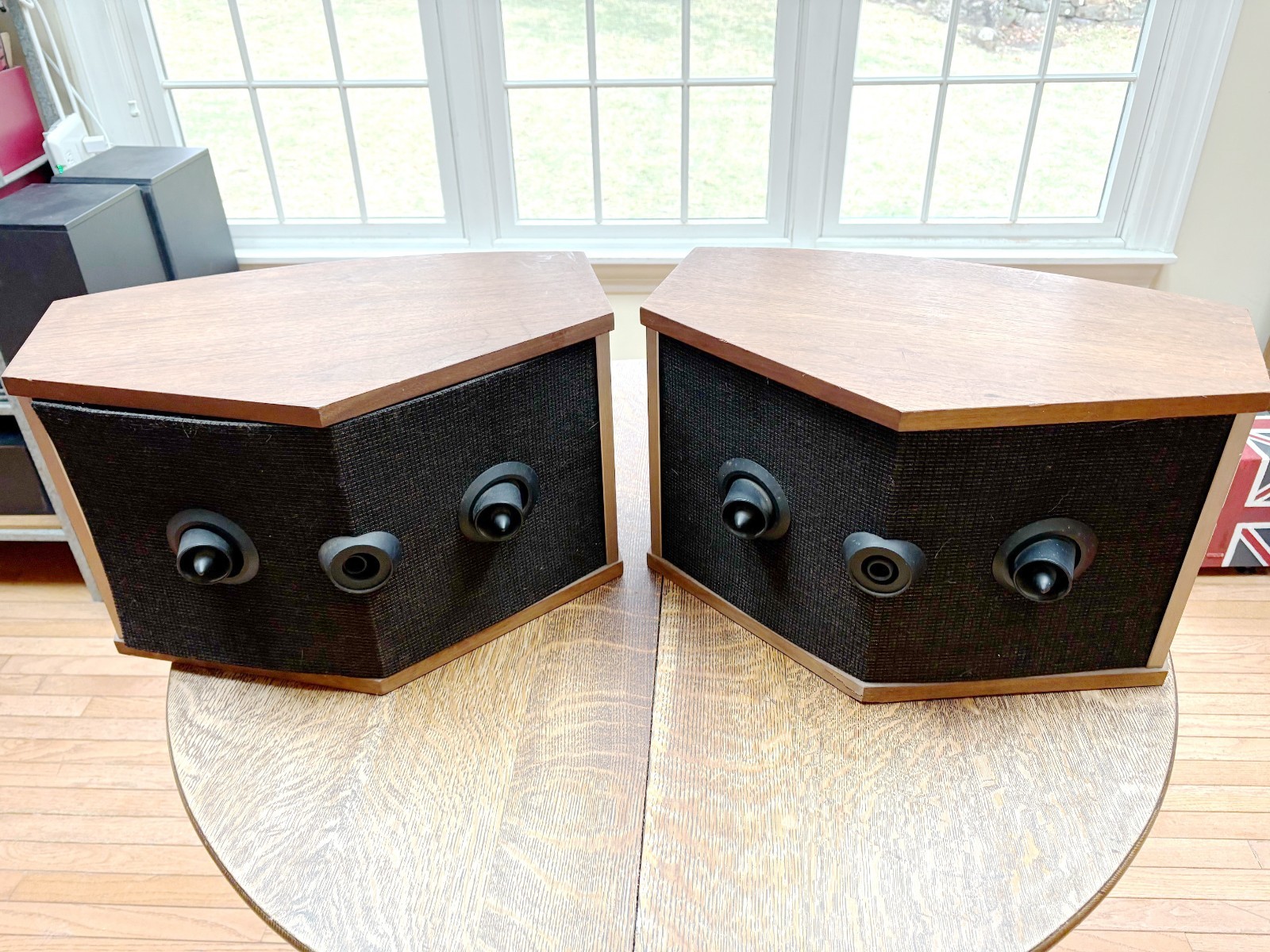
The 901’s most defining trait is its array of nine full-range drivers per cabinet. One faces forward; eight are mounted on an angled rear panel, directing sound toward the wall behind the speaker. This arrangement is not about brute output but spatial dispersion. By minimizing direct radiation and maximizing reflections, the system reduces the dominance of the speaker itself in the sonic image. Instead of hearing “two boxes,” listeners experience a diffuse field where instruments seem to occupy space independently of the physical speakers. While later series introduced refinements like reinforced drivers and foam surrounds (which are now prone to deterioration), the core layout remained unchanged throughout the model’s lifespan.
Direct/Reflecting® Sound Design
Bose’s Direct/Reflecting® principle was revolutionary in 1968 and remains the 901’s conceptual foundation. Traditional speakers aim to control reflections, treating them as distortions. The 901 does the opposite—harnessing them as essential components of the listening experience. The target ratio of 11% direct to 89% reflected sound attempts to replicate the balance found in concert halls, where most of what listeners hear arrives via room reflections. This approach requires careful room integration. Owners report that placing the 901s too close to walls or in acoustically dead spaces undermines their intended effect, while reflective rooms enhance it. The design accepts that speaker performance is inseparable from room characteristics—an idea now common in high-end audio but radical at the time.
Dedicated Active Equalizer with Room Compensation
The 901 cannot function as intended without its matching active equalizer, which was included with every system. The equalizer applies significant tonal correction—up to 18 dB of bass boost—to counteract the natural roll-off caused by the rear-firing drivers and the physics of the enclosure. It also provides user-adjustable controls for room compensation, allowing listeners to tailor the sound based on their space’s reflective properties. Electrically, this places high demands on the amplifier. Sources suggest that a minimum of 60 watts per channel is advisable, with headroom needed to handle the EQ’s signal processing without clipping. The equalizer units themselves have known vulnerabilities: collectors note that ground lugs were often secured by press-fit connections rather than solder, leading to intermittent grounding issues over time.
Evolution of Enclosure Design Across Series
While the driver layout stayed consistent, the enclosure evolved. Early Series I and II models used sealed, acoustic suspension cabinets made of wood. Later generations, including Series V and VI, transitioned to ported (bass reflex) designs and incorporated what Bose called the Acoustic Matrix®—a bracing system intended to reduce cabinet resonance. The Series VI, the final iteration, weighed in at 42 pounds and measured 30.75 inches tall, reflecting a trend toward denser, more rigid construction. However, material changes introduced new aging issues: later versions used foam surrounds on the drivers, which degrade over decades, requiring replacement to restore performance.
Historical Context
Launched in 1968, the Bose 901 emerged as a bold departure from conventional speaker design. Its success was both commercial and cultural—eventually becoming one of the best-selling speaker models in history. The system remained in production for over 50 years, with six distinct series released before its retirement in 2017. Throughout its lifespan, the 901 maintained its core architecture despite evolving audio trends. Its initial reception was divided: some praised its immersive quality, while others criticized its deviation from audiophile norms. Notably, the design found unexpected favor beyond the consumer market—Bose later observed that professional musicians and sound engineers were adopting the 901s in studio environments, drawn to their diffuse, non-localized sound.
Collectibility & Value
Today, the Bose 901’s value depends heavily on series, condition, and completeness. A full set—including speakers, original equalizer, and stands such as the PS-9—commands a premium, especially if all components are functional. Series VI models in mint condition have sold for around $200, while rarer or complete high-end configurations have listed for significantly more, though currency and market context vary. Foam surround deterioration is a widespread issue in later series, making working examples with original or replaced drivers more desirable. The equalizer units also present maintenance challenges, particularly with grounding due to press-fit connections that degrade over time. As a result, fully operational systems are increasingly rare, and collectors often seek out units with service records or upgraded internal wiring.
eBay Listings


As an eBay Partner, we earn from qualifying purchases. This helps support our independent vintage technology research.