Arcam Alpha Tuner: The Quintessential British Tuner of the Early 1980s
Introduction
The Arcam Alpha Tuner, introduced in 1980 and produced until 1985, stands as a hallmark of British hi-fi engineering during a transformative period in audio history. As the dedicated tuner component in Arcam’s acclaimed Alpha series—designed to pair seamlessly with the Alpha 2 and Alpha 3 amplifiers—it embodied the company’s early commitment to high build quality, clean sonic performance, and elegant, understated design. During its five-year production run, the Alpha Tuner offered audiophiles a reliable and sonically transparent way to enjoy FM, Medium Wave (MW), and Long Wave (LW) broadcasts, at a time when radio remained a primary source of music and news. Its release coincided with the rise of high-fidelity component systems, and Arcam positioned itself as a serious alternative to more established names like NAD and Linn. The Alpha Tuner, though not flashy, earned respect for its solid construction, excellent reception, and tonal neutrality—qualities that continue to attract vintage audio enthusiasts today.
Technical Specifications
| Specification | Value |
| Model | Alpha Tuner |
| Category | Tuner |
| Years Produced | 1980–1985 |
| Power Output | Not specified |
| Impedance | 75 ohms (FM), 300 ohms (MW/LW) |
| Frequency Response | FM: 30Hz - 15kHz; MW: 100Hz - 4.5kHz; LW: 100Hz - 4.5kHz |
| Total Harmonic Distortion | < 1.0% (FM), < 2.0% (MW/LW) |
| Signal-to-Noise Ratio | FM: > 60dB; MW: > 50dB; LW: > 48dB |
| Dimensions | 430x125x300 mm |
| Weight | 6.5 kg |
Design & Engineering
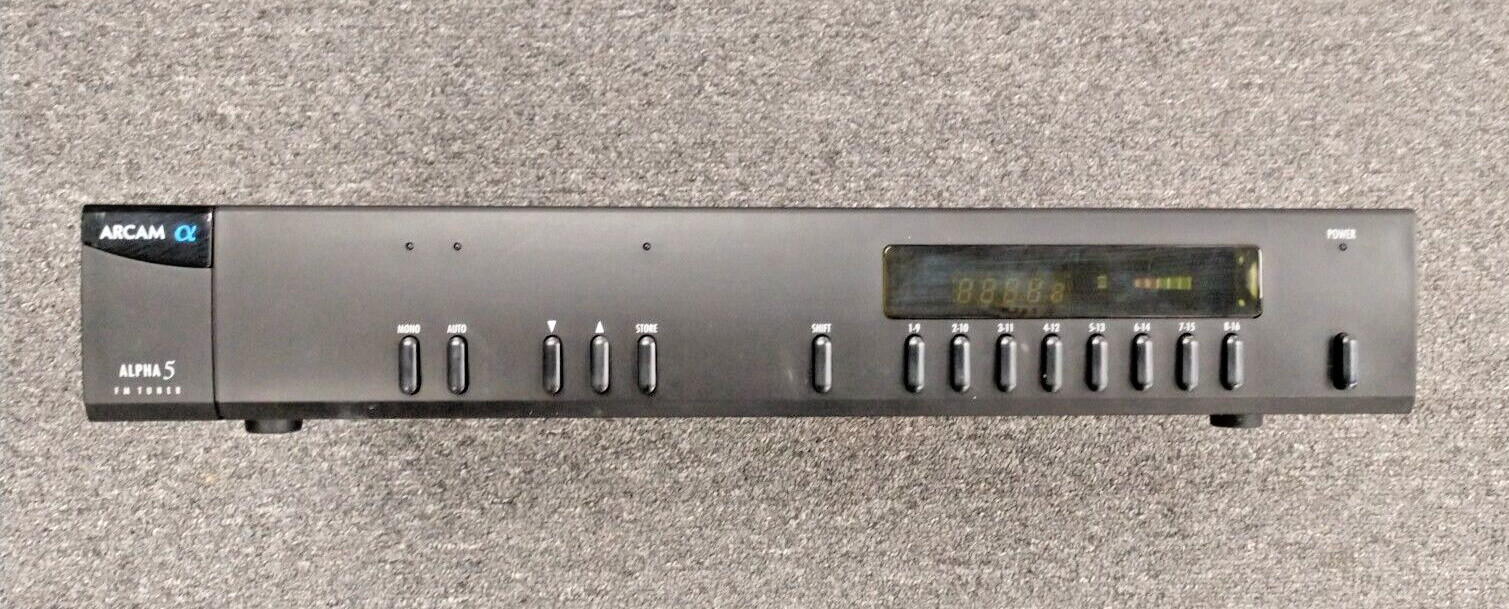
The Arcam Alpha Tuner reflects the minimalist, functional aesthetic that defined early 1980s British audio equipment. Housed in a sturdy steel chassis with a brushed aluminum front panel, it exudes a sense of durability and precision. The large central tuning dial dominates the front, offering smooth, direct manual control—no digital displays or synthesizers here. This analog approach appealed to purists who valued tactile feedback and simplicity. The dial is flanked by small indicator windows for band selection and tuning strength, with a clean layout that avoids clutter.
Internally, the Alpha Tuner features a well-shielded design to minimize interference, a critical consideration for sensitive radio reception. The FM section uses a high-gain RF amplifier and a double-conversion superheterodyne circuit, which improved selectivity and reduced image interference—a notable advantage over simpler single-conversion designs. For MW and LW bands, the tuner employs a high-permeability ferrite rod antenna, internally mounted to reduce external noise and allow for easy positioning within a cabinet.
Arcam paid close attention to grounding and power supply isolation, using a toroidal transformer and regulated power rails to maintain signal purity. The rear panel includes both 75-ohm coaxial and 300-ohm twin-lead antenna inputs for FM, along with standard unbalanced RCA outputs. Grounding terminals are provided to reduce hum when connected to other components. The build quality is consistent throughout, with high-grade potentiometers, quality capacitors, and point-to-point wiring in critical signal paths.
Sound Characteristics
The Arcam Alpha Tuner delivers a balanced, natural sound that complements the transparent character of the Alpha amplifiers. On FM, it captures the full warmth of stereo broadcasts with a wide soundstage and good stereo separation. Its frequency response extends cleanly to 15kHz, preserving the brightness of well-transmitted stations without introducing harshness. The low distortion and high signal-to-noise ratio ensure that quiet passages remain clear and free from background hiss.
Medium and Long Wave performance is surprisingly capable for a component of its class. While limited by the inherent bandwidth of AM broadcasting, the Alpha Tuner extracts maximum clarity from MW and LW signals, making it ideal for talk radio, news, and classical music broadcasts from European stations. The tuner’s excellent selectivity helps reject adjacent-channel interference, a common issue in urban environments.
When paired with the Alpha 2 or Alpha 3 amplifier and a quality speaker system, the Alpha Tuner forms the heart of a cohesive, high-fidelity setup. Its sound is never colored or exaggerated—it aims for accuracy, letting the broadcast source speak for itself. Audiophiles who value authenticity over sonic embellishment will appreciate its honest, uncolored presentation.
Market & Collectibility
Today, the Arcam Alpha Tuner is a sought-after component among vintage hi-fi collectors, particularly those restoring complete Alpha series systems. While not as rare as some limited-production Japanese tuners, original units in good working condition command a premium, typically ranging from $250 to $450 depending on cosmetic condition and functionality. Fully operational units with a responsive tuning dial and strong reception are especially prized.
When purchasing a vintage Alpha Tuner, buyers should check for common age-related issues: dried lubricant in the tuning mechanism, degraded rubber drive belts (if present in the dial assembly), and capacitor aging in the power supply. Some owners opt for recapping as part of a restoration to ensure long-term reliability. Antenna connections should be inspected for corrosion, and the internal ferrite rod should be intact and securely mounted.
Modifications are rare, as the tuner’s design is already well-regarded, though some enthusiasts upgrade the internal wiring or add external antenna preamplifiers for weak signal areas. Originality is highly valued, so any modifications should be reversible.
The Arcam Alpha Tuner remains a testament to thoughtful, no-nonsense design—a tuner that prioritized performance and reliability over gimmicks, and continues to deliver satisfying listening experiences nearly half a century after its debut.
eBay Listings



As an eBay Partner, we earn from qualifying purchases. This helps support our independent vintage technology research.
Related Models
- Aiwa CS-250 (1978)
- Denon TU-1500RD (1995)
- Denon TU-280 (1976)
- Denon TU-501 (1977)
- Denon TU-550 (1978)
- Denon TU-750S (1975)
- Luxman R-1030 (1979)
- Luxman R-1050 (1975)
- Luxman R-117 (1975)
- Denon TU-400 (1976)