Aiwa CS-250 (1983)
A punchy, four-band boombox from the golden age of portable stereo — compact, colorful, and loaded with Aiwa’s DSL magic.
Overview
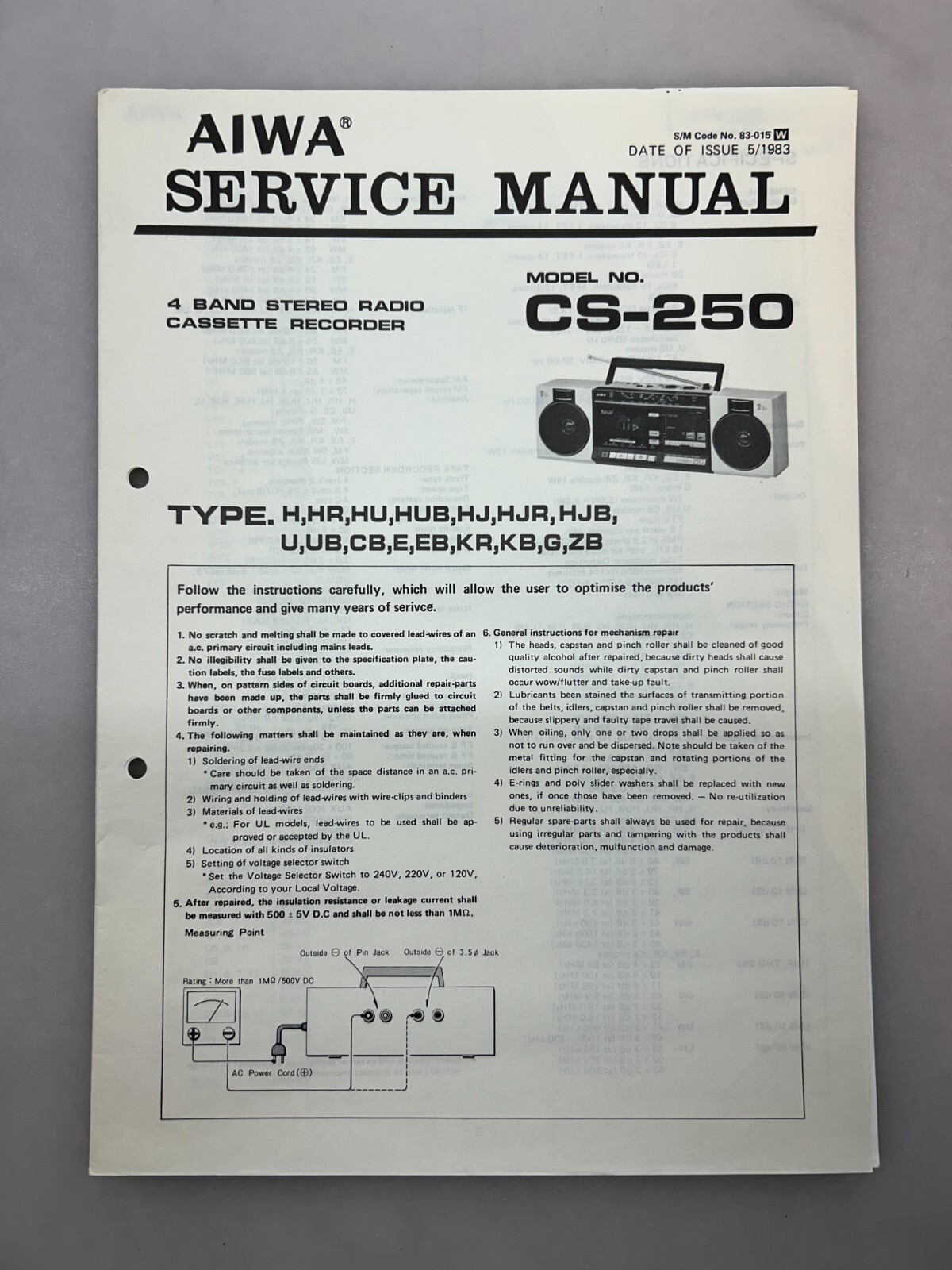
The Aiwa CS-250 isn’t some forgotten shelf component — it’s a full-blooded 1980s boombox, the kind that turned sidewalks into sound stages and bedrooms into concert halls. Officially named the 4 Band Stereo Radio Cassette Recorder Stereo 250 CS-250 E/Z/K, this portable powerhouse rolled out in 1983 as a mobile command center for music lovers who demanded radio, recording, and battery-powered freedom in one tidy package. Built by Aiwa Co. Ltd. in Tokyo, it hit the market at 290.00 DM, slotting into the mid-tier of portable audio with a feature set that punched above its price.
Unlike the sleek, modular tuners Aiwa made for home systems, the CS-250 was built for attitude. It’s a plastic-bodied, dual-speaker stereo rig with a cassette deck, four radio bands, and that unmistakable boombox profile — wide, slightly hunched, and ready to roll. Available in black or white, it was designed to be seen and heard, whether propped on a dorm desk or lugged to a park hangout. And with six D-cell batteries powering it, you didn’t need a wall outlet to make noise — just a tape, a station, and the will to be loud.
It’s not a high-fidelity relic in the audiophile sense, but owners consistently call it a “great little unit” and a “sweet looker,” praising its “good sound” for the era. It’s the kind of machine that didn’t just play music — it announced your presence.
Specifications
| Manufacturer | Aiwa Co. Ltd.; Tokyo |
| Model | CS-250 |
| Year Introduced | 1983 |
| Type | Portable Stereo Cassette Recorder with multi-band radio receiver |
| Wave Bands | FM (UKW), Short Wave (KW), Medium Wave (MW), Long Wave (LW) |
| Frequency Ranges (Radio) | UKW: 87.5 – 108 MHz; KW: 5.9 – 18 MHz; MW: 530 – 1605 kHz; LW: 150 – 285 kHz |
| Power Output | 7 W (unknown quality) |
| Loudspeakers | 4 speakers / Ø 12 cm (4.7 inch) |
| Speaker Drivers | 10 cm woofers and 2 cm tweeters |
| Tape Wow and Flutter | 0.08% |
| Tape Frequency Response | 40 Hz to 15 kHz (using Metal tape) |
| Power Source | Line / Batteries / 50–60 Hz, 110–120 V or 220–240 V; 6 × 1.5 V (D-cell) |
| Dimensions (W×H×D) | 478 × 159 × 139 mm (18.8 × 6.3 × 5.5 inch) |
| Weight | 3.2 kg (7 lb 0.8 oz) |
| Material | Plastics (no bakelite or catalin) |
| Main Principle | Superheterodyne (common) |
| Number of Semiconductors | 18 |
Key Features
Four-Band Radio: Global Reach in a Box
The CS-250 doesn’t mess around with just FM and AM — it gives you four bands: FM (labeled UKW), Short Wave (KW), Medium Wave (MW), and Long Wave (LW). That means you can tune into local pop stations, international shortwave broadcasts, or regional AM signals with ease. The frequency coverage is broad: LW from 150 to 285 kHz, MW from 530 to 1605 kHz, KW from 5.9 to 18 MHz, and FM from 87.5 to 108 MHz. For travelers, news hounds, or radio tinkerers, this was a serious upgrade over basic two-band portables.
Dynamic Super Loudness (DSL): Aiwa’s Secret Sauce
One of the CS-250’s standout features is Aiwa’s Dynamic Super Loudness (DSL) — a bass and treble enhancement circuit designed to make small speakers sound bigger, especially at lower volumes. It’s activated by a dedicated “DSL button,” and users clearly loved it: one owner on a forum specifically said, “I prefer the DSL button on your 250” when comparing it to a CS-360. It’s not high-end equalization — it’s more like sonic cheat code, pumping life into thin cassette tapes and weak radio signals.
Integrated Two-Way Speakers: Loud, Not Detachable
Despite some period advertising suggesting otherwise, the CS-250 does not have detachable speakers. The speakers are built into a one-piece box, with four total drivers: two 10 cm woofers and two 2 cm tweeters, arranged in a two-way configuration. The 12 cm (4.7 inch) speaker diameter and 7 W output may sound modest, but in a small room or outdoor setting, this thing could fill space. It’s not about precision — it’s about presence.
Tape Deck with Metal Compatibility
The onboard cassette deck is no afterthought. With a wow and flutter rating of just 0.08%, it’s mechanically solid, and its frequency response reaches up to 15 kHz when using Metal tape — a nod to Aiwa’s commitment to better-than-average tape performance even in portable gear. It’s a recorder, not just a player, so you could mix tapes off the radio or dub from another source. And yes, it has an “aux in” — a rare and welcome feature for a machine of this era, letting you plug in a Walkman, turntable (with preamp), or later, an MP3 player.
Portable by Design, Built for Batteries
Weighing in at 3.2 kg (just over 7 pounds), the CS-250 is hefty for handheld use but manageable as a shoulder-carried boombox. Its shape — wide, low, and slightly angled — fits the “portable set > 8 inch” category, meaning it was designed to be moved but not pocketed. Power comes from either AC (with voltage variants E, Z, or K for different regions) or six D-cell batteries, giving you real off-grid playtime. The plastic construction keeps weight down and cost manageable, though it doesn’t feel luxurious — it feels used, in the best way.
Collectibility & Value
The Aiwa CS-250 isn’t a blue-chip collector’s item, but it has a loyal following among boombox enthusiasts and 1980s audio nostalgists. Owners describe it as a “nice wee mini,” a “nice looking box,” and a “great little unit” — praise that speaks to its charm and usability. It’s the kind of machine that aged into cult status not because it was perfect, but because it was fun.
One known listing on Bazos Czechia priced a CS-250 at CZK 1,300 in February 2026, suggesting modest but steady demand in European markets. Condition matters: a working unit with a functional tape deck will always command more than a silent display piece. And make no mistake — the tape mechanism is the weak point. Forum users report the “tape deck not working” as a common issue, and one noted proudly that theirs had been “fixed.” Belt replacement and head cleaning are likely part of any restoration.
There’s no data on common electronic failures beyond the tape deck, and no detailed service notes on capacitor aging or speaker degradation. But given its 18-semiconductor, superheterodyne design, it’s probably more reliable than complex all-in-one units from the late '80s.
eBay Listings


As an eBay Partner, we earn from qualifying purchases. This helps support our independent vintage technology research.
Related Models
- Aiwa CS-210 (1975)
- Denon TU-1500RD (1995)
- Denon TU-280 (1976)
- Denon TU-501 (1977)
- Denon TU-550 (1978)
- Denon TU-750S (1975)
- Luxman R-1030 (1979)
- Luxman R-1050 (1975)
- Luxman R-117 (1975)
- Denon TU-400 (1976)