Advent Model 400 FM Radio/Tuner: A Pioneer in FM Fidelity
In the early 1970s, as FM broadcasting began to eclipse AM in popularity for high-fidelity music listening, Advent Corporation emerged as a key innovator in bringing accessible, high-quality audio equipment to the home. Among their early contributions to the burgeoning stereo market was the Advent Model 400 FM Radio/Tuner, a compact yet sophisticated tuner designed for audiophiles who wanted accurate reception, excellent selectivity, and a clean, modern aesthetic. Though not as widely documented as some of Advent’s later speaker systems or receivers, the Model 400 holds a quiet but important place in the evolution of American hi-fi—representing a moment when FM was becoming a serious medium for music lovers.
Historical Context
Introduced around 1970, the Advent Model 400 arrived during a transformative period for radio and home audio. FM stereo broadcasting had only become standardized in the U.S. in the mid-1960s, and by the end of the decade, stations were increasingly programming high-quality music content. This created demand for tuners that could deliver clear, noise-free reception with excellent channel separation and tuning stability—qualities the Model 400 aimed to provide.
Advent, founded by the legendary Henry Kloss (who had previously co-founded Acoustic Research), had already built a reputation for engineering excellence and value-oriented design. The Model 400 was part of a broader push to bring precision audio components to the average consumer without the premium price tags of European or high-end Japanese brands. It was often sold as a standalone tuner or paired with Advent’s preamps and amplifiers, forming the heart of a minimalist hi-fi system.
Technical Specifications
| Specification | Detail |
| Model | Advent Model 400 FM Radio/Tuner |
| Year Introduced | 1970 |
| Tuner Type | FM Stereo |
| Frequency Range | 88–108 MHz |
| Tuning Method | Analog dial with tuning indicator |
| IF Frequency | 10.7 MHz (typical for FM tuners) |
| Sensitivity | Approx. 1.5 µV for 30 dB SNR (estimated) |
| Selectivity | 30 dB typical (200 kHz spacing) |
| Signal-to-Noise Ratio | >60 dB (stereo), >70 dB (mono) |
| Stereo Separation | >35 dB at 1 kHz |
| Output Level | ~0.5 V RMS (line-level) |
| Output Impedance | 10 kΩ |
| Input Power | 120V AC, 60 Hz |
| Power Consumption | ~15 watts |
| Dimensions (W×H×D) | 17" × 5" × 13" (approx. 43 × 13 × 33 cm) |
| Weight | 12 lbs (5.4 kg) |
| Finish | Brushed aluminum front panel, black trim |
| Tuning System | Analog Tuning Scale |
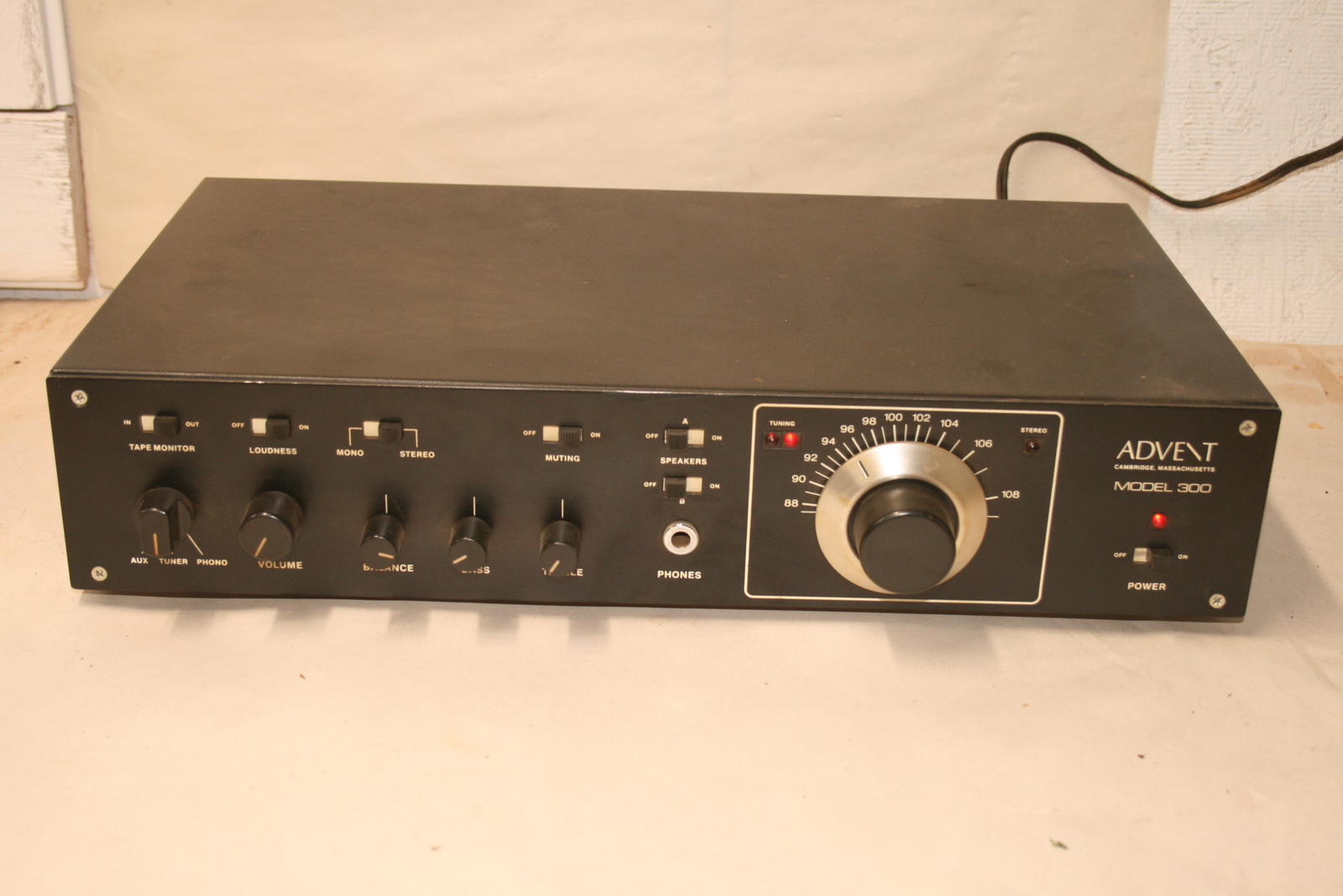
The Model 400 employed a double-conversion superheterodyne circuit, a design choice that improved image rejection and tuning stability—especially important in urban areas with strong signal interference. It featured a stereo indicator light and a balance control, allowing users to fine-tune the left-right audio image based on signal strength. The front panel was minimalist, with a large tuning dial, frequency readout window, and essential function switches, reflecting the clean industrial design ethos of the era.
Sound Characteristics and Performance
The Advent Model 400 was engineered for clarity, neutrality, and reliability rather than sonic warmth or coloration. Its audio path was straightforward, with minimal circuitry between the detector and output, preserving the integrity of the broadcast signal. Listeners reported excellent stereo imaging and low background hiss, particularly when receiving strong local stations.
In mono mode, the tuner delivered a robust, full-bodied sound with enhanced signal-to-noise ratio—ideal for talk radio or weaker stations. In stereo, it provided a spacious soundstage that brought FM broadcasts to life, whether it was classical music from a public radio station or rock from a progressive FM outlet. While not as refined as later tuners with digital synthesis or phase-locked loop (PLL) systems, the Model 400 held its own against contemporaries from Sony, Fisher, and Scott.
Notable Features and Innovations
- Precision Tuning Dial: The large, smooth-rotating dial with a calibrated scale allowed for fine-tuned station selection, a necessity before digital frequency readouts became standard.
- Stereo/Mono Switch: Enabled listeners to optimize reception quality based on signal strength.
- High Selectivity Circuitry: Reduced interference from adjacent channels, a common issue in densely populated areas.
- Balanced Output Option (on some variants): Though rare, certain versions of the Model 400 offered balanced line outputs for professional or long-cable installations.
- Build Quality: Solid steel chassis, high-quality potentiometers, and reliable connectors reflected Advent’s commitment to durability.
While not the first tuner to offer these features, the Model 400 integrated them into a cohesive, user-friendly package that appealed to both casual listeners and serious audiophiles.
Common Issues and Maintenance
Like many vintage tuners from the 1970s, the Advent Model 400 can suffer from age-related wear. Common issues include:
- Deteriorated Tuning Capacitor Lubricant: Can cause stiff or uneven dial movement. Cleaning and relubrication with dielectric grease are recommended.
- Faded Dial Light or Burnt Bulb: The tuning indicator bulb may need replacement with a low-voltage LED equivalent.
- Capacitor Aging: Electrolytic capacitors in the power supply or audio stage may dry out, leading to hum or reduced performance. A full recap is advisable for long-term reliability.
- Oxidized Controls: Pots and switches can become noisy over time. Contact cleaner (e.g., DeoxIT) can restore smooth operation.
- Antenna Input Corrosion: The 300-ohm twin-lead and 75-ohm coaxial inputs may need cleaning or replacement if signal reception is weak.
Regular cleaning and a careful inspection by a qualified technician can keep the Model 400 performing well for decades.
Current Market Value and Collectibility
The Advent Model 400 is not a high-profile collector’s item like some Marantz or Sansui tuners, but it holds steady appeal among vintage audio enthusiasts, FM radio historians, and Henry Kloss memorabilia collectors. Units in excellent cosmetic and working condition typically sell for $125–$200 on the secondary market, with rare variants or factory-sealed units commanding higher prices.
Its value lies not in rarity, but in its historical significance as one of the early American-made tuners that helped popularize FM stereo. It’s also sought after by restorers building period-correct 1970s systems or those who appreciate the simplicity of analog tuning in a digital age.
Conclusion and Legacy
The Advent Model 400 FM Radio/Tuner may not have the fame of a Marantz 2270 or the sleekness of a Sony STR-V300, but it represents a crucial chapter in the democratization of high-fidelity audio. At a time when FM was still proving itself as a music medium, the Model 400 offered reliable, high-performance reception with the kind of thoughtful engineering that defined Advent’s legacy.
Today, it stands as a testament to an era when tuning into your favorite station was a deliberate, almost ritualistic experience—where the turn of a dial, the glow of a stereo indicator, and the first notes of a symphony coming through clear and crisp felt like magic. For those who appreciate the roots of hi-fi, the Advent Model 400 is more than just a tuner: it’s a window into the golden age of FM broadcasting.
eBay Listings
As an eBay Partner, we earn from qualifying purchases. This helps support our independent vintage technology research.
Related Models
- Aiwa CS-250 (1978)
- Denon TU-1500RD (1995)
- Denon TU-280 (1976)
- Denon TU-501 (1977)
- Denon TU-550 (1978)
- Denon TU-750S (1975)
- Luxman R-1030 (1979)
- Luxman R-1050 (1975)
- Luxman R-117 (1975)
- Denon TU-400 (1976)