Sequential Circuits Prophet-5 (1978–1984)
The first truly programmable polyphonic analog synthesizer—five voices of lush, recallable sound that rewrote the rules of modern music.
Overview
The Sequential Circuits Prophet-5 wasn’t just another synthesizer—it was a seismic shift in how music was made. Before its 1978 debut, polyphonic synths like the Yamaha CS-80 existed, but they were temperamental beasts with no reliable way to save sounds. You’d spend an hour sculpting the perfect pad, only to have it vanish the moment you powered down. The Prophet-5 changed all that. For the first time, musicians could store and recall 40 patches—20 factory presets and 20 user-defined—with the press of a button. That might sound trivial now, but back then, it was revolutionary. It turned the synth from a laboratory experiment into a practical, stage-ready instrument.
And what a sound it had. Five voices of dual-oscillator analog synthesis, each dripping with warmth, grit, and character. Artists from Michael Jackson’s Thriller sessions to Toto’s “Africa” leaned on the Prophet-5 for its rich pads, searing leads, and punchy basses. Vangelis used it to score Blade Runner, giving the film its haunting, futuristic melancholy. It wasn’t just popular—it defined the sonic palette of an entire decade. The Prophet-5 wasn’t merely adopted by studios; it became a fixture, the kind of machine engineers would leave powered on for weeks just to avoid retuning.
Specifications
| Polyphony | 5 voices |
| Oscillators per Voice | 2 |
| Waveforms | Sine, Triangle, Sawtooth, Square/Pulse |
| Filter | 1 VCF per voice, 24dB/oct resonant low-pass, 12dB/oct high-pass |
| Filter Type | CEM 3320-based |
| Envelope Generators | 2 (ADSR for filter and amplifier) |
| LFO | 1 LFO with triangle, square, sample & hold waveforms |
| Keyboard | 61 keys, velocity and aftertouch sensitive |
| Memory | 40 preset patches (20 factory, 20 user) |
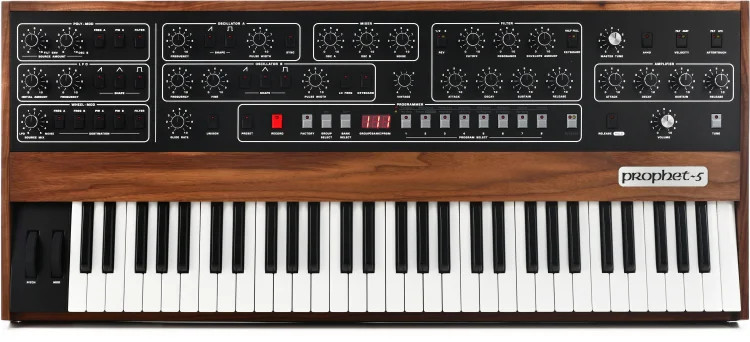
| Control Interface | Knobs and sliders for all primary parameters |
| MIDI | None (pre-MIDI era) |
| Dimensions | 38.5 x 14.5 x 4.5 inches (97.8 x 36.8 x 11.4 cm) |
| Weight | 36 lbs (16.3 kg) |
| Power | 100-120V AC, 60 Hz (with internal power supply) |
| Audio Output Level | 10 Vpp maximum |
| Audio Output Impedance | 1 kΩ |
| Frequency Response | 20 Hz - 20 kHz (+/-1 dB) |
| THD | < 1% at 1 kHz |
| Signal-to-Noise Ratio | Greater than 80 dB |
Key Features
- First Fully Programmable Polyphonic Analog Synth: The Prophet-5 was the first synth to combine polyphony with reliable preset memory. Before this, changing sounds live meant twisting knobs and hoping for the best. The Prophet-5’s 40-patch memory (20 factory, 20 user) made it the first synth that could be truly performance-ready.
- Five Voices of Dual-Oscillator Analog Warmth: Each voice featured two oscillators with selectable waveforms (sine, triangle, sawtooth, square/pulse), allowing for thick detuned pads, aggressive leads, and deep basses. The dual-VCO architecture gave it a richness that monosynths like the Sequential Circuits Prophet-1 could only dream of.
- CEM 3320-Based Filter with Character: The 24dB/oct resonant low-pass filter (plus 12dB/oct high-pass) delivered that classic analog sweep—smooth, musical, and capable of self-oscillation. Early revisions used discrete components, but the shift to Curtis CEM chips in Rev 3 improved stability without sacrificing soul.
- Hands-On Control with No Menu Diving: Every parameter had a dedicated knob or slider. No digital displays to squint at, no layers to navigate. What you saw was what you got—a tactile, intuitive interface that invited experimentation.
- Velocity and Aftertouch Sensitivity: On a 1978 keyboard, this was borderline futuristic. It allowed for expressive playing, letting dynamics shape filter cutoff or amplitude in real time—a feature even the Yamaha CS-80 struggled to implement consistently.
Historical Context
In 1978, the synthesizer world was still dominated by monophonic beasts like the Minimoog and temperamental polys like the Yamaha CS-80. These instruments were powerful, but they lacked one crucial thing: memory. If you wanted to change sounds during a session, you had to manually adjust every knob, risking inconsistency and wasting precious studio time. Dave Smith, the engineer behind Sequential Circuits, saw this as a fundamental flaw. His solution? Embed a microprocessor into an analog synth to store and recall settings. The result was the Prophet-5—a machine that bridged the analog soul of the 1970s with the digital practicality of the 1980s.
The Prophet-5 didn’t just fill a gap—it created a new category. Its success spawned the Sequential Circuits Prophet-10 (a 10-voice monster made by stacking two Prophet-5s), and later the Sequential Circuits Prophet-600, which added MIDI—something the Prophet-5 famously lacked, having been designed just before the MIDI standard emerged in 1983. Still, its absence didn’t hurt sales; studios adapted with custom control voltage solutions. By the time Rev 3 rolled out in 1981, the Prophet-5 had become the gold standard for analog polyphony, influencing everything from the Roland Jupiter-8 to the Korg Poly-800. It proved that analog and programmability weren’t mutually exclusive—a lesson the industry would carry into the digital age.
Collectibility & Value
Today, the Prophet-5 is a crown jewel of the vintage synth world. With a desirability rating of “very high” and rarity classified as “uncommon,” finding a working unit is a triumph. As of 2025, prices range from $8,000 to $15,000 USD, depending on revision, condition, and service history. Rev 3 models are often preferred for their superior tuning stability and Curtis CEM 3340 VCOs, though some purists swear by the raw character of the Rev 1’s discrete oscillators.
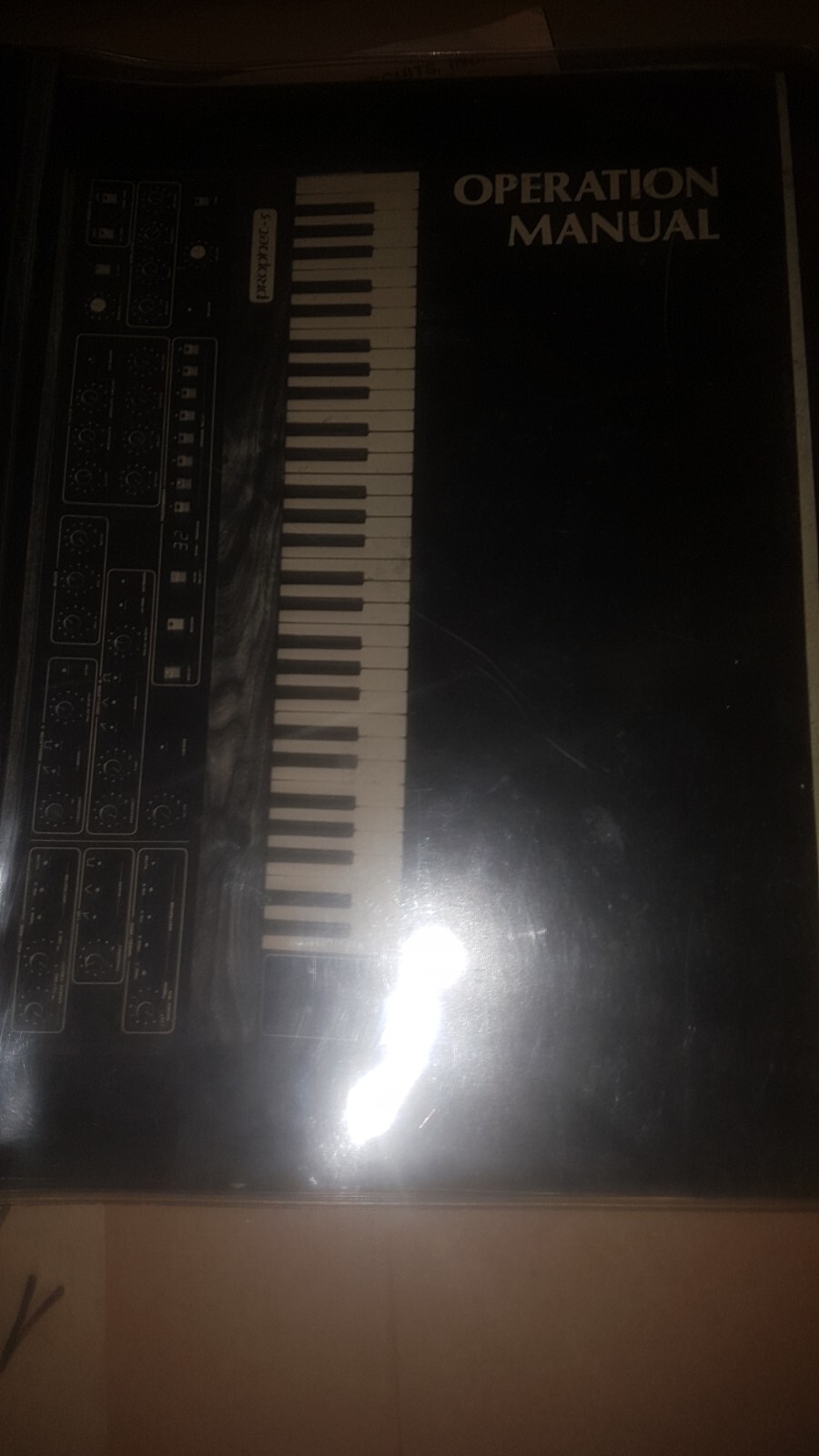
But buyer beware: these machines are aging. Early revisions (Rev 1 and Rev 2) are notorious for tuning drift, a result of analog component drift and temperature sensitivity. The CEM 3320 filter chips can fail, and decades-old electrolytic capacitors often need replacing. A thorough service—including recapping, calibration, and voice card inspection—is essential before purchase. Look for units with clean keybeds, responsive aftertouch, and stable pitch across all five voices. And if you find one that still has its original carry case and manual? Consider it a minor miracle. The Prophet-5 wasn’t just a synth—it was a statement. And in 2025, that statement still commands respect.
eBay Listings


As an eBay Partner, we earn from qualifying purchases. This helps support our independent vintage technology research.
Service Manuals & Schematics
- Manual — archive.org
- Service Manual — archive.org
- Service Manual — archive.org
- Owner's Manual — archive.org
Related Models
- Sequential Circuits Pro-One (1981-1984)
- Sequential Circuits Prophet-10 (1980-1984)
- Yamaha CS-80 (1977-1980)
- ARP 2600C (1978-1981)
- ARP 2600P (1975-1978)
- ARP Avatar (1979-1981)
- ARP Pro Soloist (1972-1977)
- ARP Solus (1975-1976)
- Korg Mono/Poly (1981-1984)
- Korg MS-20 (1978-1983)