ARP Pro Soloist (1972-1977)
A pressure applied to a held note triggers a swell that feels less like electronics and more like breath.
Overview
In the early 1970s, synthesis was often a labyrinth of cables and calibration, reserved for laboratories or wealthy collectors. The ARP Pro Soloist arrived as a antidote to that complexity, offering thirty distinct voices at the flick of a toggle switch. Documentation shows this instrument was designed not to dominate a stage but to accompany it, often perched atop a large electronic organ to provide lead lines that traditional keyboards could not mimic. While the preceding Soloist model offered eighteen presets, the Pro Soloist expanded the palette to thirty, refining the architecture to stabilize tuning and improve reliability. Owners report that despite the lack of programmability, the expressive potential hidden within the keyboard mechanism rivals fully modular systems from the same era.
The instrument resides in a unique hierarchy within the ARP family. It sits above the basic preset units like the Roland SH-1000 in terms of tonal complexity, yet below the fully programmable Odyssey or Explorer in terms of flexibility. Service technicians observe that the Pro Soloist functions as a sweet spot for players who prioritize immediate performance over sound design. It does not require patching to produce a brass section or a fuzz guitar; it simply demands that the player press harder on the keys to unlock vibrato, growl, or pitch bends. This immediacy made it a staple for progressive rock acts who needed to switch textures rapidly between song sections without interrupting the flow of a live performance.
Sound character varies wildly across the preset bank, ranging from accurate orchestral emulations to synthetic leads that defined the mid-70s aesthetic. Collectors note that the brass and string presets retain a warmth that later digital emulations struggle to replicate, largely due to the analog filter topology and the resonator bank architecture. However, the single oscillator foundation means the sound can thin out if not supported by external effects or layering. The brilliance control allows for basic filter tweaking, but the core timbre remains fixed per voice. This trade-off ensures consistency but limits evolution, making the unit a specialized tool rather than a universal workstation.
Specifications
| Manufacturer | ARP Instruments, Inc. |
| Production Years | 1972-1977 |
| Model Number | 2701 |
| Polyphony | Monophonic |
| Preset Count | 30 |
| Oscillators | 1 VCO |
| Keyboard Size | 37 keys |
| Aftertouch Type | Pressure Sensor (Channel) |
| Aftertouch Destinations | Pitch, Vibrato, Wow, Growl, Brilliance, Volume |
| Filter Type | ARP4034 |
| Filter Architecture | Three filter banks with 10 tuned resonators |
| Waveform Generation | High-frequency oscillator driving logic counter |
| Control Interface | Toggle switches for preset selection |
| Memory | None (ROM chips for preset matrices) |
| Modulation | LFO routed via preset logic |
| Expression Controls | Pitch Bend, Portamento, Brilliance, Vibrato, Growl, Wow |
| Superseded By | ARP Pro/DGX |
| Based On | ARP Soloist (1970/1971) |
| Key Scanning | Digital keyboard scanning system |
| Signal Path | Multiple paths through resonator banks |
Key Features
Resonator Bank Architecture
Unlike standard filter configurations found in contemporaries like the Korg 900PS, the Pro Soloist utilizes a complex signal path involving three filter banks containing ten tuned resonators. Documentation shows that when a voice is selected, digital gates direct the oscillator output through up to five of these resonators to obtain complex timbres. This architecture allows the unit to produce orchestral sounds that were more accurate than anything else of its era, mimicking the harmonic content of woodwinds and brass with a fidelity that single-oscillator synths typically cannot achieve. Service technicians observe that this analog complexity is the primary reason the presets remain revered decades later, particularly amongst fans of mid-70s progressive rock.
Digital Keyboard Scanning
The instrument employs a digital keyboard scanning system and ROM chips as switch matrices to change the voicing when a new preset is selected. This approach improved tuning stability compared to the fully analog control voltages of modular systems. Owners report that this digital logic ensures the presets remain consistent over time, provided the power supply voltages are maintained. The logic counter produces a stream of pulses used to generate the initial waveforms, distinguishing the audio generation method from traditional VCO sync designs. This hybrid analog-digital topology was innovative for 1972, bridging the gap between pure analog warmth and digital reliability.
Expressive Aftertouch Mechanism
Perhaps the most defining characteristic is the touch sensor keyboard, now commonly known as aftertouch. Pressing harder after playing a note introduces changes to the sound, allowing highly expressive playing. Specifically, the touch sensor controls enable pitch bend, wow, growl, brilliance, volume, and vibrato. Vintage Synth Explorer rates this as one of the most playable and expressive solo instruments ARP ever made. The ability to modulate six distinct parameters simultaneously via pressure gives the player a dynamic range that velocity-sensitive keyboards later standardized, but which was revolutionary in the early 70s. This feature compensates for the lack of programmability by giving the performer control over the voice expression in real time.
Historical Context
At the beginning of the 70s, analog synthesizers were just making their way into the hands of working musicians, and their operation was still a mystery to most folks outside of a college music lab. To avert potential user intimidation and bring synthesis to the masses, manufacturers introduced simple monophonic preset synths that were intended to sit atop an organ. ARP led the charge in 1970 with the Soloist, the first commercial preset synthesizer, featuring 18 presets and basic controls. In 1972, ARP followed it up with the Pro Soloist, updating the analog preset control with revolutionary digital read-only memory chips and expanding the preset selection to 30. Competitors like Roland and Korg were releasing similar preset units, but the ARP architecture offered deeper tonal shaping through its resonator banks.
The Pro Soloist proved popular with musicians for its ability to rapidly emulate lead instrument sounds such as horns, strings, woodwinds, and more. Despite its association with progressive rock, the unit was popular with acts as varied as Tangerine Dream, Gary Numan, Kansas, Herbie Hancock, Patrick Moraz, Styx, John Entwistle, Parliament, Billy Preston, Vangelis, David Bowie, Brian Wilson, the Ohio Players, Chick Corea, Prince, and Josef Zawinul. Most notable was Tony Banks of Genesis, for whom the Pro Soloist was his first synthesizer. The track "The Cinema Show" on the 1973 album Selling England by the Pound showcases many of the Pro Soloist's presets building up to his epic solo featuring the "Fuzz Guitar 1" preset. This historical moment cemented the unit as a lead instrument rather than a textural pad machine.
The Pro Soloist was itself superseded by the Pro/DGX in 1977, but later versions of this replaced the revered ARP4012 filter of the Soloist and ARP4034 of the Pro Soloist and early Pro/DGXs with the ARP4075, and were considered by collectors as inferior. The industry moment favored preset reliability over modular flexibility, and the Pro Soloist captured that window perfectly. It offered a bridge between the experimental noise of the late 60s and the polished production of the late 70s, providing sounds that could be integrated into pop and rock arrangements without overwhelming the mix with instability.
Collectibility & Value
Real prices by condition vary significantly due to the maintenance required to keep these units operational. The Soloist was a marvel but, sadly, it was flimsy and prone to failure. The Pro Soloist also had its shortcomings, but exuded one quality that overrode any criticisms: its 30 presets could sound amazing. However, ownership quirks are bonding points, but so are honest warnings. Service technicians observe that the unit will try to catch fire if you don't recap the power supply. Tone Tweakers Inc. reports that a meticulous restoration involves over 30 hours of highly skilled synth tech wizardry, including power supply recapping, power cord replacement, and replacement of tantalum capacitors.
Common failures include broken switches, cleaned keyboard j-wires, and cleaned bus bar issues. The aftertouch sensor is a critical component that often requires replacement, as cleaned bad connections can render the expressive features useless. Maintenance costs are high relative to simpler preset synths because of the complex resonator bank and digital scanning logic. What to check before buying includes the functionality of all 30 preset toggles, the responsiveness of the pressure sensor across the entire keyboard, and the stability of the tuning across the 37 keys. Buyers should expect to pay a premium for units that have already undergone restoration, as the cost of repair often exceeds the initial purchase price of a untested unit.
Collectibility equals an honest buying guide. A unit with original tantalum capacitors is a risk, not a treasure. Documentation shows that the keyboard bushings and plastic standoffs often degrade, requiring replacement to maintain key action. The bottom cover is often replaced with new ones during restoration. Fully disassembled keyboard cleaning is standard for serious collectors. While the sound is transcendent, the hardware is fragile. Owners report that the slide pots require lubing and reassembly to function smoothly. This sounds gorgeous but it will demand investment if you want it to last. The restoration economy supports this model well, with specialists like Syntaur offering parts and specs, but the labor intensity keeps supply low and prices firm for working examples.
eBay Listings

As an eBay Partner, we earn from qualifying purchases. This helps support our independent vintage technology research.
Service Manuals & Schematics
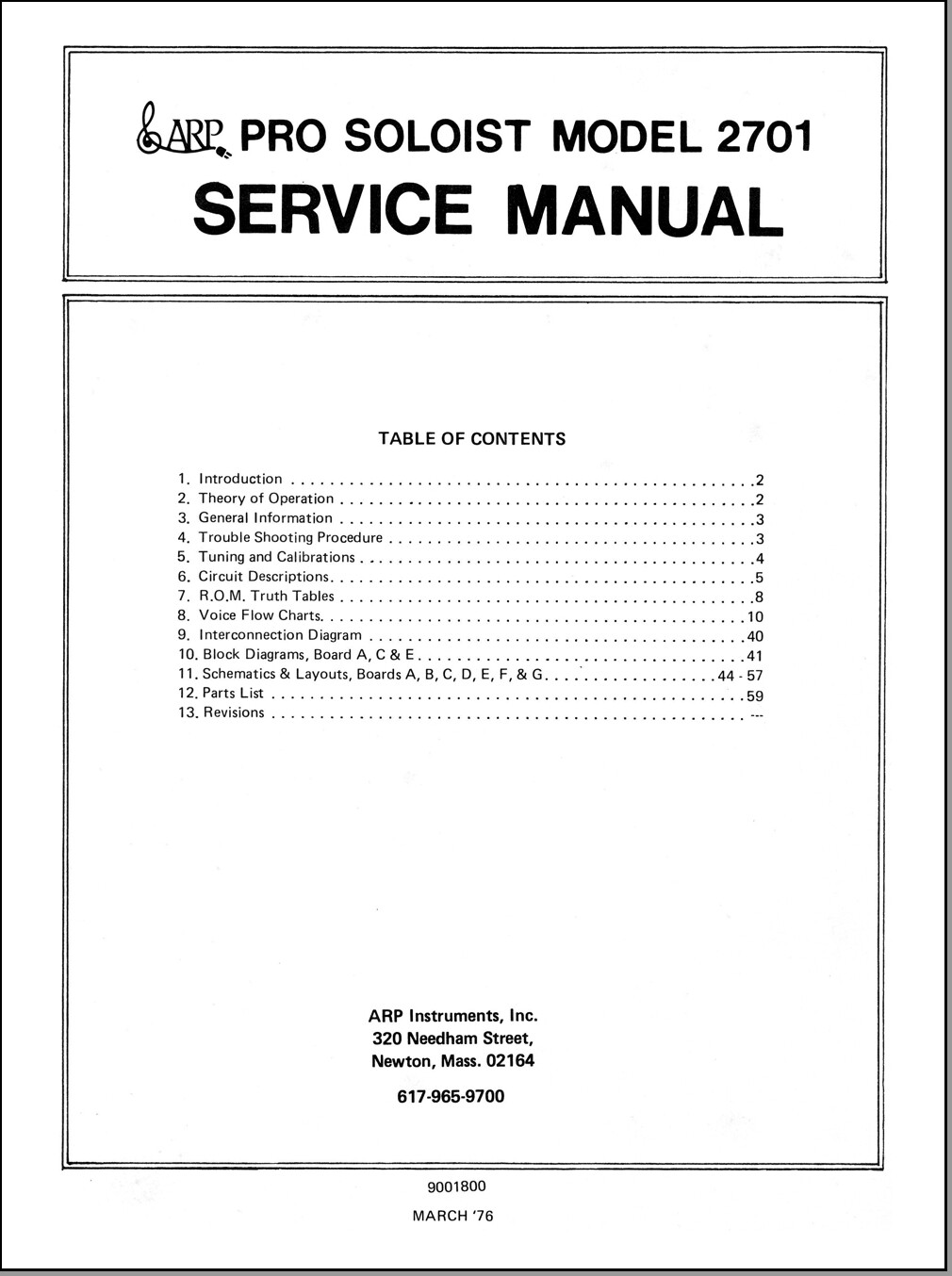
- Service Manual — archive.org
- Service Manual — archive.org
- Service Manual — archive.org
- Service Manual — archive.org
- Service Manual — archive.org
Related Models
- ARP 2600C (1978-1981)
- ARP 2600P (1975-1978)
- ARP Avatar (1979-1981)
- ARP Solus (1975-1976)
- Yamaha CS-80 (1977-1980)
- Korg Mono/Poly (1981-1984)
- Korg MS-20 (1978-1983)
- Korg Polysix (1981-1984)
- Moog Memorymoog (1982-1985)
- Moog Minimoog Model D (1970-1981)