Sequential Circuits Prophet-10 (1980–1984): The Double-Barreled Analog Titan
Ten voices of searing polyphonic analog power, born from twin Prophet-5s and a hunger for sonic dominance.
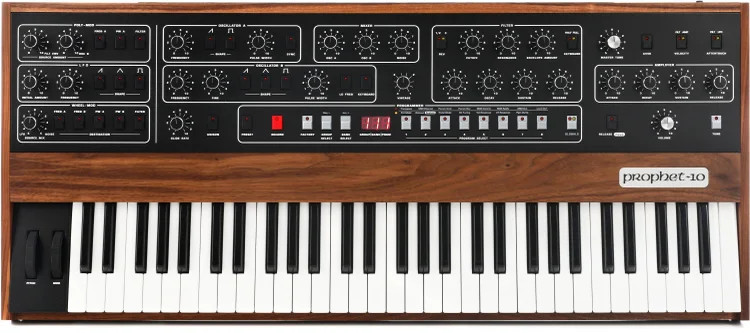
The Sequential Circuits Prophet-5 didn’t just redefine what a synthesizer could be—it rewrote the rulebook. When it launched in 1978, its combination of full programmability, polyphony, and analog warmth made it an instant legend. But for some, five voices simply weren’t enough. Enter the Prophet-10: a brute-force evolution that strapped two Prophet-5 voice boards into a single, expanded chassis, delivering a thunderous 10-voice polyphony that was, at the time, nothing short of revolutionary. Released in 1980, the Prophet-10 wasn’t just a bigger synth—it was a statement. It was for players who needed orchestral swells, dense pads, and cascading arpeggios without voice stealing, all while retaining the instantly recallable presets that had made the Prophet-5 indispensable in studios from Abbey Road to Sunset Boulevard.
Used by titans like Michael Jackson’s keyboardist Greg Phillinganes (heard on Thriller), Herbie Hancock, and Tangerine Dream, the Prophet-10 carved its niche in both pop and progressive realms. Its sound? Thick, creamy, and harmonically rich—like honey poured over molten lava. But let’s be honest: this wasn’t a synth for the faint of heart or the weak of back. At 55 pounds, it was a road warrior’s nightmare, and its dual-engine architecture came with a price: reliability issues that would haunt owners for decades. Yet, despite its quirks, the Prophet-10 represented a pivotal moment—the fleeting peak of analog polyphony just before the digital tsunami of the mid-80s. It was the last gasp of analog excess before MIDI and FM synthesis changed everything.
| Specification | Value |
|---|---|
| Polyphony | 10 voices |
| Oscillators per Voice | 2 |
| Waveforms | Sawtooth, Square/Pulse, Triangle, Pulse Width Modulation |
| Filter | 1 VCF per voice, 24dB/octave resonant low-pass, 12dB/octave high-pass |
| Filter Type | CEM 3320-based |
| Envelope Generators | 2 ADSR (VCF and VCA) |
| LFO | 1 LFO with triangle, square, sample & hold, and random waveforms |
| LFO Destinations | Pitch, Pulse Width, Filter Cutoff |
| Keyboard | 5-octave (61 keys), velocity and aftertouch sensitive |
| Memory | 120 patches (60 factory, 60 user) |
| MIDI | False |
| Control Inputs | CV/Gate inputs for external control |
| Dimensions | 38.5 x 15.5 x 5.5 inches (97.8 x 39.4 x 14 cm) |
| Weight | 55 lbs (24.9 kg) |
| Power | 100-120V AC, 60 Hz, 120 watts |
| Original MSRP | $7995 (1980) |
| Country of Manufacture | United States |
- 10-Voice Polyphony via Dual Prophet-5 Voice Boards: The Prophet-10’s core innovation was its architecture—literally two Prophet-5 Rev 3 voice cards (20 oscillators, 10 filters, 10 VCAs) crammed into one oversized chassis. This wasn’t just more voices; it meant you could layer two entirely different patches (split or stacked) across the keyboard, a feature that prefigured modern multitimbral workstations. Want a bass patch on the lower half and a string pad on top? Done. Stack two identical patches for a chorus-like thickness? Even better. It was like having two Prophets in one, albeit with a shared control panel.
- Fully Programmable with Patch Memory: In 1980, this was still witchcraft. While synths like the Oberheim OB-X required manual tweaking for every sound, the Prophet-10 let you save and recall 120 patches—60 factory presets (curated by Dave Smith himself) and 60 user slots. This wasn’t just convenient; it transformed live performance. No more fiddling with knobs between songs. The 1981 Rev 4 update added CEM 3320 filter chips, which improved tuning stability and consistency across voices—critical when you’re managing ten oscillators at once.
- Velocity and Aftertouch Sensitivity: For a synth of its era, this was luxurious. Most polysynths treated the keyboard as a simple on/off switch. The Prophet-10 responded to how hard you hit the keys (velocity) and how much pressure you applied after the initial strike (aftertouch), allowing for expressive swells, vibrato, or filter sweeps via modulation routing. This made it a favorite among session players who needed dynamic, human-sounding performances.
The Prophet-10 didn’t emerge in a vacuum. It arrived at a moment of intense competition between American synth pioneers. While Sequential Circuits had stunned the world with the Prophet-5, Oberheim countered with the OB-X—a powerful 8-voice analog monster used on Van Halen’s “Jump” and countless film scores. The OB-X had a bolder, more aggressive character, but it lacked programmable presets until the OB-Xa. The Prophet-10, by contrast, doubled down on the Prophet-5’s greatest strength: reliability through digital control of analog circuits. It was the ultimate expression of that philosophy—more voices, more memory, more control.
But the landscape was shifting. By 1982, Yamaha’s DX7—a digital FM synth with MIDI and 16-voice polyphony—was on the horizon. Suddenly, the Prophet-10’s $7,995 price tag (over $28,000 today, adjusted for inflation) looked exorbitant. Sequential responded with the Prophet-600, the first MIDI-equipped analog synth, but it couldn’t save the company from financial collapse in 1987. The Prophet-10, produced in limited numbers from 1980 to 1984, became a symbol of analog’s last stand: powerful, beautiful, and just a little too late.
Today, the Prophet-10 is a prized relic. With a rarity rating of “rare” and desirability pegged at “high,” it commands $8,000 to $15,000 on the vintage market—assuming it works. And that’s the rub. These beasts are notorious for voice card failures, often due to aging capacitors, poor ventilation, and the sheer heat generated by 20 analog oscillators running in close quarters. The power supply is another weak point; many units have been retrofitted with modern replacements to avoid catastrophic failure. When buying one, look for a unit with documented service history, stable tuning across all 10 voices, and ideally, the Rev 4 filter upgrade. A working Prophet-10 isn’t just a synth—it’s a triumph of engineering and endurance. It’s also a reminder that sometimes, the most glorious instruments are the ones that flirt with self-destruction. But when it sings? Ten voices rise in analog harmony, and for a moment, you understand why we still chase these temperamental gods of voltage and sound.
eBay Listings



As an eBay Partner, we earn from qualifying purchases. This helps support our independent vintage technology research.
Related Models
- Sequential Circuits Pro-One (1981-1984)
- Sequential Circuits Prophet-5 (1978-1984)
- Yamaha CS-80 (1977-1980)
- ARP 2600C (1978-1981)
- ARP 2600P (1975-1978)
- ARP Avatar (1979-1981)
- ARP Pro Soloist (1972-1977)
- ARP Solus (1975-1976)
- Korg Mono/Poly (1981-1984)
- Korg MS-20 (1978-1983)