Sequential Circuits Pro-One (1981–1984)
A no-nonsense, feature-packed monosynth that punched far above its weight—bringing professional analog synthesis within reach of bedroom studios and touring musicians alike.
Overview
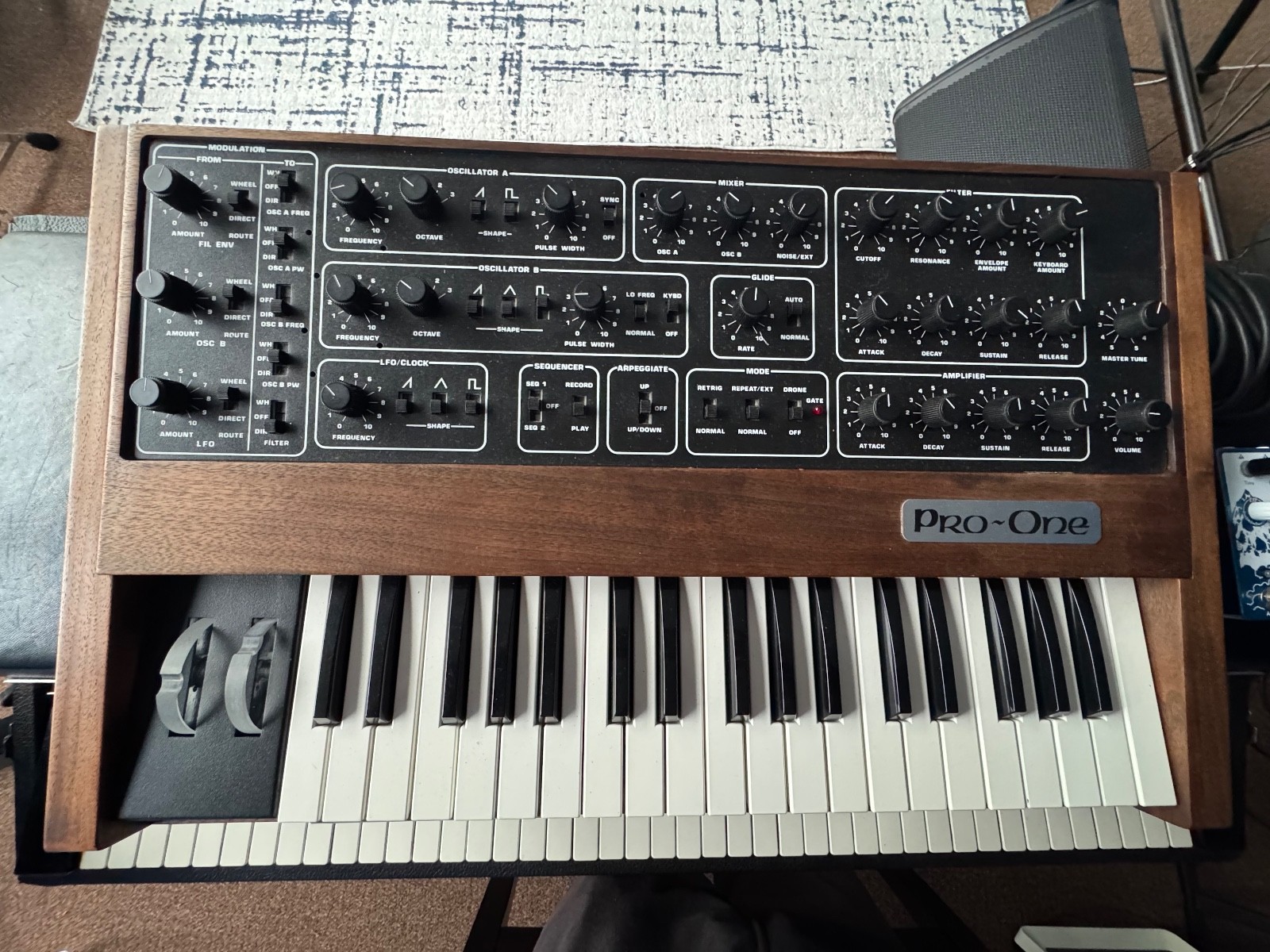
The Sequential Circuits Pro-One isn’t just a synth—it’s a statement. Released in 1981, it arrived at a pivotal moment when analog synthesis was being squeezed by the promise of digital novelty, yet demand for warm, hands-on sound remained strong. Priced at a shockingly accessible $795, the Pro-One offered a level of sonic sophistication and real-time control that belied its cost. With two voltage-controlled oscillators, a Curtis filter chip that snarled like a cornered panther, and a fully programmable 16-step sequencer built right in, this was no toy. It was a working musician’s weapon: compact enough for a flight case, powerful enough to cut through a mix, and intuitive enough to inspire at 3 a.m.
Used by everyone from underground synth-poppers to session players needing a quick bassline fix, the Pro-One carved out a niche as the thinking person’s monosynth. It wasn’t flashy—no wood panels, no flashy lights—but it had soul. The mini-keyboard (37 keys, velocity-free but with pitch and mod wheels) felt surprisingly responsive, and the layout was so logically arranged that you could dive in without touching the manual. Which, frankly, most owners did anyway—because once you started twisting knobs, you didn’t want to stop. Artists like Vince Clarke (of Depeche Mode and Yazoo fame) reportedly used it alongside his Sequential Circuits Pro-1, and its bass tones have quietly underpinned tracks across new wave, industrial, and early electronic dance music.
Specifications
| Oscillators | 2 VCOs with sawtooth, triangle, square, pulse, and noise waveforms |
| Filter | 1 VCF (24dB/oct low-pass, 12dB/oct band-pass, 6dB/oct high-pass) with resonance |
| Envelope Generators | 2 ADSR (attack, decay, sustain, release) generators |
| LFO | 1 LFO with triangle, square, and sample-and-hold waveforms |
| Keyboard | 37-note mini-keyboard with pitch bend and modulation wheels |
| Sequencer | 16-step built-in sequencer with memory for 128 sequences |
| Arpeggiator | Up, down, up/down, and random modes |
| Audio Outputs | 1x 1/4" unbalanced (150 ohms output impedance) |
| Audio Input | 1x 1/4" external audio input for filter processing |
| Control Voltage | CV/Gate, S-Trig, and Sync inputs/outputs |
| Power | 100–120 VAC, 60 Hz, 20 watts |
| Dimensions | 35.5" x 11.5" x 4.25" (90.2 x 29.2 x 10.8 cm) |
| Weight | 17 lbs (7.7 kg) |
| Patch Memory | 16 user-programmable memory locations |
| Country of Manufacture | United States |
| Original MSRP | $795 (1981) |
| Years Produced | 1981–1984 |
Key Features
- Built-in 16-step sequencer with 128 sequence memory: This wasn’t just a novelty—it was a full compositional tool. You could chain sequences, sync them to external gear via CV, and store complex patterns that would otherwise require a separate box. In 1981, having this kind of sequencing power built into a $795 synth was borderline revolutionary.
- CV/Gate and S-Trig compatibility: The Pro-One didn’t live in a bubble. With full CV/Gate and S-Trig I/O, it played beautifully with modular systems and drum machines of the era. Want to sync your Moog Rogue to your Roland TR-808? Route the Pro-One as the master clock. It was a bridge between worlds.
- External audio input for filter processing: Feed in a guitar, a drum machine, or even a cassette deck—the Pro-One’s Curtis filter would mangle it with glorious analog warmth. This feature turned it into a sound design tool, not just a synth.
- 16 user-programmable patch memories: At a time when many synths were entirely non-programmable (looking at you, Moog Rogue), being able to save and recall 16 sounds was a godsend for live use. No more tweaking knobs between songs.
- True analog arpeggiator with random mode: The arpeggiator wasn’t an afterthought. With up, down, up/down, and—rare for the time—random modes, it could generate unpredictable, evolving patterns that felt almost alive. Try random mode with a high resonance setting and a slow LFO on filter cutoff. You’ll thank me later.
Historical Context
The Pro-One didn’t emerge in a vacuum. It was the spiritual successor to the Sequential Circuits Pro-1 (1979–1981), a simpler, non-programmable monosynth that laid the groundwork. But the Pro-One was bolder: more features, more memory, more connectivity. It arrived just as the Prophet-5 was redefining polyphony, and while the Pro-One was monophonic, it offered something equally valuable—affordability and immediacy. Where the Prophet-5 cost over $5,000, the Pro-One was under $800, making it one of the first truly professional-grade synths that a gigging musician could justify buying without a record deal.
It also stood in stark contrast to its main competitor, the Moog Rogue, released the same year. The Rogue had a simpler architecture (one VCO, no sequencer, no patch memory), and while it had that legendary Moog filter, it lacked the Pro-One’s versatility. The Pro-One was the engineer’s choice; the Rogue, the purist’s. Sequential Circuits wasn’t just competing on price—they were redefining what a budget synth could do. And they succeeded so well that the Pro-One’s DNA lived on in the Sequential Circuits Six-Trak (1984), a six-voice paraphonic synth that expanded on the Pro-One’s programmability and multitimbrality.
Collectibility & Value
Today, the Pro-One is considered uncommon but not rare—roughly 3,000 units were reportedly produced across both Mk I and Mk II versions. Its desirability is high, especially among synth enthusiasts who value hands-on control and real sequencing power without the bulk of a modular rig. As of 2025, a fully functional Pro-One in good condition sells for $1,200 to $2,000 USD, with Mk II models (black panel, gold labels) often commanding a slight premium due to their improved circuit stability.
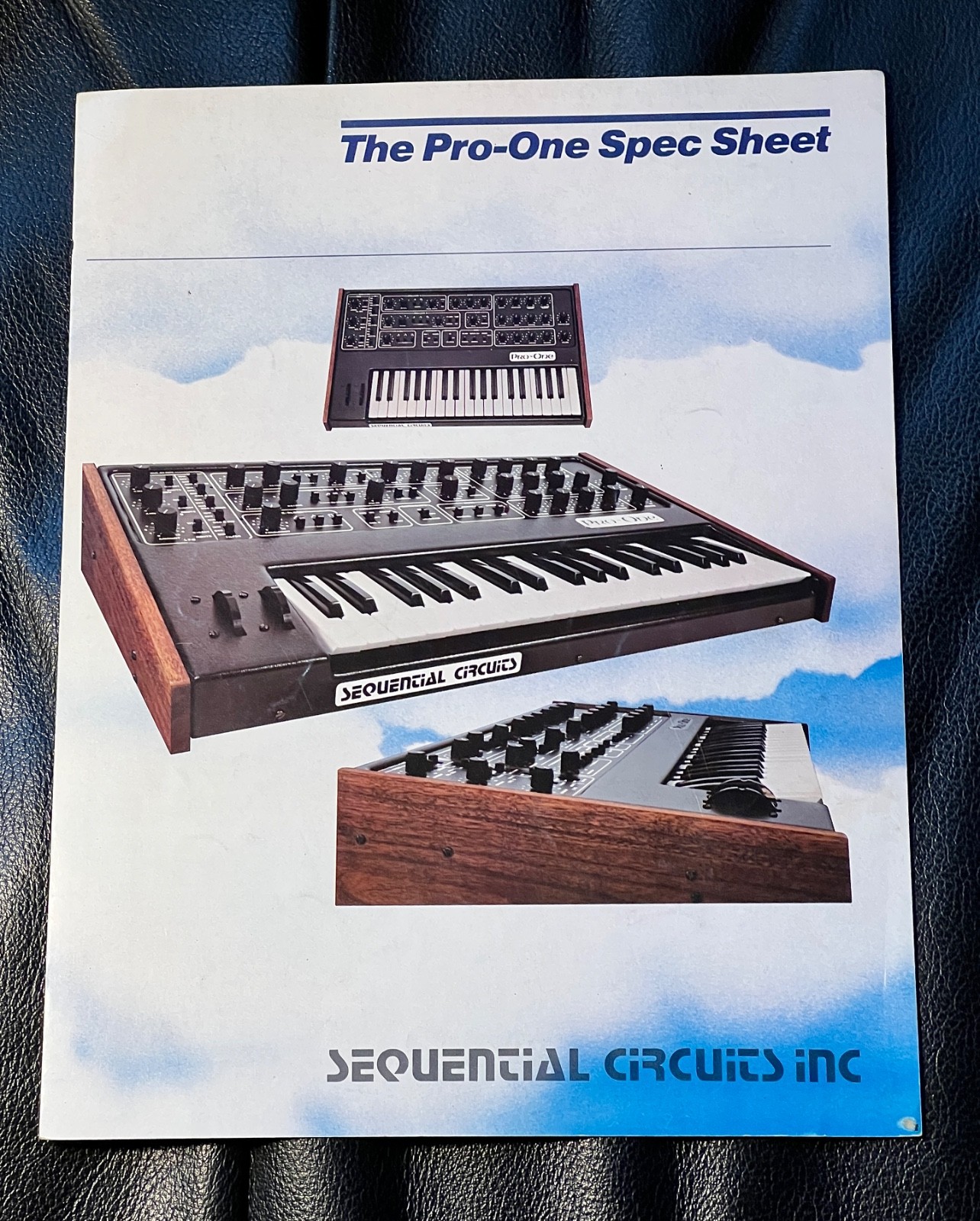
But beware: these machines are over 40 years old. The most common issues are capacitor degradation in the power supply—which can lead to hum, noise, or even failure—and wear on the mini-keyboard contacts, causing note dropouts. A Pro-One that hasn’t been serviced in decades is a project, not a purchase. When buying, insist on a unit that powers on cleanly, sequences reliably, and has full keyboard response. If it still has its original manual (a beautifully detailed 40-page guide), consider that a bonus. And if you find one with the original foam padding intact inside the case—sell tickets. That’s a miracle.
eBay Listings

As an eBay Partner, we earn from qualifying purchases. This helps support our independent vintage technology research.
Related Models
- Sequential Circuits Prophet-10 (1980-1984)
- Sequential Circuits Prophet-5 (1978-1984)
- Yamaha CS-80 (1977-1980)
- ARP 2600C (1978-1981)
- ARP 2600P (1975-1978)
- ARP Avatar (1979-1981)
- ARP Pro Soloist (1972-1977)
- ARP Solus (1975-1976)
- Korg Mono/Poly (1981-1984)
- Korg MS-20 (1978-1983)