Sequential Circuits Prophet-10 (1980–1984)
Two Prophet-5s in one chassis, ten voices deep, and heavy enough to make a touring tech weep.
Overview
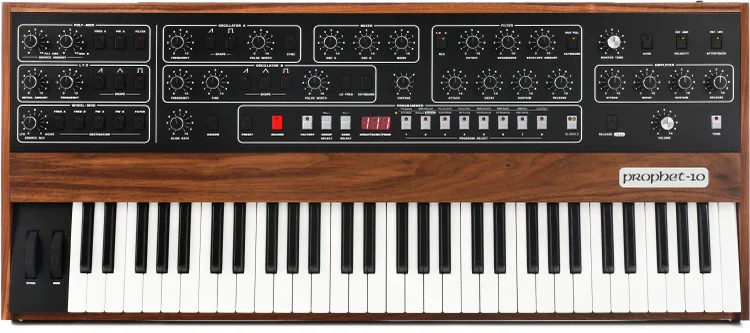
Fifty-five pounds. That's what greets anyone who tries to move a Prophet-10. Sequential Circuits took the Prophet-5 - the synth that had already taken the industry by surprise - and effectively stacked two of them together. The result was a ten-voice analog polyphonic synthesizer released in 1980, priced at $7,995, and aimed at players who found five voices insufficient for dense, layered textures.
The Prophet-10 is described as literally two Prophet-5 Rev 3 voice cards - 20 oscillators, 10 filters, 10 VCAs - crammed into one oversized chassis with a shared control panel. Each voice carries two oscillators. The dual-engine design allows two completely different patches to be played at once, either split across the keyboard or stacked. That meant bass in the left hand and pad in the right, or two identical patches layered for a chorus-like thickness a single Prophet-5 couldn't deliver. Polyphony (September 1981, p.2) described the instrument as "the most complete keyboard instrument available today," noting that each five-voice keyboard section had its own programmer so two distinct sounds could be played at once.
The Prophet-10 inherited the sound of the Prophet-5 - thick, creamy, harmonically rich. What it added was scale. Ten voices meant no more voice stealing during big chords and no more compromises on sustained pads.
Key Features
Ten Voices from Two Prophet-5 Engines
The defining feature is the ten-voice polyphony, achieved by pairing two five-voice Prophet-5 boards in a single enclosure. Each voice has two voltage-controlled oscillators feeding a four-pole low-pass filter, two ADSR envelope generators, and independent modulation capabilities. The dual-manual version, documented in period materials, split the voices across two 61-key keyboards, each with its own programmer, so two players or two hands could work entirely separate sounds. The single-keyboard configuration allowed all ten voices to be played from one manual, or split and layered. Polyphony (May 1981, p.2) said the instrument's total capabilities were "too numerous to mention," but singled out the independent programmers as the key to its flexibility.
Two Oscillators Per Voice with Full Waveform Control
Each of the ten voices carries two oscillators offering sawtooth, square/pulse, triangle, and pulse-width modulation. That's twenty oscillators total, a big count for 1980. The PWM capability gave the Prophet-10 its characteristic movement: slow, swirling phase effects. Layering two patches with slightly detuned oscillators produced a thickness that monosynths and five-voice polys couldn't match.
CEM 3320 Filters and the Rev 4 Update
The filter section is built around the CEM 3320 chip, with one 24dB/octave resonant low-pass filter per voice plus a 12dB/octave high-pass. The 1981 Rev 4 update brought the CEM 3320 into the design, and according to available documentation, it improved tuning stability and consistency across voices. That matters when twenty oscillators all need to track together. Earlier units used different filter chips, and the Rev 4 is the version collectors tend to seek out. The filter itself is classic Prophet: warm, and aggressive when pushed.
Velocity and Aftertouch Sensitivity
The five-octave, 61-key keyboard responds to both velocity and aftertouch, a luxury in 1980, when most polysynths treated keys as simple on/off switches. Velocity could be routed to filter cutoff or amplitude, while aftertouch opened up swells, vibrato, and filter sweeps without reaching for a pedal or knob. Polyphony (January 1982, p.2) noted the instrument's comprehensive modulation section as one of its defining strengths.
120 Patches of Programmable Memory
The Prophet-10 stored 120 patches - 60 factory presets and 60 user slots. In 1980 that was still remarkable. Saving and recalling sounds at the touch of a button meant no more dialing in a patch between songs while the audience waited. The factory presets were reportedly programmed by Dave Smith himself, and the user slots gave players room for their own library. A third-party "Memory Liberator" F-RAM upgrade later became available for owners looking to eliminate the battery backup.
CV/Gate Control and the Absence of MIDI
The Prophet-10 predates MIDI, and the fact sheet confirms it has no MIDI implementation. External control comes via CV/Gate inputs, which let it interface with other analog gear and sequencers of the era. Modern setups need a MIDI-to-CV converter. The onboard polyphonic sequencer, available as an option on some versions, operated on the lower manual and stored sequences to cassette. The Braemer tape drive found in some units is a known point of failure and often goes untested by sellers.
Historical Context
The Prophet-10 arrived in 1980, two years after the Prophet-5 had established Sequential Circuits as a major player in the polyphonic synth market. The company's own advertising billed it as "the Ultimate Keyboard" - a dual-manual, ten-voice version of the Prophet-5 with additional keyboard assignment modes, a programmable equalization section, and an onboard cassette unit with poly sequencer. At £6,185 in the UK and $7,995 in the US, it was positioned as a flagship instrument for the serious professional.
The competition was fierce. Oberheim's OB-X offered eight voices and a bolder, more aggressive character, though it lacked programmable presets until the OB-Xa. The Prophet-10 countered with the Prophet-5's greatest strength: reliable digital control of analog circuits, now scaled up to ten voices. By 1982, the Yamaha DX7 - a digital FM synth with MIDI and 16-voice polyphony - was on the horizon, and the Prophet-10's price tag began to look exorbitant. Sequential responded with the Prophet-600, the first MIDI-equipped analog synth, but the company's financial collapse in 1987 ended that run. The Prophet-10 was produced in limited numbers from 1980 to 1984.
Period accounts suggest the instrument found its way into notable hands. Vangelis reportedly used a Prophet-10 for low drones and effects on the Blade Runner score, and the dual-manual version appeared in the rigs of players who needed maximum polyphony in a single instrument. Polyphony (September 1981, p.2) called it "the most complete keyboard instrument available today."
Collectibility & Value
The Prophet-10 is rare, and the market prices it that way. Stated vintage market prices run from $8,000 to $15,000, assuming the unit works. Current eBay listings cluster lower, with recent examples asking $3,590 to $4,530, though those figures likely reflect condition, completeness, and the uncertainty that comes with any forty-year-old analog instrument. One MusicTech comparison put a vintage Prophet-10 at about $10,000, with the modern reissue selling for just under $5,000.
Reliability is the big problem. Voice card failures are common, driven by aging capacitors, poor ventilation, and the heat generated by twenty analog oscillators running in close quarters. The power supply is another weak point, and many units have been retrofitted with modern replacements to avoid catastrophic failure. Buying advice from the field is consistent: look for documented service history, stable tuning across all ten voices, and ideally the Rev 4 filter upgrade. A serial number 0023 unit was recently serviced for almost $2,800.
Some owners have commissioned "chopped" versions - original units modified for stage and studio use, with reduced size and weight. Purists may wince. The Prophet-10 weighs 55 pounds stock, and a chopped version is something you can actually carry.
eBay Listings



As an eBay Partner, we earn from qualifying purchases. This helps support our independent vintage technology research.