Roland VP-330 (1979–1983): The Analog Oracle of Choirs, Strings, and Synthetic Souls
A rare 10-voice string machine and 10-band vocoder in one box—equal parts celestial choir and robotic prophet, the VP-330 didn’t just make sound, it conjured atmosphere.
Overview
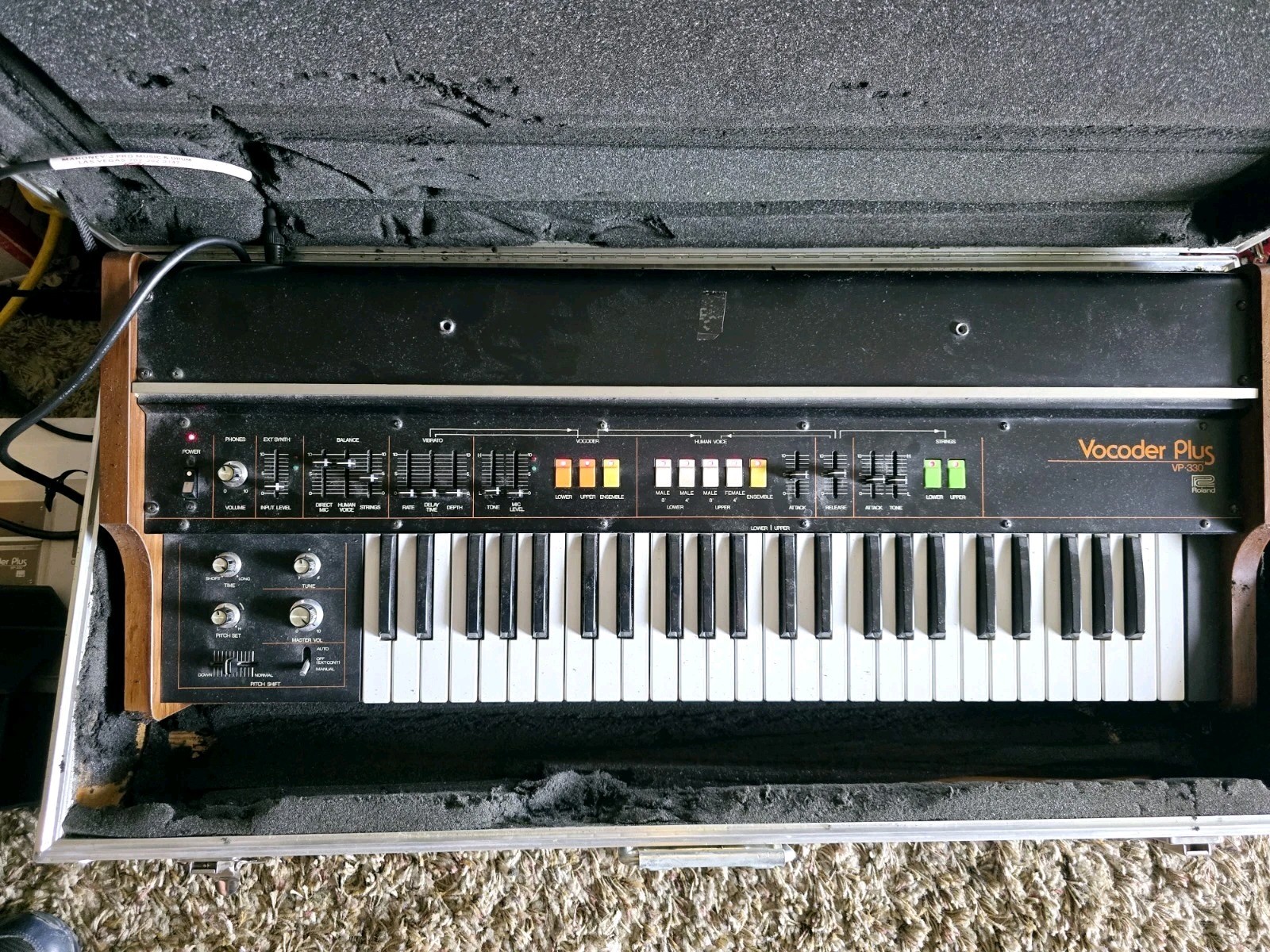
If synthesizers were cast as characters in a sci-fi epic, the Roland VP-330 would be the enigmatic oracle—part priest, part android—delivering ethereal pronouncements through a choir of ghosts and the cold logic of vocoded speech. Released in 1979 at a time when analog synthesis was rapidly expanding beyond monophonic leads and basses, the VP-330 stood out not for brute power, but for its uncanny ability to blend organic warmth with synthetic precision. It wasn’t just a vocoder; it was a polyphonic string ensemble, a built-in vocal choir synthesizer, and a 10-band vocoder—all crammed into a 37-key, 7.5-kilogram slab of late-’70s Japanese engineering. At $1,995 in 1979 (roughly $8,000 today), it was a luxury, but for artists chasing a certain kind of otherworldly texture, it was worth every yen.
The VP-330 found its voice in the hands of sonic pioneers like Vangelis—whose work on Blade Runner drips with its spectral choir patches—and Tangerine Dream, who used it to thicken their ambient tapestries with ghostly “Ahhh” and “Ooooh” layers that seemed to drift in from another dimension. Unlike most vocoders of the era, which relied entirely on external vocal input, the VP-330 had a built-in synthesized choir that could be played independently, layered, or modulated—making it a true hybrid instrument. You could play lush strings with chorus, add a floating choir pad, and then suddenly cut through with a robotic vocal effect, all without patching a single cable. This integration was revolutionary. In an age when most studios required multiple racks of gear to achieve such textures, the VP-330 was a self-contained atmosphere generator.
Specifications
| Synthesis Type | Analog subtractive |
| Polyphony | 10 voices (strings), 1 voice (vocoder) |
| Vocoder Bands | 10-band |
| Oscillators | 1 DCO per voice (sawtooth, pulse) |
| Filters | 1 VCF per voice (24dB/octave low-pass) |
| Envelopes | 1 ADSR (VCF and VCA) |
| LFO | 1 LFO (triangle, square, sample & hold) |
| Keyboard | 37 keys (3 octaves) |
| Inputs | Microphone input (1/4"), external audio input (1/4") |
| Outputs | 1/4" mono output |
| Power | DC 16V (via included power supply) |
| Dimensions | 630 mm × 275 mm × 105 mm |
| Weight | 7.5 kg |
| Country of Manufacture | Japan |
| Original MSRP | $1995 (1979) |
Key Features
- 10-band vocoder with built-in microphone preamp: Unlike many vocoders that demanded external processing, the VP-330 had a full 10-band vocoder with a dedicated mic input and internal preamp—plug in a mic, speak, and instantly become a synth. The clarity and responsiveness of the banding gave it a more natural, less “bubbly” articulation than competitors, making it ideal for both speech and melodic vocal effects.
- Polyphonic string ensemble with chorus effect: Borrowing from Roland’s legacy in string machines (like the RS-202), the VP-330 delivered lush, detuned string pads with a rich, built-in analog chorus. This wasn’t just a cheap ensemble effect—it was the kind of warm, wobbling texture that defined 1970s film scores and early synth-pop ballads. The 10-voice polyphony meant full chords without voice stealing, a rarity in its class.
- Integrated choir (Ahhh/Ooooh) synthesis independent of vocoder: This is where the VP-330 transcended gimmickry. The choir wasn’t a sample or a vocoder trick—it was a fully synthesized tone generator producing vowel-like timbres that could be played like any other synth voice. You could layer strings and choir, modulate them with the LFO, and use the chorus to make them swell like a cathedral full of ghosts. And because it was independent, you could vocode speech over a choir bed—a meta-layering feat that still sounds futuristic today.
Historical Context
The VP-330 emerged at a pivotal moment: 1979, when disco was collapsing under its own glitter, punk had burned bright and fast, and electronic music was shedding its academic skin to embrace pop sensibilities. Synthesizers were no longer just for experimental composers—they were tools for hitmakers. But most were either monophonic (like the Jupiter-4) or limited in expressive range. The VP-330 offered something different: not leads or basses, but ambience. It was an instrument for texture, for mood, for the spaces between notes.
Its closest competitor was the Korg VC-10, a more traditional standalone vocoder with 10 bands and external synth control. But the VC-10 lacked any internal sound generation—it was a processor, not an instrument. The VP-330, by contrast, was all-in-one: vocoder, strings, choir, keyboard. Its predecessor, the Roland VP-770 (1978–1979), was a larger, more expensive stage-oriented unit with similar features but less portability and no built-in mic preamp. The VP-330 was the refinement—smaller, smarter, more studio-friendly. Roland never released a true successor; the VP-770 reappeared in concept form decades later, but the VP-330 remains the apex of Roland’s vocoder-string-choir experiment.
It’s telling that the VP-330 didn’t dominate the market—it was too niche, too expensive, too strange. But its influence was outsized. You can hear its DNA in the vocal pads of early Depeche Mode, the atmospheric layers of Jean-Michel Jarre’s Zoolook, and even modern film scoring where synthetic choirs evoke unease or transcendence. It defied the trend of specialization, insisting that a synth could be many things at once. In doing so, it became a cult classic—a machine not for everyone, but for those who needed to summon the uncanny.
Collectibility & Value
Today, the VP-330 is a rare beast. Few were made, fewer survived, and even fewer remain in working order. Its rarity is compounded by its complex analog circuitry and age-sensitive components. On the used market in 2025, a fully functional VP-330 commands between $2,500 and $4,000 USD, with pristine units or those with original packaging fetching the upper end. It’s not just the sound that drives value—it’s the mystique, the Vangelis connection, the fact that no software plugin perfectly replicates its layered, slightly unstable analog warmth.
But buying one is not for the faint of heart. The known issues are serious: capacitor leakage is common in units that sat for decades, potentially damaging the PCB. The original power supply is notoriously prone to failure—many units were killed by incorrect voltage or reversed polarity from third-party replacements. When shopping, insist on a unit with a re-capped motherboard and a tested, original or compatible PSU. Also check the keyboard: the 37-key F-7000 keyboard is durable, but sticky keys or dead notes can indicate deeper issues. And test both the vocoder and choir—some units lose the choir section due to failed ICs.
Despite the risks, the VP-330 remains a holy grail for synth collectors and analog purists. It’s not the most practical synth, nor the most versatile. But when you hear that choir swell into a vocoded phrase over a chorus-drenched string chord, you understand why it’s revered. It doesn’t just make sound—it breathes.
eBay Listings


As an eBay Partner, we earn from qualifying purchases. This helps support our independent vintage technology research.
Service Manuals & Schematics
- Service Manual — archive.org
- Owner's Manual — archive.org
- Service Manual — archive.org