Roland TB-303 (1981–1984)
A commercial flop that became the snarling, squelching heart of acid house—and one of the most influential electronic instruments ever built.
The Roland TB-303 is the ultimate example of failure breeding revolution. Introduced in 1981 as a "bass player in a box" meant to accompany solo guitarists, it was supposed to simulate a bass guitar with its monophonic analog circuitry and built-in sequencer. Instead, it sounded nothing like a bass guitar—thankfully. Its sharp, nasal, and aggressively synthetic tone, especially when the filter was cranked, was so alien that most musicians of the early '80s wanted nothing to do with it. Roland discontinued the TB-303 in 1984 after selling fewer than 10,000 units, writing it off as a failed experiment. But in the hands of broke, visionary producers in Chicago and Detroit, the 303 found its true voice: a searing, liquid, psychedelic wail that could make your spine vibrate.
By the mid-to-late 1980s, the TB-303 had become the defining instrument of acid house. Tracks like Phuture’s “Acid Tracks” (1987) exploited its resonant filter and quirky sequencer to create hypnotic, evolving basslines that slithered and bubbled like molten rubber. The magic lay in how the sequencer could apply accent and slide (portamento) to individual steps—when combined with aggressive resonance and filter cutoff modulation, the result was a sound that felt alive, unpredictable, and deeply physical. It wasn’t just a synth; it was a performance instrument with a mind of its own. Today, the TB-303’s DNA is embedded in nearly every form of electronic dance music, from techno to trance to footwork. Its legacy isn’t just sonic—it’s cultural. It proved that the most revolutionary tools aren’t always the ones that work as intended.
| Synthesis Type | Analog subtractive |
| Oscillators | 1 DCO (Digitally Controlled Oscillator) |
| Waveforms | Sawtooth, Square/Pulse |
| Filter | 24dB/oct resonant low-pass filter (diode ladder type) |
| Envelope | ADSR (Attack, Decay, Sustain, Release) |
| LFO | 1 LFO with square wave only |
| Keyboard | 13-key mini keyboard (one octave plus one note) |
| Sequencer | 16-step monophonic sequencer with real-time and step recording |
| Memory | 4 user patterns, 1 song (up to 24 measures) |
| Outputs | 1x 1/4" unbalanced mono |
| Power Supply | 12 V DC (via included AC adapter) |
| Current Draw | 500 mA |
| Dimensions | 355 mm × 200 mm × 70 mm (14.0" × 7.9" × 2.8") |
| Weight | 2.5 kg (5.5 lbs) |
| Audio Output Level | 1 Vpp (typical) |
| Frequency Response | 20 Hz - 20 kHz (-3 dB) |
| THD | <0.5% (at 1 kHz) |
| S/N Ratio | 70 dB (typical) |
| Country of Manufacture | Japan |
| Original MSRP | $695 (1982) |
- Step Sequencer with Accent and Slide: The 16-step sequencer wasn’t just a playback tool—it was a compositional engine. You could record in real time or enter notes step by step, but the real magic came from assigning accent and slide to individual steps. Accent boosted the amplitude and widened the filter envelope, creating punchy, dynamic accents. Slide (portamento) allowed smooth glides between notes, and when combined with rapid step sequences, produced the iconic bubbling, melting basslines that define acid. Try programming a simple C-G-C-G pattern with alternating slide and accent—within seconds, you’re in acid territory.
- Resonant Diode Ladder Filter: While many synths use transistor ladder filters, the TB-303’s diode ladder design gives it a sharper, more aggressive resonance peak. When you crank the resonance and sweep the cutoff via the sequencer, the filter doesn’t just emphasize frequencies—it oscillates, shrieks, and squelches. This isn’t a subtle effect; it’s a full-body sonic massage. The filter’s behavior is nonlinear and slightly unpredictable, especially as components age, which adds to the charm. No software emulation has perfectly captured this chaos—there’s a reason purists insist on the real thing.
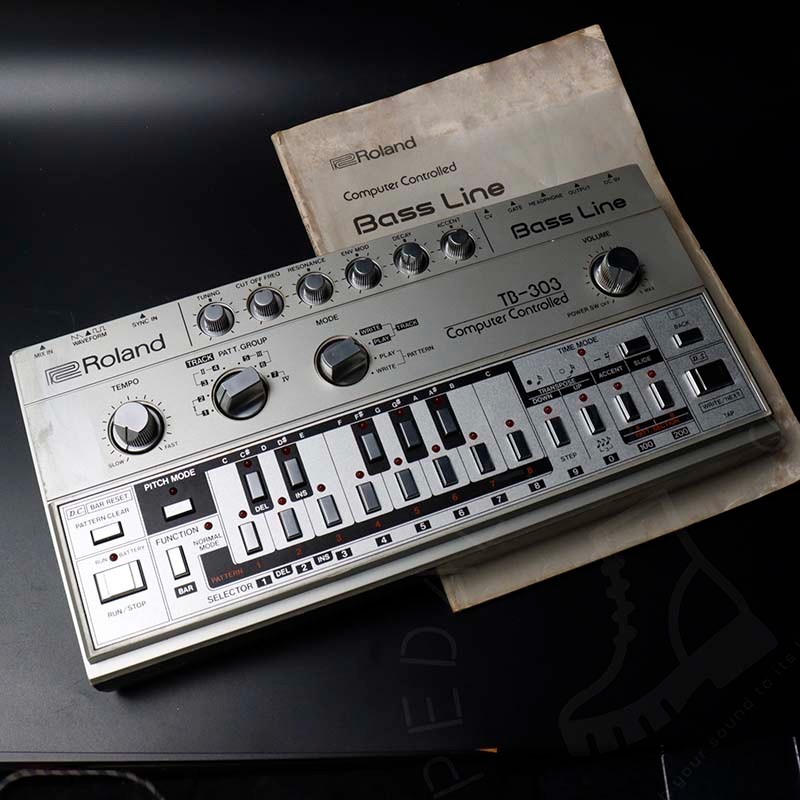
- Compact, Self-Contained Design: At just over two inches tall and weighing under six pounds, the TB-303 was built for portability. The 13-note mini keyboard wasn’t meant for virtuoso playing (the keys are tiny and stiff), but it was perfect for entering basslines into the sequencer. The front panel is sparse—knobs for cutoff, resonance, envelope modulation, and a few sequencer controls—but every knob matters. There’s no display, no MIDI (a major limitation by 1983), and only one output. Yet this minimalism forced creativity. You had to think in sequences, not chords. You had to commit. And when it worked, it felt like alchemy.
The TB-303 didn’t emerge in a vacuum. It was part of Roland’s early '80s push into affordable, programmable groove tools—machines like the Roland TR-808 and Roland MC-202 that prioritized pattern-based composition over traditional keyboard performance. The 303 was meant to be the bass counterpart to the TR-606 rhythm box, forming a self-contained backing band. But while the TR-808 found quick adoption in hip-hop and electro, the 303 flopped. Its failure wasn’t just commercial—it was conceptual. Guitarists didn’t want a robot bassist that sounded like a dying mosquito.
By 1983, digital synths like the Yamaha DX7 were on the rise, offering pristine FM tones and MIDI connectivity. Analog gear, especially monophonic boxes without MIDI, seemed outdated. Roland moved on, releasing the MC-202 in 1983—a dual-voice synth and sequencer that could actually sync with other gear via DIN sync. But the 303, with its quirks and limitations, slipped under the radar. It was cheap on the used market, and that’s exactly why Chicago producers like Phuture and Sleezy D could afford one. They weren’t trying to replace bass players—they were building new worlds. The 303’s lack of MIDI wasn’t a flaw; it forced you to work in isolation, to let the machine surprise you. Its limitations became its strengths. And while Roland didn’t know it at the time, they’d accidentally created the first instrument designed for rave alchemy.
Today, a working Roland TB-303 in good condition commands between $3,000 and $5,000 USD (2025), a staggering leap from its original $695 price tag. With fewer than 10,000 units ever made and decades of circuit degradation, truly functional units are very rare. Collectors and musicians alike prize the 303 not just for its sound, but for its authenticity. Software emulations and clones (like the Korg Monotribe) come close, but they lack the component-level unpredictability of a real 303—especially one with original capacitors and sliders.
When buying a vintage TB-303, beware of common failure points. The most notorious issue is capacitor leakage, particularly in the power supply and filter section, which can damage the PCB if left unchecked. Many units have been recapped, which is often a good sign—but ask for details. The slider potentiometers for cutoff, resonance, and envelope modulation are also prone to wear; gritty or jumpy response is a red flag. Test every knob and slider, check that the sequencer records and plays back accurately, and verify that accent and slide function on individual steps. Also, ensure the original power supply is included or replaced with a correct 12V DC center-negative adapter—using the wrong voltage can fry the board instantly.
Despite its flaws, owning a TB-303 is like holding a piece of musical rebellion. It’s not the easiest synth to use, nor the most versatile. But when you twist the resonance knob and feel that filter start to scream, you’re not just playing a synth—you’re summoning a spirit. One that was supposed to die in obscurity but instead rewired the nervous system of electronic music.
eBay Listings


As an eBay Partner, we earn from qualifying purchases. This helps support our independent vintage technology research.
Service Manuals & Schematics
- Owner's Manual — archive.org
- Service Manual — archive.org
- Service Manual (1982) — archive.org
Related Models
- Roland Juno-106 (1984-1988)
- Roland Juno-60 (1982-1984)
- Roland Jupiter-4 (1978-1981)
- Roland Jupiter-6 (1983-1985)
- Roland Jupiter-8 (1981-1985)
- Yamaha CS-80 (1977-1980)
- ARP 2600C (1978-1981)
- ARP 2600P (1975-1978)
- ARP Avatar (1979-1981)
- ARP Pro Soloist (1972-1977)