Roland SH-101 (1982–1986): The Pocket-Sized Analog Powerhouse That Ruled the Raves
A no-frills, monophonic synth with a built-in sequencer and a voice so punchy it became the secret weapon of acid house and synth-pop alike.
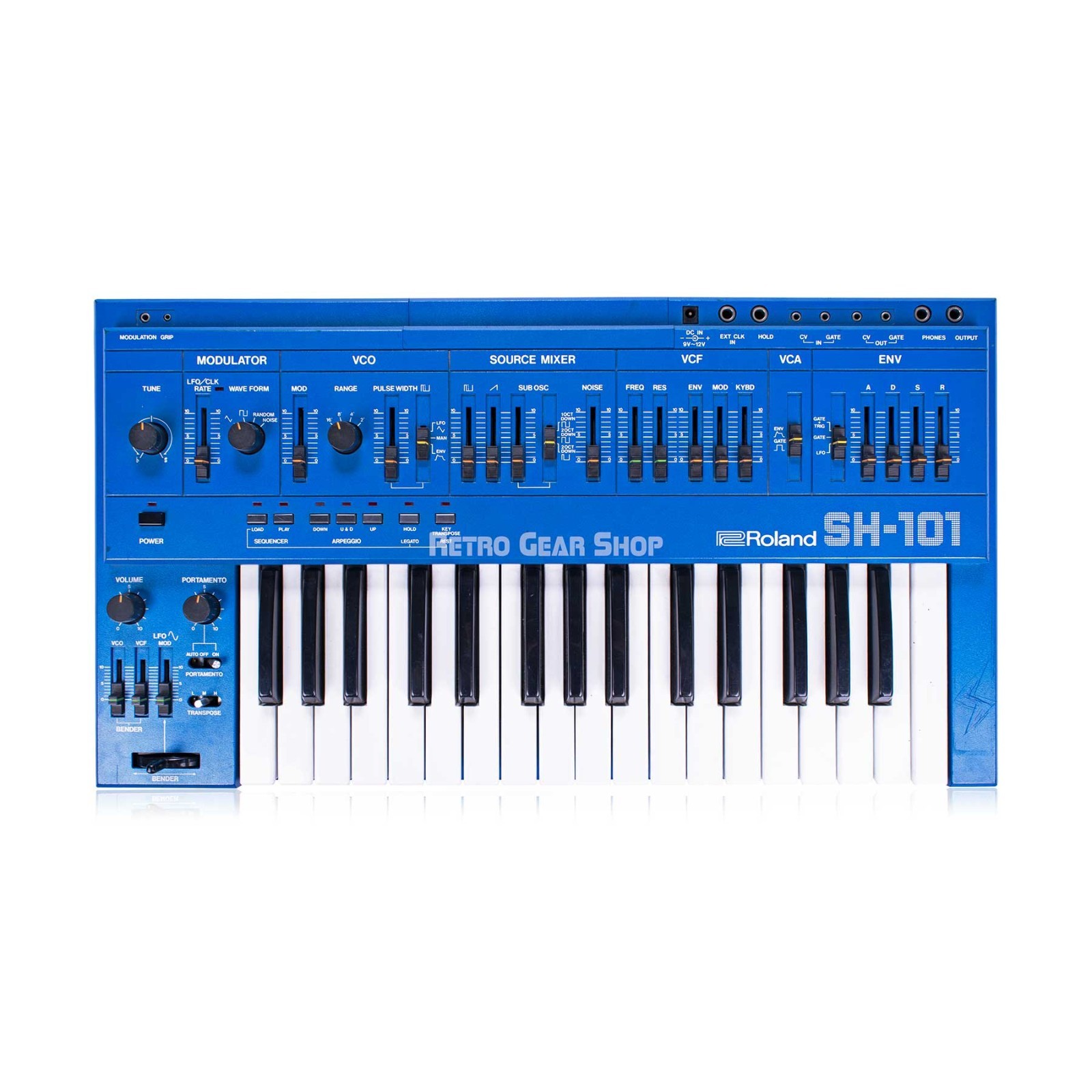
Let’s get one thing straight: the Roland SH-101 wasn’t supposed to be legendary. Released in 1982 at a modest $295, it was marketed as an entry-level analog synthesizer—Roland’s budget-friendly answer to the growing demand for portable, easy-to-use synths in the post-SH-2 era. But sometimes, greatness emerges from the margins. What the SH-101 lacked in polyphony (it’s strictly monophonic) and oscillator count (just one VCO), it made up for in character, immediacy, and sheer sonic attitude. Its square-wave basslines could crack concrete, its sawtooth leads sliced through mixes like a laser scalpel, and its noise generator was perfect for everything from snappy snares to alien windstorms.
Used by artists from Depeche Mode to Aphex Twin, the SH-101 found its true calling not in the sterile studios of 1980s pop, but in the sweaty basements of the 1990s rave scene. It was affordable, durable, and—thanks to its built-in step sequencer and arpeggiator—completely self-contained. You didn’t need a computer, a tape machine, or even a MIDI interface to compose an entire track. Just plug in headphones, dial in a squelchy filter sweep, and start stepping through sequences like a one-person electronic orchestra. It wasn’t just a synth; it was a portable studio, a sketchpad for sonic anarchists, and, in retrospect, one of the most influential analog monosynths of the decade.
| Synthesis Type | Analog subtractive |
| Oscillators | 1 VCO (Voltage Controlled Oscillator) |
| Waveforms | Sawtooth, Square, Pulse, Noise |
| Filter | 1 VCF (24dB/octave resonant low-pass filter) |
| Envelope Generators | 2 (ADSR for filter, AR for amplifier) |
| LFO | 1 (triangle and square wave, with rate and depth controls) |
| Keyboard | 32 keys (with pitch bend and modulation sliders) |
| Sequencer | 1-track, 100-note step sequencer with real-time and step recording |
| Arpeggiator | Up, Down, Up/Down, Random modes |
| Inputs/Outputs | Audio input, CV/Gate in/out, Sync in/out, Headphones out, Direct out |
| Power Supply | DC 9V (external adapter) |
| Dimensions | 430 mm × 265 mm × 75 mm (16.9" × 10.4" × 2.9") |
| Weight | 3.5 kg (7.7 lbs) |
| Display | LED step display for sequencer |
| Country of Manufacture | Japan |
| Original MSRP | $295 (1982) |
| Variants | SH-101B (black), SH-101R (red, limited) |
Key Features
- Built-in 100-note step sequencer: Unlike most synths of its class, the SH-101 didn’t require external gear to sequence. You could record in real time or step mode, and the LED step display made it easy to visualize your patterns. It wasn’t flashy, but it was rock-solid—and essential for live improvisation.
- Integrated arpeggiator with Random mode: The arpeggiator wasn’t just up/down—it had a genuinely useful Random mode that could generate unpredictable, chaotic patterns perfect for experimental textures. This tiny feature made it a favorite among ambient and industrial musicians.
- 32-key mini keyboard with performance sliders: The keys were small and not velocity-sensitive, but they were surprisingly playable. More importantly, the pitch bend and modulation sliders (right above the keys) made expressive playing intuitive—no wheels to fumble with mid-solo.
- Audio input for external processing: You could route drum machines or even vocals through the SH-101’s filter and envelope, turning it into a real-time effects processor. This feature was criminally underused but beloved by sonic tinkerers.
- CV/Gate and Sync I/O: In an era transitioning from analog to digital, the SH-101 bridged worlds. You could sync it to a Roland TB-303 or a drum machine, or control it from a modular system. It was a true team player.
- Portability and optional shoulder strap: At just 7.7 lbs and with a sleek, angular design, the SH-101 was built to move. Roland even offered a shoulder strap (sold separately), making it one of the few synths you could literally wear like a guitar. Try doing that with a Korg MS-10.
Historical Context
The early 1980s were a time of transition. Analog synths were being eclipsed by digital workstations and FM synthesis, and many manufacturers were moving toward expensive, complex instruments. Roland, meanwhile, doubled down on accessibility. The SH-101 arrived just a year after the TB-303—a machine that would later become iconic, but was then a commercial flop. The SH-101 avoided the 303’s fate by being more versatile, more intuitive, and, crucially, more affordable. It wasn’t trying to be a stage piano or a workstation; it was a pure analog tone generator with a brain of its own.
Its predecessor, the Roland SH-2 (1979–1981), was a more traditional two-oscillator synth aimed at professional musicians. The SH-101, by contrast, was designed for students, hobbyists, and bedroom experimenters. It stripped things down to the essentials: one oscillator, one filter, one envelope for the amp. But that simplicity was its strength. Every knob did something obvious and immediate. No menus, no hidden functions—just twist and hear. This philosophy would later influence the design of the SH-201 in 2000, though that digital successor never quite captured the raw charm of the original.
Competitors like the Korg MS-10 offered patch cables and a more modular approach, but the SH-101’s fixed architecture made it faster to use. You didn’t need to patch to get a sound—you just dialed it in. And while the MS-10 had a certain DIY appeal, the SH-101 felt like a finished product: polished, portable, and ready to go. It wasn’t the most powerful synth of its time, but it was arguably the most fun.
Collectibility & Value
Today, the SH-101 is a highly sought-after piece of analog history. Its value has steadily climbed, with working units now fetching between $800 and $1,500 USD in 2025, depending on condition and color. The standard blue model is uncommon but findable; the black SH-101B is slightly more common; but the red SH-101R is a true rarity, released in limited quantities and often commanding a significant premium. If you see one, don’t blink.
However, buyers beware: two issues plague vintage SH-101s. First, the rubberized coating on the case is notorious for degrading over time, becoming sticky or leaving a greasy residue on surfaces. Some owners strip it off entirely; others replace it with a modern vinyl wrap. Second, the internal 9V battery (used to retain sequencer memory when powered off) often leaks, causing corrosion on the circuit board. Always check for battery damage—replacing the battery holder and cleaning any corrosion is a must for long-term reliability.
When shopping, prioritize units with responsive keys, clean pots (no crackling when you turn them), and a filter that resonates smoothly up to self-oscillation. The sequencer should step reliably, and the arpeggiator should cycle through modes without skipping. If it powers on, holds tuning, and sequences cleanly, you’ve struck gold. And if it’s red? Well, you might want to call your lawyer before you sign the bill of sale.
eBay Listings



As an eBay Partner, we earn from qualifying purchases. This helps support our independent vintage technology research.
Service Manuals & Schematics
- Owner's Manual — archive.org
- Service Manual — archive.org
- Service Manual — archive.org
Related Models
- Roland Juno-106 (1984-1988)
- Roland Juno-60 (1982-1984)
- Roland Jupiter-4 (1978-1981)
- Roland Jupiter-6 (1983-1985)
- Roland Jupiter-8 (1981-1985)
- Yamaha CS-80 (1977-1980)
- ARP 2600C (1978-1981)
- ARP 2600P (1975-1978)
- ARP Avatar (1979-1981)
- ARP Pro Soloist (1972-1977)