Roland Jupiter-8 (1981–1985)
The eight-voice analog titan that defined the sound of the 1980s—and still commands six-figure sums when it works.
Overview
The Roland Jupiter-8 wasn't just a synthesizer—it was a declaration of war on the limitations of early digital music technology. Released in 1981 at a staggering $5,495 (over $17,000 today, adjusted for inflation), it was Roland’s flagship analog polyphonic synth, designed to dominate studios and stages with its lush, warm, and dynamically expressive sound. With eight true analog voices, each equipped with two oscillators, a resonant 24dB/octave filter, and full programmability, the Jupiter-8 arrived at a moment when most synths were either monophonic, unstable, or couldn’t remember their own patches. It did all three—and did them brilliantly.
Artists from Prince to Duran Duran, Tangerine Dream to Brian Eno, seized on the Jupiter-8 for its rich pads, searing leads, and punchy basses. Its voice was unmistakable: fatter than a Yamaha CS-80, and far more flexible than its predecessor, the Roland Jupiter-4. Unlike many synths of the era that required manual tuning before every gig, the Jupiter-8 could—*in theory*—stay in tune for days. In practice? Well, we’ll get to that. But when it worked, it sang like no other. It wasn’t just a tool; it was a statement. If you had a Jupiter-8 in your rack in 1983, you were serious.
Specifications
| Polyphony | 8 voices |
| Oscillators per Voice | 2 |
| Waveforms | Sawtooth, Square/Pulse, Triangle, Noise |
| Pulse Width Modulation | Yes |
| Filter Type | Roland IR3109 low-pass, 24dB/octave |
| Filter Frequency Range | 10Hz to 20kHz |
| Envelope Generators | 2 (ADSR) |
| LFO | 1 with triangle, square, sample & hold, noise waveforms |
| LFO Modulation Targets | Pitch, Pulse Width, Filter Cutoff |
| Keyboard | 76 keys, velocity and aftertouch sensitive |
| Aftertouch | Channel aftertouch |
| Memory | 64 preset patches (32 factory, 32 user) |
| Arpeggiator | Up, down, up/down, programmable hold |
| Pitch Bend | Joystick (pitch and modulation assignable) |
| Modulation Matrix | Hard-wired routing with modulation switches |
| Audio Outputs | 1x 1/4" unbalanced (left/main), 1x 1/4" unbalanced (right) |
| Audio Inputs | 1x 1/4" external audio input per voice |
| Foot Controllers | 1x foot controller (volume), 1x footswitch (sustain, arpeggiator on/off) |
| Dimensions | 1050 mm × 375 mm × 115 mm (41.3" × 14.8" × 4.5") |
| Weight | 21.5 kg (47.4 lbs) |
| Power Requirement | AC 120V / 220-240V, 50/60 Hz, depending on region |
| Current Draw | 35W |
Key Features
- 8-Voice True Analog Polyphony: Each of the eight voices is a complete analog signal path with two VCOs, filter, and envelope—no digital shortcuts. This meant you could layer chords with detuned oscillators and get that iconic “wall of sound” without digital aliasing or memory compression.
- Programmability with Instant Recall: At a time when most synths required manual knob-twiddling for every sound change, the Jupiter-8 offered 64 patches (32 factory, 32 user) with near-instant recall. This made it viable for live performance—revolutionary in 1981.
- Split and Layer Modes: You could split the keyboard into two zones or layer two patches across the entire range. This turned one Jupiter-8 into two synths, letting you play a bass patch with your left hand and a string pad with your right—without a mixer.
- IR3109 Filter: The heart of the Jupiter-8’s character. This discrete Roland-designed filter delivered smooth sweeps, musical resonance, and a warmth that many engineers still swear by. It’s the reason Jupiter-8 pads sound “expensive” on recordings.
- External Audio Input per Voice: A rare and powerful feature: you could route external audio (like a drum machine or guitar) through each voice’s filter and envelope. This made the Jupiter-8 not just a synth, but a real-time analog processor.
- Channel Aftertouch (Not Polyphonic): While not polyphonic aftertouch (which would’ve been unheard of in 1981), channel aftertouch allowed expressive control over modulation, filter, or volume across all notes—perfect for swelling pads or adding vibrato mid-chord.
Historical Context
The Jupiter-8 didn’t emerge in a vacuum. It was Roland’s answer to the Yamaha DX7 (1983) were beginning to loom on the horizon. The Jupiter-8 was, in many ways, the last great analog flagship before the digital wave. It bridged the gap between the hands-on warmth of the 1970s and the clinical precision of the mid-80s. Its successor, the Roland JX-8P (1985), already leaned into digital control with its “membrane” buttons and limited front-panel editing—proof that the analog golden age was ending. The Jupiter-8, then, was both a culmination and a swan song.
And then there’s the rack version: the Roland MKS-80 “Super Jupiter” (1984), which shared the same voice architecture but in a 19” chassis. While the MKS-80 is revered (and often more stable), it lacked the tactile immediacy of the Jupiter-8’s knobs and switches. For purists, the original 76-key beast remains the holy grail.
Collectibility & Value
Today, the Jupiter-8 is a museum piece—and a temperamental one at that. With a current market value between $8,000 and $12,000 (2025), it’s not for the faint of wallet. Fully restored units with upgraded power supplies and recalibrated voice cards can fetch even more. Its rarity stems not just from limited production (Roland never released exact numbers, but estimates suggest fewer than 3,000 were made), but from its reputation for failure. Early units, especially pre-Rev 5 models, are notorious for capacitor leakage and power supply meltdowns. The original power supply design used components prone to overheating, and when they failed, they often took the voice cards with them.
Then there’s tuning. The Jupiter-8’s analog oscillators are temperature-sensitive. Turn it on, and you’ll hear it drift for 20 minutes. Even Rev 5 models (1983), which improved stability with revised voice cards and power supplies, require regular maintenance. If you’re buying one, insist on a recent service history. Look for units with replaced electrolytic capacitors, cleaned pots, and a stable calibration. Avoid any with “crackling” sounds or dead voices—repairing a single voice card today can cost $300+.
Yet, despite its flaws, the Jupiter-8 endures. Why? Because when it works, it sounds like nothing else. That IR3109 filter, the weight of the keyboard, the tactile joy of flipping switches to route modulation—it’s an experience. In an age of plugins and emulations, the Jupiter-8 remains a defiantly physical instrument. It doesn’t just make sound. It demands respect.
eBay Listings


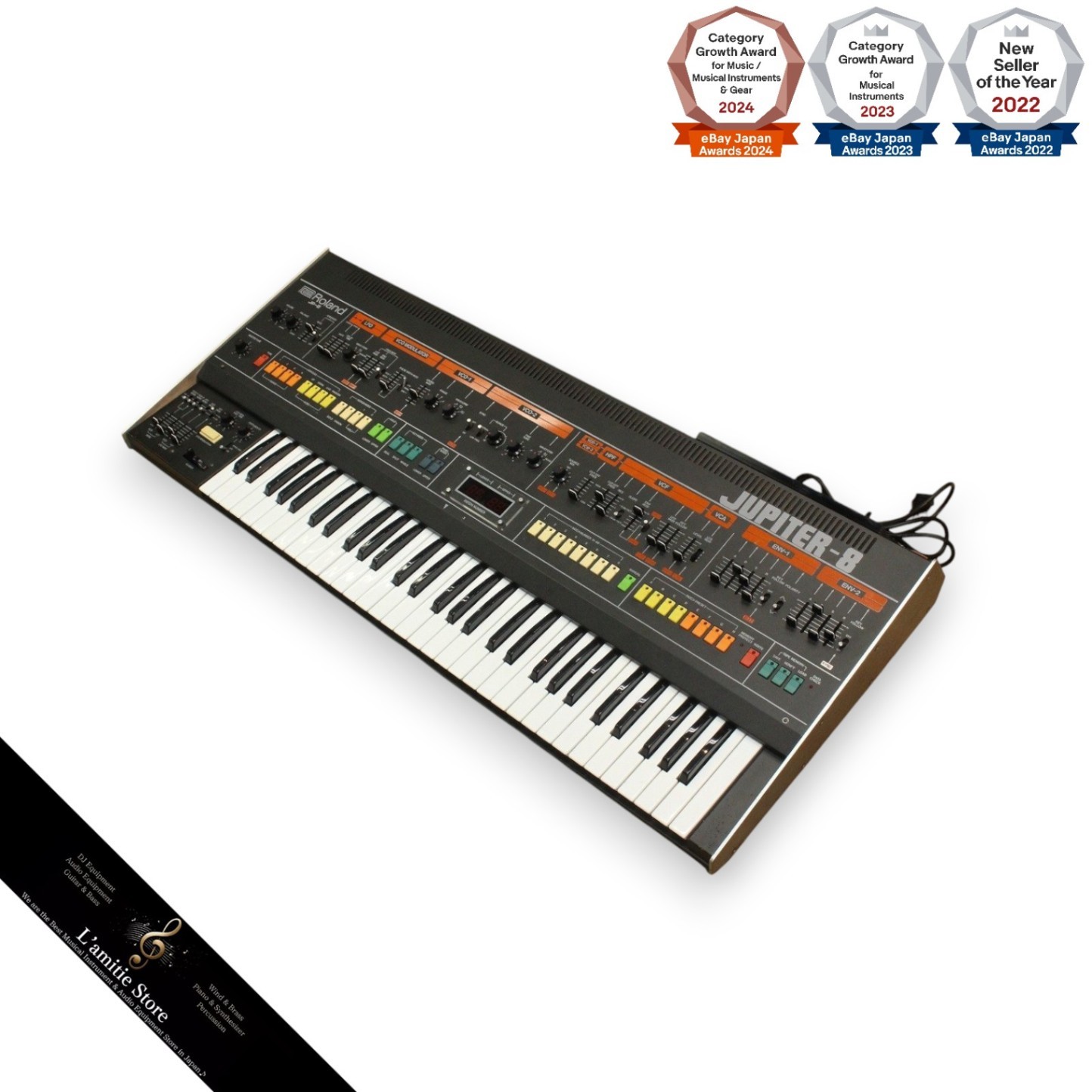
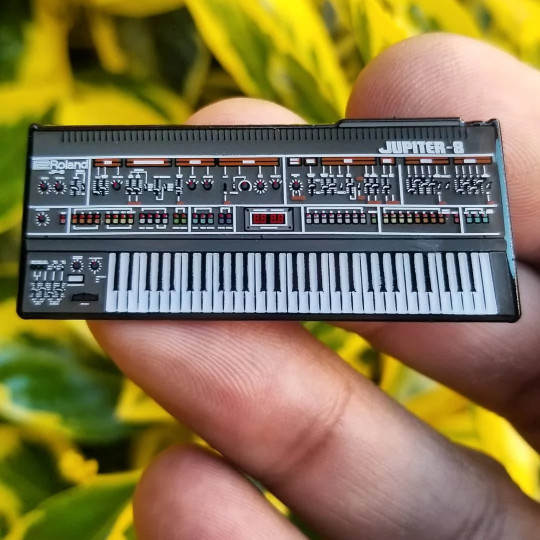
As an eBay Partner, we earn from qualifying purchases. This helps support our independent vintage technology research.
Service Manuals & Schematics
- Owner's Manual — archive.org
Related Models
- Roland Juno-106 (1984-1988)
- Roland Juno-60 (1982-1984)
- Roland Jupiter-4 (1978-1981)
- Roland Jupiter-6 (1983-1985)
- Roland SH-101 (1982-1986)
- Yamaha CS-80 (1977-1980)
- ARP 2600C (1978-1981)
- ARP 2600P (1975-1978)
- ARP Avatar (1979-1981)
- ARP Pro Soloist (1972-1977)