Roland Jupiter-6 (1983–1985): The Analog Workhorse That Bridged Two Eras
A six-voice programmable polyphonic analog synth with dual DCOs, a full polyphonic sequencer, and the soul of a Jupiter—just when the digital revolution was kicking down the door.
Overview
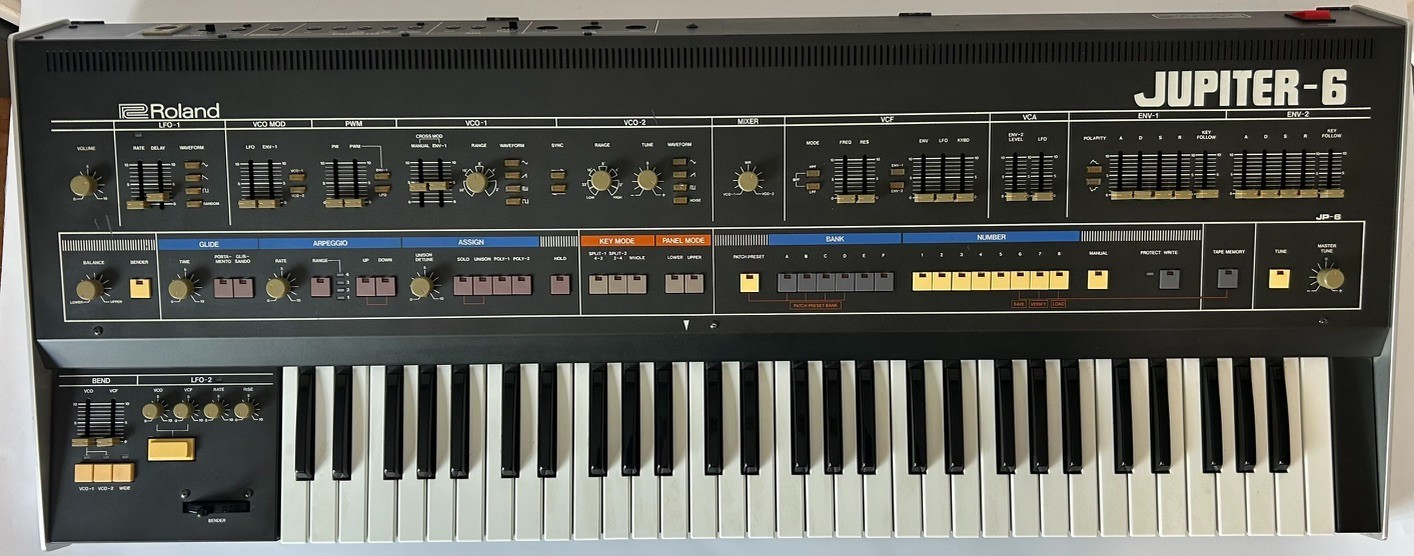
The Roland Jupiter-8 may have been the crown jewel of Roland’s early '80s analog empire, but by 1983, the world was changing. Synth players wanted programmability, MIDI, and reliability—without sacrificing that lush, breathing analog character. Enter the Roland Jupiter-6: a machine built not for the spotlight, but for the studio, the stage, and the late-night sound design grind. It didn’t have the raw prestige of its eight-voice predecessor, but it packed a serious punch—six voices of dual DCOs, full MIDI integration (on later models), and a 128-step polyphonic sequencer that was practically unheard of in a standalone analog synth at the time.
Used by artists ranging from Depeche Mode to New Order, the Jupiter-6 was the synth that could do it all: warm pads, biting basslines, rhythmic arpeggios, and even rudimentary sequencing for live performance. It was Roland’s answer to the rising tide of digital synthesis—not by going digital, but by refining analog into something smarter, more flexible, and more practical. Where the Jupiter-8 was a hand-crafted sports car, the Jupiter-6 was a high-performance sedan: less flashy, but ready to haul gear, take abuse, and still sound incredible after 40 years.
Specifications
| Polyphony | 6 voices |
| Oscillators | 2 DCOs per voice (saw, pulse, triangle, square) |
| Waveforms | Sawtooth, Pulse, Triangle, Square |
| Filter | 1 per voice, 24dB/oct resonant low-pass (IR3109 chip), 12dB/oct high-pass |
| Envelope Generators | 2 ADSR (VCF, VCA) |
| LFO | 1 LFO (triangle, square, sample & hold, noise) |
| Keyboard | 61 keys, velocity and aftertouch sensitive |
| Aftertouch | Channel aftertouch (not polyphonic) |
| Arpeggiator | Up, down, up/down, random modes with programmable latch |
| Sequencer | 128-step polyphonic sequencer with real-time and step recording |
| Memory | 128 patch memory locations (64 internal, 64 cartridge) |
| Outputs | 1x 1/4" main output (unbalanced), 1x 1/4" headphone output |
| Inputs | 1x 1/4" external audio input |
| CV/Gate | CV In, Gate In, CV Out, Gate Out (for external synth control) |
| MIDI | MIDI In, Out, Thru (added mid-production run) |
| Power | 24 V DC (external power supply: PSA-120S or equivalent) |
| Dimensions | 1030 mm × 345 mm × 110 mm (40.6" × 13.6" × 4.3") |
| Weight | 14.5 kg (32 lbs) |
| Display | 16-character LED display |
Key Features
- Dual DCOs per voice with PWM and cross modulation: Unlike many synths of the era that used VCOs prone to tuning drift, the Jupiter-6 employed digitally controlled oscillators (DCOs) for rock-solid tuning—crucial for live performance. But don’t let the “digital” fool you: you could still modulate pulse width via the LFO or envelope, and even cross-modulate DCO1 with DCO2 for FM-like metallic tones that bordered on digital, long before Yamaha made it mainstream.
- Programmable polyphonic sequencer: This is where the Jupiter-6 truly stood out. A 128-step sequencer that could record chords, not just monophonic lines? In 1983? That was witchcraft. You could lay down evolving arpeggios, syncopated bass patterns, or even full progressions and let them run while you played over the top. It wasn’t a workstation, but it played one on TV.
- IR3109 filter chip with high-pass option: The same filter used in the Jupiter-8 and Roland JX-8P, the IR3109 delivered that smooth, singing Roland low-pass character with musical resonance that never gets shrill. The addition of a 12dB/oct high-pass filter per voice was rare for the time and gave you surgical control over low-end mud—especially useful when layering sequences or stacking sounds.
- Full MIDI implementation (on later units): Early 1983 models shipped without MIDI, a baffling omission as the spec was already gaining traction. But Roland corrected course quickly: units from mid-1984 onward included full MIDI In, Out, and Thru, making the Jupiter-6 one of the first truly integrated analog/digital hybrid instruments. If you’re buying one today, verify the MIDI presence—it’s a dealbreaker.
- External audio input with filter/VCA routing: Want to process your drum machine, guitar, or even a vocal through that gorgeous IR3109 filter? The Jupiter-6 lets you. Route an external signal through the filter and envelope, and modulate it just like a synth voice. It’s a feature that feels almost modern in its flexibility.
Historical Context
The Jupiter-6 arrived in 1983 at a pivotal moment. The analog golden age was peaking, but cracks were showing. Yamaha’s DX7, released the same year, was about to redefine pop music with its FM synthesis and pristine digital clarity. Synth buyers were dazzled by presets, velocity sensitivity, and MIDI—features that made the Jupiter-8, for all its brilliance, feel increasingly like a boutique instrument. Roland needed a synth that could compete on specs without abandoning its analog soul. The Jupiter-6 was that compromise: not as luxurious as the Jupiter-8, but smarter, more connected, and $1,000 cheaper at $2,995.
It shared DNA with the Sequential Circuits Prophet-600, which also launched in 1983 with MIDI and DCOs. But while the Prophet-600 leaned into raw analog aggression, the Jupiter-6 was all about refinement and workflow. It was also a direct predecessor to the Roland JX-8P, which would take the “programmable analog” concept further—but at the cost of hands-on control. The Jupiter-6 struck a rare balance: deep programmability, real-time editing via membrane buttons and sliders, and that unmistakable Roland chorus (yes, it has the same warm, swirling stereo effect as the Juno-106).
Collectibility & Value
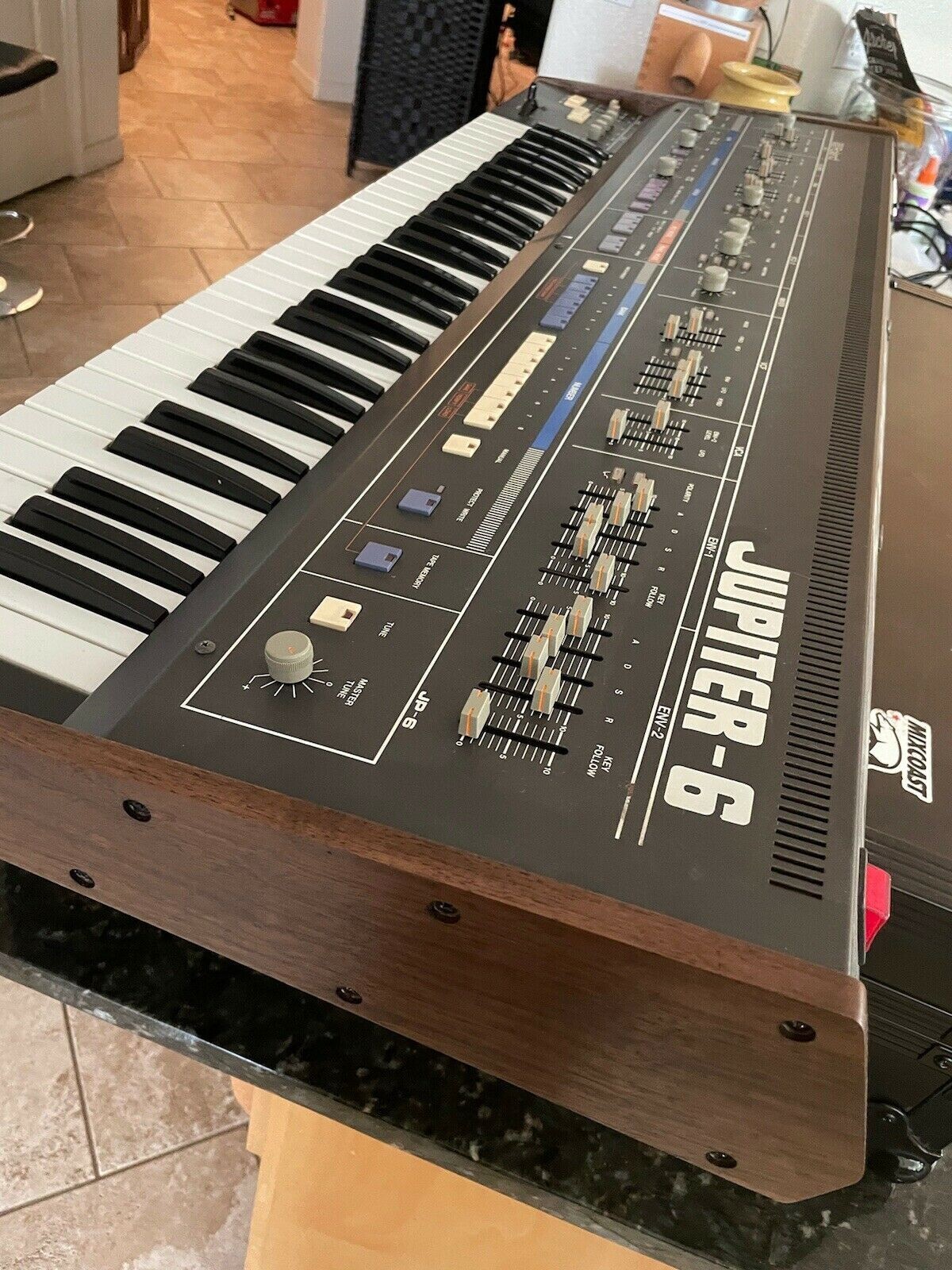
Today, the Jupiter-6 is uncommon—not ultra-rare, but not exactly common either. Production numbers were modest compared to the Juno series, and many units suffered from neglect or power supply failure. On the market in 2025, expect to pay between $1,500 and $2,500 USD for a working unit, with fully serviced, MIDI-equipped models commanding the top end. Cosmetically clean units with original packaging and cartridges are unicorn-tier and can spike higher.
But buyer beware: the PSA-120S power supply is notorious for failure, and its death can take the synth’s internal regulators with it. Always test the unit with its original PSU or a known-good replacement. Also, the membrane switches for the sequencer and programming functions wear out—sticky, unresponsive buttons are a red flag. A full service should include recapping, especially if the synth has been stored poorly. That said, when maintained, the Jupiter-6 is a tank. Its build quality is exceptional: thick steel chassis, solid keybed, and that satisfying, clicky Roland keyboard action.
If you’re hunting for one, prioritize a post-1984 model with MIDI. The sequencer alone makes it worth it, and MIDI integration transforms it from a vintage curiosity into a living part of a modern studio. And don’t sleep on its sound: it’s not as thick as a Jupiter-8, but with two DCOs, cross modulation, and that lush chorus, it can get scarily close. In fact, some of us quietly believe the Jupiter-6 is the most underrated Roland synth of the '80s. It didn’t win the glamour race, but it won the war of longevity.
eBay Listings


As an eBay Partner, we earn from qualifying purchases. This helps support our independent vintage technology research.
Service Manuals & Schematics
- Owner's Manual — archive.org
Related Models
- Roland Juno-106 (1984-1988)
- Roland Juno-60 (1982-1984)
- Roland Jupiter-4 (1978-1981)
- Roland Jupiter-8 (1981-1985)
- Roland SH-101 (1982-1986)
- Yamaha CS-80 (1977-1980)
- ARP 2600C (1978-1981)
- ARP 2600P (1975-1978)
- ARP Avatar (1979-1981)
- ARP Pro Soloist (1972-1977)